Those are the adventures of Mr. Fimbulmyrk, in bushcraft and blacksmithing, mountainbiking and hiking, reenactment, writing, singing, dancing, stargazing and having a piece of cake and a coffee. Pray have a seat and look around you, but be warned - the forest´s twilight is ferocious at times.
Oh yes, it is here. Still the leaves are green and the trees bear their flesh, but all too soon wild storms will bring in death and sleep to all living things. But for now the secret life sprouts from the dark; the mighty roots flourish from deep, deep down. For it is in the darkness they weave root to root and deed to deed. There is no tree but forest, and there is not a mushroom, but one mycelium. Like to the growth of crystals it flourishes secretly in the dark; and when winter cometh, it sprouts forth its fruit of twilight.
Cauliflower fungus (sparassis crispa, in German: Krause Glucke) waiting for harvest... haven´t seen one for ages! Was not quite sure, and it was still so tiny, so I left it be.
Other ´shrooms were not so lucky. And it is funny, for the boletus in the picture seems to be a friend of mine. Each and every year I come round the place where it lives and cut the mushroom off, and it´s always a kind of ritual to make a stew from it, sometimes, when it´s bigger than now, from it alone, and sometimes with other boletus and bay boletus. I try my best to make the best dish I can from it and take my time relishing in it. This time it was a ragout:
I took one handful of bacon, one shallot, one piece of garlic and chopped it finely. I added some tomato paste as big as a hazelnut and roasted it all until golden brown. I deglazed with my homemade mead, added one big bay boletus and my little friend chopped into slices, some allspice, clove, one bay leaf, (in this case) ritual salt (which I mined myself in an ancient Celtic mine in Hallstatt, Austria, pepper and just a hint of cinnamon (pray don´t overdo it!), and coriander leaves. I ate it with fresh handmade grey rye bread and butter.
Anyway, I had a fairly good harvest, and all of the time I wondered of the mystery of the mycelium. Look, every year the same mushroom, always slightly different, but still the same root brings forth another fruit. You cannot see the root most of the year. But if you could look underground you would be terrified how far it reaches. Mist rises up and brings up the scent of the strong, old soil, growing ever richer with every year of decay that is piled, one layer up and over another, years and years and metres of dark, fertile earth. High do they rise, those old trees, and the treetops sing a song in the racing wind; winter cometh, they cry.
My trail went on. I collected some spruce and fir resin for varnish and medicinal purposes.
For a cough syrup take one grain resin, one part ribwort, one part thyme, one part sage, one part origanum vulgaris, one teaspoon curcuma, one tablespoon lemon juice, and fill up with three parts honey. Heat it up gently and fill into vacuum jars. Use one tablespoon and take three times a day. You can also fill it up with hot elderberry syrup and hot water as a precaution.
On I went on my merry way. All was silent, and I really took in the fragrant forest air and my heart became stilled. By the trailside lay this bone, presumeably of a roe deer, and remembered me that autumn also is the season of the dying and the hunt.
At a hut beside the trail I rested and simply listened to the wind and the rustling of leaves. A squirrel made a cache just two metres away from me. It looked at me, anxiously, but also curiously. Then it came even nearer, until it sat right at my feet. I held my breath and was still as a stone, until it went on its merry way. I sipped my tea and watched the birds, the mouse and the tiny birds all busy with their preparations for winter.
I was happy, and still, and the green world once again gave me a sense and feeling of purpose that I dearly miss in the world of man. Often I simply would like to shake my fellow humans and yell at them to just SEE, when all they do is LOOK. But if we could see, we would see that it is all that much more simple. I daresay the divine is either laughing or crying constantly at our stupidity; we want to live on eternally, a life with no ups and downs, with no hurt and no surprises. But I ask you: How boring would that be? We fear death, and righteously so, but where is the point to wish idly that we would live on forever? And a life like a parody, as we are doomed to do by this our society? Mammon promised we could have safety and no surprises. We paid him with our dreams, with our passion and love, and in turn he gave us glittering junk. And turned our love into lust, our love into greed, our passion into hate and fear, our sensuality into nymphomania, our loyalty into philistinism. He took our longing and yearning to turn into consumerism. Machines do the thinking and dreaming for us, and every little action is becoming more and more complex to us that we seek consiliation in a dream world created by the almighty machinery that is our society, or even worse, in escapism, so much in fact that our life is a mere waiting for the end while slaving for the master.
All the while the truth is so much simpler. All the while the truth is so obvious.
A silent song. A squirrel preparing for winter. A creek and the wind filling a heart with music.
And a path that leads yonder hill and dale to somewhere we don´t know.
Just a short bimble away from my home there is a garbage treasure trove, and there is not one hike I return from without a bag full of treasure. This time it was particularily stunning. I found a whetstone of exactly the right grain, and three ingots of crucible steel. I have yet to learn how to process it, but you can bet on it-I will learn. I have enough now to start experimenting with it.
For a history of the steel finds and cutlery, look here.
On a recent flea market round my place I found this little very interesting folding knife. It is a Turkish grape knife. The blades are held open by friction alone, the handle is plastic with a handmade brass collar. The sickle knife has tiny, well-made serrations, and both blades were razor sharp.
And blimey, they are less than a millimetre thin! That knife cuts like the proverbial devil. It is made in the city of Bursa using a very inetersting mix of traditional techniques and modern technology. Look here for a knifemaking video how they work in Turkey:
So the knife I got is called a Tosya Cakisi and while it is a great knife in itself, what is most intriguing is that it opened up a whole world of knifemaking to me. When you look at the cutlers and smiths in Turkey you get pretty much humbled by their efforts, for they work with amazing skill and little provisions. And if you complain about your nine-to-five day job, try working from 8.30 am to 7 pm!
There is a lot to learn from Turkish culture. I daresay I am a bit prejudiced what concerns Turkish people in Germany, especially the younger ones. Many of those youth are taking pride in a "gangstah" mentality, are violent and rough, and spill junk and spit wherever they walk. And it is not exactly easy to tell one Muslim from the other, so to say. But if you talk to the elderly people, the ones who can actually still tell you about all that knowledge, which is about to get lost in the process of "europeization" you get a whole different picture. Their hospitality and generosity is simply great, they love to tell stories and are obsessed with good food and good cooking (and don´t confuse "Doner" Kebab with Turkish cuisine, it´s a German invention), and they are diligent workers and craftsmen. I sincerely hope they can preserve those crafts, including knifemaking and blacksmithing.
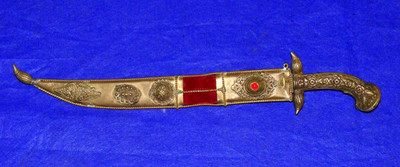
The next find is also quite interesting. I found one example on www.antiquesnavigator.com like this:
The next photo is mine. It bears some striking similarities to the one above, i.e. the decoration on the guard and pommel, the suede on the sheath, the wirework and the handle décor. The one above sold for 180$. The one below sold for 16€. :-)
The knife is presumeably of Greek or Balkan origin. The blade measures about 24 cm. The handle is cast and silver plated bronze, the sheath mountings seem to be silver plated or nickel silver.
The decoration is finely cast, the soldering accomplished well enough. The suede shows little wear, but is not stitched, but held in place by wirework and a kind of glue which has worn off on some parts.
The decoration is figural which will not allow for a Muslimic country as country of origin, but rather hints towards an orthodox or conventional Christian provenience.
Chape and mouth are bot decorated with beautiful wire work.
The blade is soldered into the handle with a kind of "Habaki" style ricasso out of brass. The blade shows coarse file marks.
The blade, which is out of high carbon steel, is engraved with a stylized fish and a presumeably Greek inscription.
The blade gives a lovely ring when drawn, and seems to be nicely tempered. It is selectively tempered (the spine is softer than the edge). A fine, well hardened and sharp file is just so able to take off shavings, making for an estimated hardness of 58-60 HRC in the edge area.
The blade is very flexible, however, and I guess the temper does not reach deep.
What intrigues me most is that this is most certainly constructed as a cold steel weapon. In central Europe and America, we tend to give daggers and fighting knives hilariously thick spines. Now look at that thickness: It´s just 2,5 mm thick at its thickest and tapers to under a mm. That way this knife will also make for a great slicer and a knife suited for everyday chores as well as mortal combat. But hey, carrying a knife and knowing it´s just to kill people? How sick would that be? Far more realistic is that a knife like this, while suitable for representational and traditional attire duties, was used for butchering, farm work and the like more often than not. It was a valued companion, but also a do-it-all workhorse.
I find it most interesting that all of my tribal knives have spine thicknesses under 3mm, most come in at just 1,5-0,5mm thicknesses. Yap, of course, this is not a prybar. But for prying you can use a prybar. But still, these knives can stand up to a lot of abuse. The secret is in the skill. Modern European and American knives are made by skilled workers, but often mastery is substituted by machinery. If you know your steel and how to work it, you can push it to limits otherwise out of bounds. Plus, if you break your knife in a Balkan village, you go back to the smith who had made it, and he will repair it. In modern capitalism, this is no longer possible, and liability issues are mirrored in the layout of the knife.
It is good to see that the knifemakers in Turkey try to bridge the gap between tradition and modernity.
I, for one have learned a lot by doing the research for this article, and I have gained another different perspective on knifemaking.
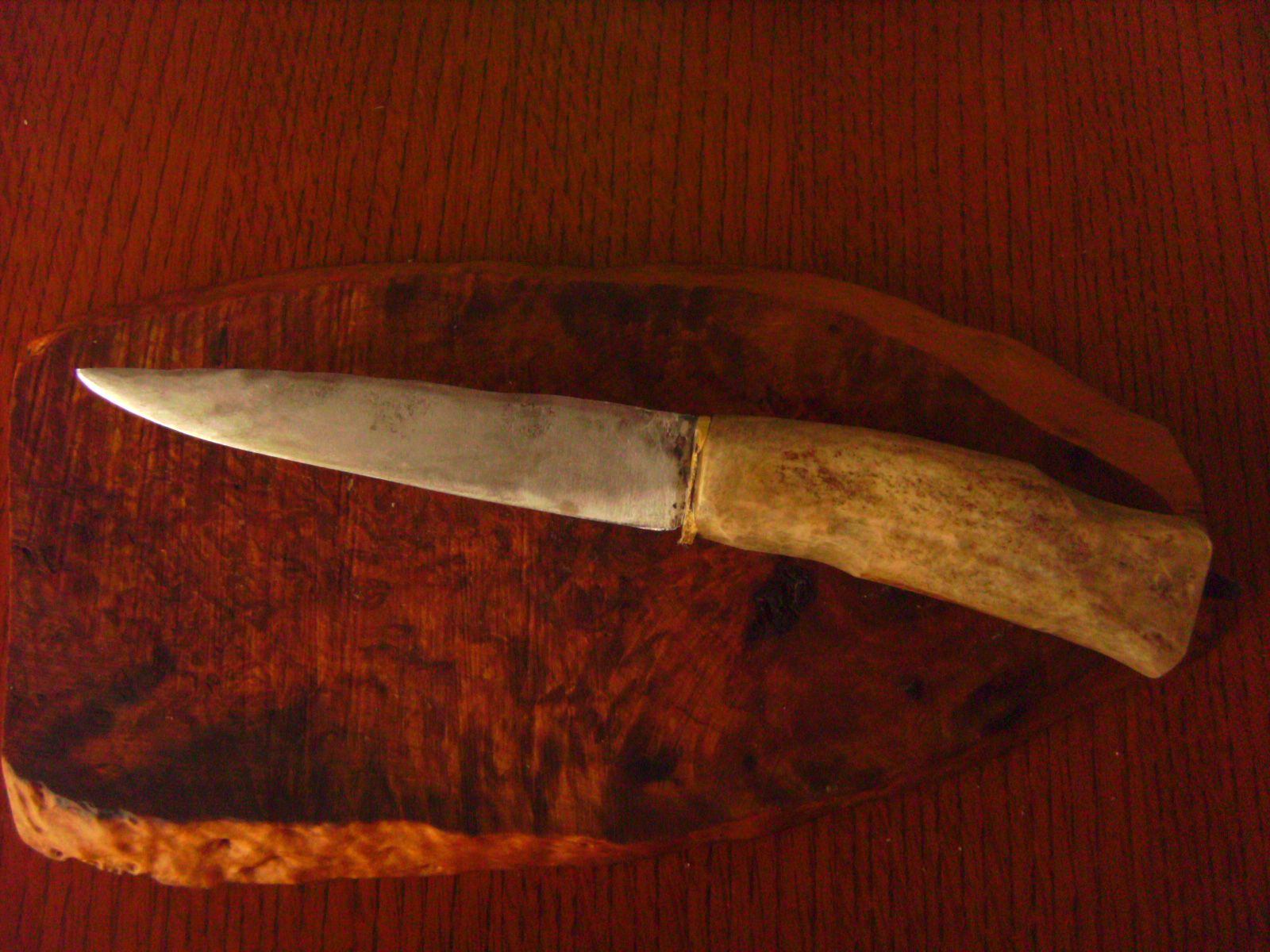
....aaand yet another one design experiment. This one is inspired as well by Thai En-Nep designs as by the obsessive pondering about the whiplash line. I realized when drawing out the layout for the blade that you can draw a golden spiral towards the blade. A recurve blade always has a kind of sweet spot where the most cutting force is cumulated, and you can portray this by a golden spiral ratio. This is not an earnest calculation ratio and of course you need no rocket scientist degree to draw a layout for a knife, but still I wondered. The handle is a bit longer than usual to give it more reach and slashing and chopping prowess when gripped farther back. When handling it I realized it is somewhat of a fast-forward and point-concentrated knife which would also make it a good Krav Magá companion, but the most power is indeed concentrated into the sweet spot. It is a bit awkward at first for small whittling tasks until you realize that you need another technique with it. Making fuzz sticks is a cinch, for all you need is a linear motion. With an arcing cut as with most straight designs you can easily cut a hazel stick one finger thick in one motion!
The blade is made from salvaged ancient leaf spring steel from an old carriage wreck, 150+ years old, 11,5x5 mm with a full tang. Scales are elk antler, brass tubing and mosaic pins. The blade has a selective temper and a high convex bevel. Estimated hardness is about 58 HRC.
It has to see some polishing and then it´s ready for the etch.
So far - so good, this is the new whittler for the woods. It´s made from ancient (150years plus) leaf spring steel I found in the woods, and bog oak from a coalmine in the Muttental, Witten, an ancient coalmining area. It has a rich burgundy colour due to lying submerged in water which was rich with iron oxide for more than a hundred years. I put it together with mosaic pins and a lanyard hole. The blade is 90x3,8mm with a selective temper, the hardness is about 58 HRC. It has a high convex bevel. The balance point is right on the index finger, making for a light and lively knife in your hand. The handle is a bit short, but I had to compromise this, because it shall ride in a pocket via clipper sheath.
Still a lot of polishing work and then it´s off for the etch.
Hope that brings out the pattern of the steel...;-) my other knives from this steel show a strange scaly pattern. I find it more interesting if a blade has a bit of a structure.
That little monster will get a clipper sheath to ride in a pocket or on the waistband of some baggy, comfy pants I love for being in the woods.
I find it fascinating to go to the edges (pun intended;-)) of knife design, and in this case it is experimenting with the relation between lightness, comfortable carrying and serviceable length. The knife certainly is not a big chopper, but is designed to be a little-everyday-task and whittling knife and a companion knife for a set.
This is like living in a legend; only but recently I have told the tale of the knife above. On a stroll through the woods behind my home, those noisy, ravaged forest aisles that deserve to be loved even more for the fact that they have been raped by civilization, I found a piece of steel. It just lay there, washed up from the ground by the rain, a piece of waste that had served to fill up the trails. It was customary to use junk and scrap metal to fill up the trail base up to the 70´s in my hometown, so the trails are mostly made from steel and slag and volcanic glass and smelting leftovers, aluminium, brass, copper, haematite and sulphurous. On the trail surface it lay, shaped like a crescent on one side and with something like a tang protruding on the other, rusted deeply, pitted and torn, but at the thickest some 8mm thick. When I touched it with my boots it gave a high ringing sound. Now this shape is exactly how I forge the preform of a knife blade before forging the bevel. It is forged on the inside of the crescent. You drive the material towards the spine, and that way you can manipulate the edge line to a straight-back or drop-point layout. So I took it home, and for a while it sat on my shelf as a constant cause of wonder. Then I forged it out, doing as little manipulation to the preform as I could, because I respect the smith who had given it its shape in the first.
It was when quenching it that I realized that it shows a pattern under the scale. It might be a fading phenomenon, but after quenching the pattern was most distinct, and after grinding there´s still a hint of it, so that I look forward to the etch. Might be it turns out a creeper, but still I wonder.
Who was the smith of this blade who involuntarily cooperated with me? I am doing some research these days. What I found until now is
"Inhalt : Firmensitz: Hagen Branche: Eisen-, Blech- und Metallwarenindustrie (Gabelfabrik) In der Nähe des Stammsitzes Funckenhausen in (Hagen-) Vorhalle erwarb Georg Funcke 1702 ein Hammerwerk an der Geitebrügge, heute (Hagen-)Eckesey. Die Anlage blieb bis 1990 im Eigentum der Familie. Nachdem das Hammerwerk zwischenzeitlich verpachtet worden war, übernahm es in der vierten Generation Carl Gottfried Funcke. Er betrieb bis 1855 zunächst eine Kompagniehandlung mit Caspar Bröcking aus Gevelsberg. C. G. Funcke wandelte das Hammerwerk in eine Fabrik für Pflugscharen und Schraubstöcke um. Sein Sohn Carl, dem aus dem Erbe das Hammerwerk zugefallen war, begann 1879 unter der Firma C. G. Funcke Sohn mit der Produktion von Gabeln für die Landwirtschaft. Bekannt wurde das Fabrikzeichen "Victoria". C. G. Funcke Sohn war bald führender Gabelhersteller im Raum Hagen/Ennepe-Ruhr. Der Neffe des kinderlos verstorbenen Carl Funcke, Richard, trat 1920 nach Absolvierung der juristischen Ausbildung in das Unternehmen ein. Es firmierte zwischen 1924 und 1937 als Aktiengesellschaft (Stammkapital 460.000 RM). 1970 übernahm das Unternehmen unter der Leitung von Carl Richard Funcke die Wilhelm Abt GmbH, Schorndorf. Die zunehmende Mechanisierung der Landwirtschaft zwangen 1989 zum Zusammenschluß mit James Neill Tools Ltd., Sheffield und zur Schließung des Werks Eckesey zum 30. April 1990. 1,5 m Chroniken (angelegt vor allem durch Carl Richard Funcke) 1702-1990 (22, mit Sammelgut zur Firmengeschichte); 250jähriges Jubiläum 1952 (5); Bilanzbücher 1880-1895 (2); Hauptbücher 1871-1935 (3); Betriebsversammlungen 1960-1979; Plakat Victoria-Gabeln; Prospekte; Fotos; Lagepläne; Porträts der Unternehmer (4); Manuskripte von Richard Funcke (Vizepräsident und Ehrenmitglied der Vollversammlung der Südwestfälischen Industrie- und Handelskammer Hagen).
Darin: Eingabe von Dr. Johann Caspar Funcke an das Generaldirektorium zu Berlin wegen Werbefreiheit, Rückzahlung von Kriegskrediten, Tuchscherenfabrik und Eisenschmelze zu Sundwig (1764)."
It seems that there are several corporations in the vicinity coming into account for the disposal of their waste. This would be the screw manufacturer and stamp shop Funcke & Hueck in Eckesey, a district of my hometown, Hagen, and the manufacturer of pitch forks and rakes, C.G.Funcke und Sohn, and maybe the iron works Harkort and Krupp in Eckesey. One evidence of manufacturers of hand-forged cutting implements is the Corporation Funcke in Iserlohn-Hemer (also an iron works). The problem is that this dates back to 1764. Also possible is the corporation Söding and Halbach, specializing in crucible steel tools and running a rod steel hammer:
"Inhalt : Firmensitz: Hagen Branche: Eisen- und Stahlindustrie (Edelstahlwerk), Amboßfabrik 1783 pachtete Johann Caspar Söding (1755-1815) einen Roh- und Reckstahlhammer an der Volme im Wiedey, heute im Stadtkern von Hagen gelegen. Johann Caspar Söding betrieb ab 1797 die Hämmer in Kompagnie mit Kriegs- und Domänenrat Wülfingh und kaufte 1805 ein halbes Feuer des Stabeisenhammers. Nach seinem Tod übernahmen die Söhne Johann Caspar (1785-1843) und Carl Friedrich Söding (1798-1867) die restlichen Anteile. 1841 nahm Friedrich Söding gemeinsam mit H.P. Winterhoff unter der Firma Friedrich Söding & Co. die Amboßherstellung auf (ab 1863 vereint mit Fa. J.C. Söding & Halbach). 1860 fusionierte Söding mit dem Stahlwerk von Carl Gustav Halbach in Haspe zur Fa. J.C. Söding & Halbach. Diesem Unternehmen wurde 1877 die Gußstahlfabrik Erkenzweig & Schwemann in (Hagen-)Eckesey angegliedert. Die Fa. Erkenzweig & Schwemann war 1855 als Remy & Erkenzweig (ab 1867: Remy, Erkenzweig & Schwemann) gegründet worden und spezialisiert auf Tiegelstahl. 1918 wandelten die Inhaber beide Firmen, die vorher als oHG bestanden, in Kommanditgesellschaften um. Nach 1918 konzentrierten sich J.C. Söding & Halbach auf Spezialstahlsorten und schwere Werkzeuge, während Erkenzweig & Schwemann Stahl für die Werkzeugindustrie herstellten. 1 m Nach der Vernichtung der älteren Firmenregistratur bei einem Luftangriff 1943 enthält der Bestand vor allem Sammelgut, das anläßlich des 180jährigen Firmenjubiläums 1963 durch Frau Ellen Soeding zusammengestellt wurde. Es ist z.T. ergänzt durch Splitter aus dem Firmenarchiv" (same source as above: http://www.archive.nrw.de/LAV_NRW/jsp/bestand.jsp?archivNr=4&tektId=212 )
The latter seems to be more realistic, since one branch of the corporation in Remscheid also made saber blades, and the corporation branch in Hagen also had the licence to forge saber and rapier blades or at least produce the steel for it. Remy, Erkenzweig and Schwemann were producing crucible steel before 1918 and after 1855. My blade blank now will date back to that time when crucible steel still was produced and used for scythes, saws and shears. And knives, one could argue, for in the region it was quite traditional to produce tools, saws, hammers, tongs, anvils as well as scythes and machetes. Originally, the manufacture of Halbach was situated in Hagen - Haspe, a centre of scythe and machete manufacturing, and even in Hagen - Wehringhausen in the near vicinity there was a great number of smithies producing shovels, saws, scythes, hammers, tongs, knives, hatchets, axes, anvils and the like:
"Wehringhausen erstreckte sich im 19. Jahrhundert vornehmlich beiderseits der 1788/94 ausgebauten Chaussee nach Schwelm (heutige B 7) und war voller gewerblicher Anlagen. Hierzu Martin Sellmann in dem 1979 vom Hagener Heimatbund herausgegebenen Buch „Wehringhausen“, Seite 78: „Mit Wasser- und Dampfkraft wurden hier Puddel- und Zementstahlöfen, Raffinier-, Amboß- und Breithämmer, Schleifkotten und Eisengießereien betrieben. Daneben wurden in zahlreichen Schmieden vielerlei Kleineisenwaren, Beile, Schüppen, Sackhauer, Hacken und Bratpfannen verfertigt.“ Namen wie Grueber, Post, Eicken, Harkort, Elbers, Vorster, Bechem und auch Adolph Müller, der Gründer der Accumulatorenfabrik AFA (später: VARTA Batterie AG), seien stellvertretend für viele andere Fabrikanten aus der Ära der Industriellen Revolution genannt."(source: http://www.wochenkurier.de/archiv/2012/03/14/erinnerung-an-die-kaiserzeit/ )
So, there is a huge amount of possibilities. What remains is that the blade blank is presumeably at least 87-145 years old. It is more probable that it is older, since knife blades were rarely produced in the 1900s, for then industrial production of other tools was more prominent. It was also hand-forged to shape so it is safe to say that it is a bit older and dating back to a time when there were more small smithies in the vicinity. The oldest guess I could make would be the 18th century, but this feels a bit bold. Evidence to this is found in Johann Dietrich von Steinen (1756): Westphälische Geschichte:
"Eilpe, so den Namen von dem Eilperbach, welcher nahe dabey in die Volme fliesset, träget, lieget an der Landstrasse, so von Hagen nach Delstern, Breckerfeld, und so weiter führet. Es ist sonst dieser Ort sehr volckreich, und wegen der Degenklingen und Messerfabriquen sehr berühmt." Eilpe, another city district nowadays, but more of the city centre in that time, was famed throughout Europe for the quality of their knife, dagger, sword and rapier blades. Wetter, the city situated at the Ruhr river next to Hagen, also was a centre of knife- and swordmaking since 1661:
"Wie in Hagen-Eilpe zeugen auch in Wetter Baudenkmale von der Anwerbung bergischer Klingenschmiede in die Grafschaft Mark. Sie ließen sich in Hagen-Eilpe, in Wetter, Oberwengern und auf dem benachbarten Gut Hülsberg nieder. In der Freiheit Wetter ließen sich im Gegensatz zur Langen Riege in Hagen-Eilpe ausschließlich Messerschmiede nieder. Die Meister bezogen bestehende Gebäude und ergänzten sie um einen kleinen Werkstatt-Anbau. In ihm fertigte der Meister zusammen mit einem Gesellen und einem Lehrling auf kleinen Handschmieden mit Hammer und Amboss die Messer. Gemeinsam führten sie alle erforderlichen Arbeitsschritte selbst aus. Anschließend wurden die Messer in einem von allen Schmiedemeistern genossenschaftlich betriebenen Schleifkotten geschliffen. Er befand sich etwas außerhalb Wetters am Mühlenteich im Tal der Limbecke. Trotz der gezielten Ansiedlung eines „protoindustriellen Exportgewerbes“ wuchs die Einwohnerzahl Wetters nur langsam. Die Messerschmiederei blieb jedoch bis ins 19. Jahrhundert in Wetter ein bedeutender Wirtschaftszweig. Den aus dem bergischen Land stammenden Handwerkern gestand der Kurfürst in einem Privileg Glaubensfreiheit zu. Als reformierte Christen schlossen sich die Messerschmiede der bereits bestehenden Gemeinde in Wetter an. Sie unterhielt in der Burgstraße 17 eine eigene Schule für die Kinder der Glaubensbrüder. Nachdem die Schule 1839 in ein größeres Gebäude umgezogen war, bewohnte zwischenzeitlich die Industriellen-Familie Harkort das große schlichte Fachwerkhaus. Heute ist hier das Stadtarchiv Wetter beheimatet." (source: https://www.lwl.org/LWL/Kultur/fremde-impulse/die_impulse/Impule-ueber-die-Wupper-gehen/Messerschmiedehaeuser-Wetter )
If the blank is from Wetter, however, it must be far older, since knifemaking is evident only until the end of the 19th century. At least I can say it was washed up from a deeper "cultural occupation layer". How old exactly it is, I cannot say now and probably will never; but it is a great feeling to own something that has waited so long to be completed. It is like opening a window into another time, and not just watching, but actively taking part in a history that is long gone.
Okay, so an archaeologist might still whack the shite out of me for disturbing the find coherence, but, hey, the find coherence of this trail is actually worth a fart, for in the meantime it has been rearranged at least three times by construction work. That way you find stainless steel beneath crucible steel and the other way round, and we are talking scrap metal and special waste in a forest environment. If it is from 17hundredsomething, that´s not my fault;-).
Anyway, this is a very, very special knife to me. It is mine, and it conveys a lot of meaning, as you might guess. I will always treasure it and it will be a special companion to me.
As is customary I am now about to find its name, and then it will get its runes and carvings. In this artefact especially myth and history, legend and tool will unite unlike in any other knife I own.
At Khukhuri house I found this very excellent "making of" a Khukhuri.
Now most of my readers are acquainted with this formidable tool, the big knife of the Gurkhas, not only a British army unit, but more so a Nepalese ethnos. Legend has it that as the British came to Nepal, the Gurkhas gave them a right kicking up the spine. But who are those famed warriors feared throughout the world for their fighting prowess.
The Gurkhas are often associated with their area of provenience. Gorkha is one of the 75 districts of Nepal. Each year thousands of Gorkha youth compete for 200 positions in the British army. This is due to severe poverty in the area, and it can be argued that the Tibet / Nepal thematic complex and the earthquake that only but recently took place in Nepal does not help either. The British government now is about to find a solution to cater for veteran Gorkha soldiers who had served in the British army.
During WWI the Gurkha soldiers of the British batallions were feared in the trenches throughout France for their fierce and merciless style of fighting and their fearsome Khukhuri blades.
The warcry "Ayyo bír gorkhali" (people of Gorkha over you!) therefore struck terror into the hearts of their enemies. But is that all there is to those people? In Gorkha (and throughout Nepal) the Khukhuri is more often than not used as a simple farming tool. It´s used for chopping wood and butchering, but also preparing food, even peeling potatoes. Even Nepali housewives take pride into their skill when preparing food with a Khukhuri!
The name of the Gorkha region goes back to a Hindu warrior saint, Guru Gorakshanath. The suffix -nath seems to refer to a master, and in Yoga there are nine masters, "Naths". Guru Gorakshanath therefore might have the meaning of "master teacher of Gorkha". Gorakshanath is said to be watching mankind for several thousand years and the teaching of "Laya" Yoga, a special meditation practice stimulating the so-called Chakra energy centres of the human body. Simply put, there might be a connection between the ancient mythology and modern neurology, but here´s not the place to rant on endlessly about it. Suffice to say that Laya Yoga is closely connected with Kundalini yoga. In Yoga mythology, the Kundalini is symbolized by a snake along the spine. The Kundalini force is awakened by meditation and practice (Yoga) and connects the higher and lower neurological areas. Pribram (1969) and Kamiya (1968) have both given evidence of the possible existence of neurological master areas and the possibility of the conscious control of brain waves, resulting in the possibility of mastering the subsemantic and subconscious areas of the mind and the neural cortex.
Gorakshanath practiced Tapasya (ascetic practice by heat, a common experience when meditating Kundalini) and teached his learnings as a legendary master in Gorkha.
Don´t know how you see this, but I get ideas...;-)
The knife itself gives evidence of a deeper cultural connection than usual. I quote from www.himalayan-imports.com:
"What we call a 'blood-gutter'* is called the aunlo bal (meaning 'finger of strength'). The notch near the hilt, called a cho or a kauro (Turner [2740]), has various meanings: the sun and moon (symbols of Nepal), the sexual organs of Hindu gods and goddesses, a cow track (the cow being sacred to the Hindus). Rawson writes of the cho : '[t]he root of the edge of a Kukri blade contains a semicircular nick about three-quarters of an inch deep, generally with a tooth at the bottom, which like the lotus [often stamped] on the blade of the Kora, the Gurkhas say represents the female generative organ, intended presumably to render the blade "effective"' (pg. 54) [in this connexion it is also interesting to note that Shivaji, the 17th-c. Marathi 'rebel' against the Mughals, named his sword 'Bhavani', one of the names of the goddess (see Rawson, pg.89 n.80)]. The buttcap of the knife is said to resemble the eye of god - always watching, ever seeing. The rings around the handle also mean something though their true significance has been lost in the mists of time. Even the basic curve is said to look like a crescent moon, a symbol of Nepal."
The knife therefore, even in everyday use, has more or less cultural implications and even a ritualistic meaning. In every culture, however, a sword or any cold steel weapon is seen as an extension of the body. In Japan, the famed Katana sword is said to carry the soul of the samurai. In medieval Europe, similar things can be said of the sword of chivalry. The apotropaeic meaning and symbolism of knives is also found throughout the world. In Finland, it was said to believe that if you found a Puukko you could use it to protect your crops, to invoque Pellonpekko, the God of crops, and to ward off Hiisi (goblins) in modern folklore, or, more traditionally, to mark a "hiisi" (sacred place in nature) (A.V. Rantasalo: Der Ackerbau im Volksglauben der Finnen und Esten). In Germany, the famed "Drudenmesser", also had an apotropaeic meaning. Apotropaeism, however, is not dynamic, in that it is meant to fend off Evil in a symbolic context. In the case of the Khukhuri, however, the symbolism is far more dynamic. The "finger of strength" has a phallic meaning, while the Cho represents more of the chtonic, female aspect. I strongly suspect that the incorporation of male and female aspects shows a strong background in either shamanistic symbolism (Kirati or similar styles) or Hindu yoga philosophy. This becomes even more abundantly clear if you call the "finger of strength" what it is called in some cases, namely the "Shivalingam". Often translated wrongly as a "phallus", it is the "mark of (formless) Shiva". Shiva is seen as "limitless, transcendent, unchanging and formless", and incorporating both genders. If you now take out your prized Khukhuri, and look at the blade, you get some more ideas.
Taking into account that Guru Gorakshanath received his tutoring by Nath Matsyendra, who overheard the lessons of Shiva himself at the bottom of the ocean, and that the Gorkhali trace their origin back to this warrior-saint.
My theory is that, while the martial art of the Gorkhali has never been systematically laid out, as in Chinese or Japanese martial arts, the lessons learned are actually immanent in the very concept of the tool and weapon. The Khukhuri in itself is a philosophical concept of a somewhat sic-et-non nature, incorporating both female and male aspects. These aspects are united to make the blade, making it in itself a manifestation of Shiva. Given that Yoga practice is a sacred art in India (and Nepal), also practiced by the Kshatriya and belonging in part to Dhanurveda, and a skilled warrior is always part of the Kshatriya caste (and the arduous training of Gorkha youth implies that they work according to a similar routine), we can easily assume that the warrior as well masters the spiritual as the actual dimension of wielding the blade. If I may say it in a bit of an abbreviated manner, it is as if you hold the symbol of your God in hand. A crucifix makes for not so good a cutting tool, but a sword as an abstraction as in chivalry does. Please take note that I do NOT think any Gorkhali soldier is a warrior saint and lives according to this code of conduct. But I can but guess what is left in modern Gorkhali mythology of this philosophy. In any way, this people takes pride in their inheritance and I strongly suspect that this background shows in their fighting prowess.
But this is but one aspect. Imagine something a bit less romantic now. Imagine you live in a region a central European would simply call a wasteland, with next to no resources. Agriculture is next to impossible, and yet this is your home. Families can but just so make a living from the ground they live on. The literacy rate is about 60%, health care is scarce and in an emergency people have to go a long distance or end up dying. This means you NEED to develop your survival skills, and even getting goods in and out means a great effort. Then you have the chance to become a warrior according to your mythology. You strive hard to become one, and then some recruiting officer of the British Royal Army drops by offering you a fairy-tale payment you have never dreamt of. Plus, you then will be a part of a legendary army unit. Wouldn´t you take pride in the fact that because your ancestors gave them a kicking, and won the battle, but not the war, the victors would respect you so much they want your service instead of routing your culture. A victor, who is not quite known for entertaining that endeavour at all? But your people are nearly the only culture respected by this world power due to their fierce fighting prowess? What would you do? I guess it is self-explanatory.
I think, personally, that there are several aspects of the military superiority of the Gorkhali units:
-their hard life left them with superior survival skills and a nothing-to-lose-everything-to-win-mindset
-due to their mythology, they take pride in prowess and loyalty
-their martial skills, while no longer systematically laid out and practiced, date back to ancient roots where the skill with blade and shield and other weapons were of grave importance
-martial training has some religious aspects, if not serving as religious practice in itself
I believe we can learn from the Gorkhali. In Western civilization, we suffer from a loss of values and over-saturization. There is a taboo put on religion and philosophy. Rationalism and monetary issues even rule our interhuman relationships. Why then, a martial art? Why not tell fairy tales and be content?
Because we have to break a whole world of taboos. Philosophy is currently smiled at, and while you can buy the next salvatory religion at every corner, there is no authentic spiritual dimension to most of them. Even Christianity suffers from a sellout. If you believe in fairy tales and tell them to your children, you are a dunce. Kids of an age of 7 converse with each other about capital assets. Their goal in life is to become a top manager.
War and martial arts cannot but be "ultima ratio". The term has a very explanatory dimension, meaning the ultimate reason. It is the last effort of reasoning, it is an extreme measure not to be employed. Therefore it is well suited to mark out the extreme end of the range. "Bello pater omniae", war is the father of all things in our culture. Martial arts do not teach you just how to deal with an opponent, but render you strong enough to cope with a task not necessarily with violent means.
But a martial art give you the whetstone of reality. If your spiritual concept works in a martial and thusly existential situation, chance is, it contains enough truth to be considered "probatum est", proved.
The Khukhuri was not meant primarily as a weapon of warfare, and while it is very effective in that, it is safe to say it is seeing far more use as an everyday tool. It is made in Gorkha, for instance, with very simple implements and a skill far exceeding ours. Every step of even producing it can be seen as a symbolic one. Talking a bit more mundanely, we could say, it is made with care. It is not in the professional equipment (they have none). It is in the care and skill and love that goes into the production process. Even at this level, we are talking of a non-dualistic concept, a sic-et-non view unto the world. We as a Western civilization have to learn to integrate the dualities. We should not pray to Shiva, but look closely at our inheritance and myth and integrate it with our skill and prowess.
Oh, and we have to quit whining. Those Kami create wonders from crap. From junkyard steel, with a hole in the ground for a forge. They do not need 1.2379 (D2) for a knife. They make legendary blades with spring steel that work in the most existential challenges one can imagine. I guess the point is made.
If I have created some interest in you, you can read a lot more on Gorkhali culture apart from the WWI "romanticism". And if you feel so inclined, you have a veritable chance to preserve their culture while doing something for literacy in Nepal: Buy a Bir Gorkha or similar Khukhuri fair-trade.
Of course, feel free to make a donation to help Gorkha out of the mess the earthquake (which was called the Gorkha Earthquake for a reason) left in Nepal, but I guess it will be more realistic you go ahead and buy one of those villager jewels.
But if you cannot afford one, roll your own, but pay them due respect. They deserve it.
I wrecked my bike recently. When riding up a fire-road, "just riding along", in fact, my derailleur hanger, chain and rear derailleur broke. Grumbling, I had fixed it by shortening the chain and rode single - speed to the smithy or to the bike shop to order a spare part I normally could not afford, but it´s late summer, so I figured there´d be enough to eat in the woods and I could do with loosing some fat, so I thought I´d cut down on eating for a month. Why is that so, you might ask, and shake your head in disbelief. Let me explain this. Mountainbike riding, and bicycle riding in general, gives me a kind of freedom. Poor people should not be allowed this freedom. We should get on the dole and be enslaved by big-term temporary employment agencies and, first and foremostly, shut up in front of the white - collared Herrenmenschen. I give an example to many people. I dismiss greed in a shark´s basin and don´t take money for many things I do - for you don´t rid a shark´s basin from the sharks by becoming one. I always have. Plus, the one thing you can afford when being poor, is a certain kind of pride. I ride my bike in a special way. Of course I love to ride for fun, but life is not always fun. I use my bike to get around most of the time, for foraging, and, of course, to soothe my soul. Feeling flow is important to me, be it by sitting beneath a creek, smithing, drawing, making music or poetry, or mountainbike riding. When I look down at my belly and, well, the times of my lean waistline are well behind me, so to say;-), I daresay I can afford to be on a diet for some time, and so I set my priorities.
Now, bummer, the spare part I needed did not arrive, and I still thought about getting out into the woods. At first I thought to go for a walk, for riding a singlespeed bike in the mountains can be painful. But then my father and grandfather had nothing else but a singlespeed bike and still rode the hills of the Sauerland and went on epic rides well before WWII. I don´t want my ancestry being ashamed of me, so I packed my pack, made a flask of tea and out I rode into the hills. At first I stopped a bit to watch the wild pigs for some time, with bristles golden in the sun... smug in their laziness basking in the sun.
The sun was a radiant, vibrant star blazing through the bright green of a summer´s day, and it was hot.
I pounded up a hill that would normally pose no threat to me... but with one gear alone pain was my companion constantly, and my legs were burning. Still, I was in the woods, and it is a matter of respect that you be strong in these halls.
I relished in the twilight and the dancing shadows that passed overhead, removed from the bright, blue sky. I felt very much alive then, sweating hard and pounding and breathing hard and hammering the pedals up the hill that seemed so much steeper. Many people live for this feeling of pain. Normally my life is painful enough, so I don´t like that feeling much actually, but this time it was different. It felt like cheating that bitch fate, by being stronger than its ordeals.
And eventually I arrived on top of the hill. There wild pigs roam free.
I followed the fireroad winding, sloping gently, making for a good way to recover from the ordeal.
I rode some technical singletrail also, and it was good fun.
Up another incline, I arrived at a place I cherish in my heart. There are three oak stems growing from one root, and in between the stems I had sat even as a child. The tree has grown, and it survived the storm, and spring and winter are but a breath´s tide. My tiny problems just have no place there. There I am oak.
Over the hills I looked, and dreamed...
The lake, like a jewel embedded in a cloak of green.
I had brought the Viking bush knife to give you a progress shoot.
And then it was teatime. I sat and sipped some tea, while ants were scurrying over my feet.
But they did no harm to me... it felt good, a bit like being welcome in this green world.
Down the tricky, hairy, technical singletrack with good flow I rode, and relished in it.
All of a sudden I was on my way back.
...and I would not have thought that this might as well be the end of it all at least for a long, long time.
For when I was on my way home, and it was well dark, the ratchet brace in my rear wheel slipped, my chain was thrown off, and my axle broke at the same time with the teeth on my rear cogs bending. I tried to fix it and limped home in the dark. Advice: Hyperglide cogs make for very poor excuses for singlespeed cogs.
And, the culprit is, I can never afford a new wheelset, a derailleur, new cogs and chain and front chainwheels at the same time. And, the spare derailleur hanger I ordered might not be available anymore, so I might also need a new frame.
But, coming back with all the pictures in my mind, you can bet your hat on me finding a way. I WILL ride. The woods are calling, and no catastrophe of my life will prevent me from answering.
Okay, you have watched this video already...;-), and it´s just for starters. This project is more and more fascinating me.
In Myles Mulkeys poem about the sword forged by Petr Florianek for the exhibition "The sword-form and thought", taking place at Klingenmuseum Solingen, there is a strong emphasis on the civilizational aspect of defending the mead hall, and thusly the hearth fire. In an unfathomed world of wild woods and mountains, wild animals and creatures that are less than man but more than beast, of Evil and savage beings lurking at the forest´s edge, respite is only found in the "comfort of home and kin/ the house of music/ song of lyre / the gleaming joy of bright hearth fire".
In Beowulf this respite is assaulted by exactly this representant of the savage forces of the wild, Grendel, a being that is more and less than human, belonging to the wild. In classical Arthurian romance from Chretien de Troyes to Wolfram von Eschenbach, there is always a kind of double - loop - structure with the Arthurian court serving as an anchor point; the hero comes from the civilized world to the court to venture (aventiure: what comes to the hero) out into the wild. The wild is a place where giants, hermits, fairies and trolls live. Grendel belongs to that sphere. He is a troll, so to say, even if he is not called that name in Beowulf, for it is a Northern Scandinavian word. There is a strong etymological connection of the relatively modern word "troll" to the ancient word "þræll", thrall. A Thrall was a member of society which had not the same rights as Jarl or Karl. In some cases, the þræll slaves captured on raids, but it is almost safe to say that even more so the þræll were formerly free men who were sentenced to thraldom due to debts or other transgressions against the laws of society. þræll had next to no human rights whatsoever, and they were very much subject to the capriciousness of their masters. Some few of them might even have led a life with not as many hardships and could become free again by working hard, but more often than not they were just like slaves. They had no right of bearing arms, severe restrictions towards housing, food, and even sexuality and could be killed without further ado. It is safe to say that some of them preferred to hide in the woods to become outlaws. They were "skóggángr" not because of a sentence, but to remove themselves from the hardships of thraldom. This trade is of very much questionable bargain, for they had to flee the company of their fellow humans and had no part in human society anymore. This made them very dangerous to human society; deprived of their humanity, they were no longer obliged to follow the laws of man. Their life must have been even harder than that of þræll in society, and despair must have been their constant companion.
Lacking weapons to succeed in survival in the wilderness, they either had to develop skills and prowess or steal from the society they had to abandon, or both. This is one aspect of the "troll" that endangers society. Even in modern internet language, a troll is someone who defies the cultural consent, e.g. in internet forum platforms. But there is more to the troll than just the sociological and historical aspect. Trolls were associated with sorcery (gáldr) and witchcraft (seidhr), so much in fact, that some curses worked in an indirect way; to curse someone you had to insult the trolls in his name to inflict their revenge upon that person.
Given that some þræll in fact were "imported" from Sápmi, and enslaved from the indigenous Sáami peoples with a strong background in shamanism (which in fact, is the very essence of galdr and seidhr, as in divination, the lore of potions and rituals to reach the other world), it can be argued that this might give further evidence to this theory. Also, the Sáami people are genetically distinct in the whole of the North and thusly look different, too. So there is another aspect: A xenophobic impulse to demonize an obviously different kind.
This historical ground might have paved the road for the mythological spice. In Norse mythology, there was the antagonist race of the Gods, the more primeval giants, powerful, but demonic forces. The Gods were the ones civilizing the wilderness by building Asgard, Midgard and Utgard and the nine worlds, but they were not responsible for the world tree, Yggdrasil, nor what lay beneath. The worlds of man and Gods were constantly threatened from outside: In the Iarnwíd (iron wood) around Asgard (and Midgard), out (út) side the circle or orchard (gárdr) there lived the jótunar (jótunn) or thursar, the giants and trolls of old. Given that mythological grammar always takes place in "illo tempore" (THAT time) in contrast to the "haec tempore", the actual time and in "illo loce" (THAT place), myth always mirrors reality and the other way round. What now becomes a most intriguing aspect of this process is that this is not a one-way street, and follows fractal logic. So what happens in "illo tempore" sees a manifestation in actual time. Along these lines it was possible to build the actual Babylon by driving an iron pole into the soil to fix the would-be, potential Babylon to the earth of every day life by "nailing the Tiamat (snake of Chaos)" (Mircea Eliade). So Asgard is a symbol coinciding the act of building Asgard in the wild by tricking the frost giants out of it with the act of building a home in a hostile environment. Now comes into play what I would like to call a dualistic coincidentia oppositorum; for troll and god are two aspects of the same process or state of being; one, representing the untamed, hostile wilderness and the other the order of human society. I personally believe that troll and god are psychological aspects united in one.
Now let us conclude: The troll represents the untamed wilderness. In a world where wilderness reigns supreme, this is a threat to mankind. By myth and by magic, by cunning and craft, man strives to preserve "the gleaming joy of bright hearth fire". The troll, who stands outside of human society, threatens the delicate balance and therefore has to be extinguished.
I recently read a most excellent article on the martial arts and zazen concept of Satsujinken-Katsujinken. Roughly translated from Japanese this means "a sword of life-a sword of death" or "the sword that kills, gives life". This is somewhat difficult to understand. In short, it is exactly what Myles says in his poem:
"(...)the one respite Found by men Is the comfort of home and kin; The wooden walls Of carven hall Of roof and rafters raised up tall, The house of music, Song of lyre, The gleaming joy of bright hearth fire. (...) Bold heroes must Make safe that place Holding monsters in grim embrace. With bare hands And their wills alone, They could not hope To return home. And so the smiths Did labour long To craft the lute Of raven song; They forged a sword And clad it in Moonlit silver and ember gems.(...)" (Myles Mulkey, Béado-Léoma, 2015)
The ritualized centre of the "gárdr" was the hall, the "house of music", but this was not all about this building. In the hall there was spoken justice, tales of lore were told, tradition was kept, alliances were forged. It was the very centre of civilization, and civilization was crucial for the survival of the kin and families. It was crucial for life. In Beowulf, Grendel kills every guest of Hrothgar, the prince of the Danes. So he threatens life, as the trolls and the creatures of the night in Myles´poem and in the concept of Petr´s sword. Satsujinken is the sword that kills. In order to preserve life, the opponent, the creatures of the night, the demons of the wild, have to be killed off, fended off, so that life can be defended. Thusly, the sword that kills, preserves civilization, and thusly, gives life.
But a sword that kills to preserve life, still kills. The question in Zazen now is, is it legitimate to kill 100 bad guys (which would be legitimate in that line of thought) in order to preserve the lives of 10 innocent people? Or, is it legitimate to sacrifice 10 innocents to preserve the lives of 100? And, what is Good and what is Evil?
Let me now look at it differently. Nowadays, the story just goes the other way round. We have one of the most complex civilizations in history. Crops are genetically manipulated, there is little wilderness left. Many wild animals died out because we "fended them off", "defended ourselves", killed them. Wolf and bear and birds of prey have been routed because they endangered our civilizational asset. But the scale is turning; by doing so we completely messed up the ecological balance. Even the sword, which was replaced first by the gun and then industrial killing machines, machine guns, tanks, rockets, now is belonging to a subconscious part, to the wilderness we strove to rout. But killing this off only leads to more killing, and we killed the stories and tales of lore and the mead hall together with wolf and bear and troll.
Wolf and bear and troll were feared in ancient times, but also respected in the early period of civilization, when the mead hall was an actual respite. Later on, killing them became a sport. Christianity gave many princes and champions the legitimation to rout what did not fit into civilization; head prizes were paid for the killing of wolf, bear, man and "troll". Everyone and everything that or who did not fit into the gárdr, had either to bend to fit the scheme or was killed. This is not necessarily due to the actual gospel, but more often than not might have its roots in the fact that most people were illiterate and just sought a legitimation to live out their violent mindset or even their fear, as it is still the case. The "go forth and multiply" and the assumption of power over the Earth in my book was never meant to be THIS way. But the wine is spilled, the deed is done, the wench is pregnant, so to say. The sword, that much is safe to say, no longer is the symbol of our time. It is tank, and whip, and credit card. The sword has been discarded into the wilderness in the back of our minds, together with cross and Bible, tale of lore, wolf and bear and troll and fiend, God and Giant, magic, even science. Mammon reigns supreme and the end justifies the means. Grey Gods rule from the top story of temples of glass, gold and concrete, grey gods of their own devices decide the ins and outs of life and death, with scarce mercy and with jaundiced eyes they survey this world for bargain. They calculate loss and bargain, and nothing more. They are not evil, but they stand opposed to the concept of good and evil. They are not black nor white but strive to bring an eternal grey. They do not mean any harm. They destroy life in itself.
The bad news is-they are us.
What we have done is irreversible. We have destroyed an entire world of life while we thought to preserve life. The question is not who is the bad guy anymore, but when or where we were going amiss.
I personally would say that we have to accept that there are two worlds, and both are absolutely necessary for our survival. To wield the sword that gives life we have to accept there has to be a balance. We have to be troll and warrior, fiend and defender at the same time. We have to be balanced ourselves. We have to be coincidentia oppositorum, sic et non, yin and yang.
It is hard to understand, but it´s time to lay down the sword. It´s time to take up the sword and fight to the death. It´s time to kill and hate and love and give life. It´s time to inflict wounds and heal wounds-but it is also time to inflict only those wounds we can heal, to take life only if we can give or have given life. The hands of a king are the hands of a healer...
Phrases at first glance, well, and contradictory ones. To understand this we have to realize exactly what we have done; and I personally have the impression that our mistake was to kill off ALL of the wilderness. With no wilderness there can be no respite, without darkness there can be no light. At least humans cannot tell the difference. Without being able to tell the difference, there is indifference. Indifference is a grey void. So, by killing off all the wilderness around us and in ourselves, we also killed the gleaming joy of the hearth fire, and we extinguished even the roaring dragon fire of the forge, and the sometimes violent flame of poetry and knowledge gained thereof. Without all of this, there can be no hero, no sword, no song, no smith, no birth, no life.
So we can assume that this our cherished civilization threatens the very centre of life. Paradoxically, it should not be called "uncivilization", for it is civilization that threatens itself. We need Satsujinken-Katsujinken in order to restore it. Civilization is not an enemy. The parody we have made of it is one, but there is no one to blame but ourselves.
My personal line of thought along the lines of trying to solve the problem is what I like to call "Skóggángr" (hey, I have a midlife crisis, so I must be allowed to found a sect of my own, don´t I ? *ggg*). What I mean by this is, that ancient knowledge learned by tale of lore is not dead. It is alive in fairy tales and sagas and manuscripts from the medieval age, in children and old people, in love and lust and joy, in the forest and the green, in traditional bushcraft and housekeeping and homesteading and martial arts, in crafts and arts. We just have to learn to live anew. This goes as far as learning to walk naturally again, to eat food we are made to eat, to wear clothing that does exactly what it should, namely clothe one and not tie one down like a webbing load restraint assembly, to speak, and dream, and sing.
Béado-Leoma not only is made for trolls. It´s made for ourselves. It is a chance. Xiphos is the "piercing light", the motto of the exposition. Four swords have been forged. Four swords were born from fire and the dark soil. Four piercing lights shine in the darkness. But five fingers hold the handle of the sword-birth, life, love and death. Where is the thumb?
Only in silence the word, only in dark the light, only in dying life: bright the hawk’s flight on the empty sky. (Ursula K. Le Guin)
for his beautiful sword he made for the expo. To me, it hits the nail on the head.
Only in silence the word means to me, that while we have access to myriads of therabits (and pieces, pun intended), and there´s always someone talking, we cannot hear the word anymore. We need silence in order to hear what matters, in the world, but more so in ourselves. We have to listen closely to the wilderness within and the bright hearth fire, to troll as well as god.
Only in dark the light: Anyone seen the stars in a big city recently? In order to see the stars, we need a dark sky without light pollution. Working for a city marketing I am well acquainted with the term "territories and spaces of fear", meaning dark places where Mr. Boogeyman MIGHT lurk. In order to prevent Mr.Boogeyman from doing us harm, we light everything with glaring lights, to an extent that we destroy the ecosystem with it, shortly said and vastly abbreviated. But the dark still remains, and if the lunatic Mr. Boogeyman can´t shoot you in the dark, he will just as well do so in the light. We are weak, and instead of getting stronger, we bend the world to our desires. But we pay dearly for that, for we can´t see the stars anymore.
Only in dying life: Oh, we play at being immortal. Our medical science is vastly superior for those who can afford it. We pay for it, and our doctors are bought and paid for; but they market their products, and we pay with fear. Will that virus kill me? Will that flu be my end? Better take some antibiotics... blimey, doesn´t work anymore, virus has adapted to it. Of course, that´s not all there is, and if I am sick, I visit a doctor, if I cannot help myself anymore. But fear is our constant companion. Death walks with us every day of our lives. It gives valuable council, but fear makes us constanly gibber on endlessly like "bibbybabbabubbu" in order to silence death. The bad news is, it won´t shut up just because we want to. And so we fear even more. And our betters tell us in order to be deprived of all fear we just have to abandon our dreams and beliefs and passions and affections, for they are dangerous, and we confuse sedation with peace.
Freedom is not being without laws. Freedom never is free. It is lonesome, and there is an empty sky to be crossed. But only then we can live our truest light. Only then we can forge our inner sword, our dragon´s spine, our pillar of fire, our tree of life. Only then can we fly.
Only then are we legitimate to take up the sword. Yeah, we WILL fall. We will do worse than we intended. We will make mistakes, we ultimately WILL die. We will be sad. We will be lonesome, and bitter, and hurt. We will be faced with our dark side.
But the hero walks into the darkness wielding the flame. He wields the flame of life even when he deals death. There is nothing simple anymore, and in order to find your appropriate master these days, you have to be a master yourself. But walking the way has no alternative. And things will find themselves, and everything will fall into its place. Oh, no, it will not necessarily be all good. But there will be stories-if we tell them. There will be drawings and paintings-if we paint them. There will be wild love-if we live it. There will be stars-if we dare to walk out alone into the night.
And, maybe a long time from now, we will find a tiny spark of the hearth fire beneath the ashes of grey, and maybe with our flesh and bone we can kindle it anew.
I wished it should not have been in my time, but it is idle to wish. What I wish is without relevance.