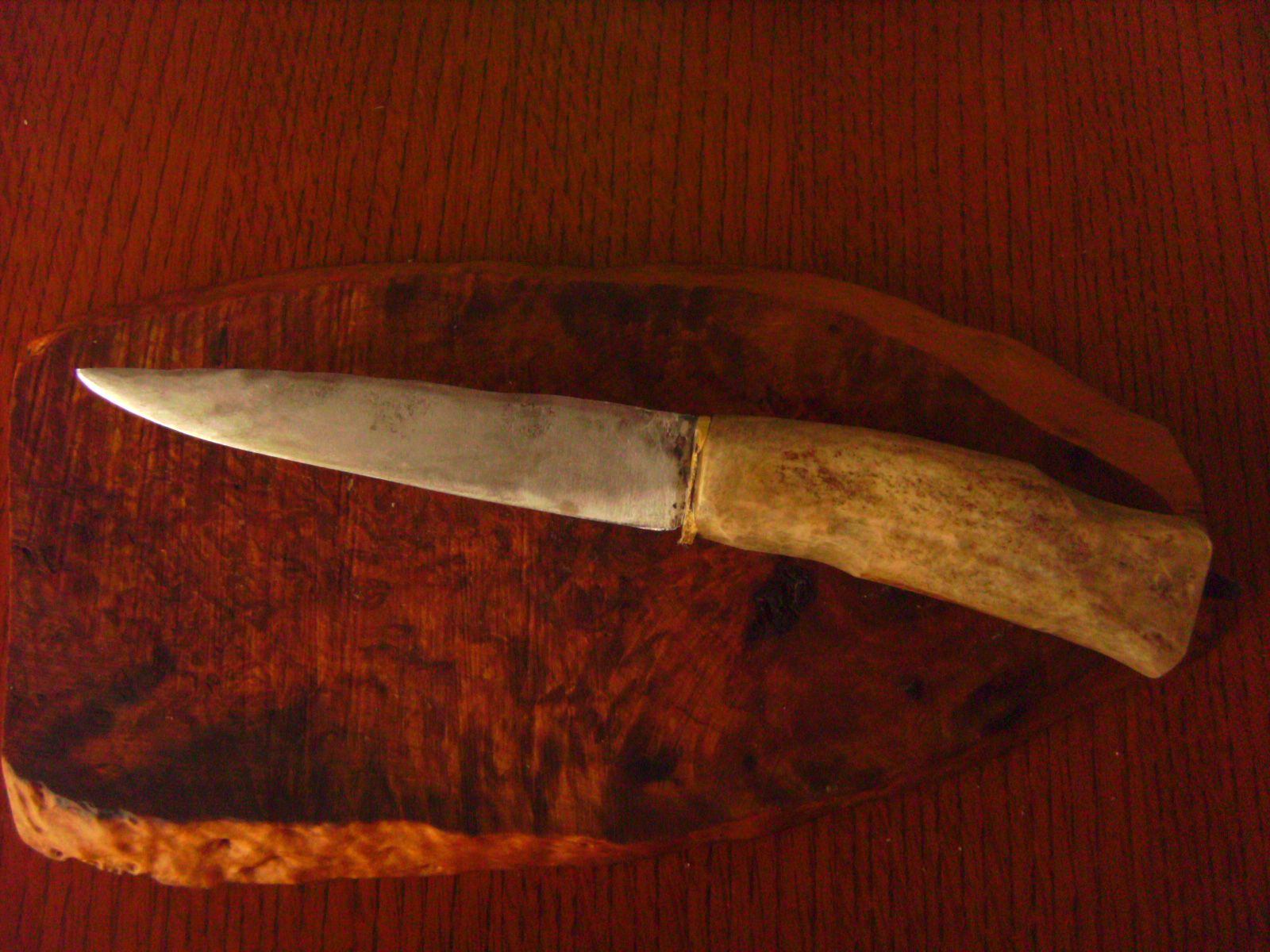
This is like living in a legend; only but recently I have told the tale of the knife above. On a stroll through the woods behind my home, those noisy, ravaged forest aisles that deserve to be loved even more for the fact that they have been raped by civilization, I found a piece of steel. It just lay there, washed up from the ground by the rain, a piece of waste that had served to fill up the trails. It was customary to use junk and scrap metal to fill up the trail base up to the 70´s in my hometown, so the trails are mostly made from steel and slag and volcanic glass and smelting leftovers, aluminium, brass, copper, haematite and sulphurous. On the trail surface it lay, shaped like a crescent on one side and with something like a tang protruding on the other, rusted deeply, pitted and torn, but at the thickest some 8mm thick. When I touched it with my boots it gave a high ringing sound. Now this shape is exactly how I forge the preform of a knife blade before forging the bevel. It is forged on the inside of the crescent. You drive the material towards the spine, and that way you can manipulate the edge line to a straight-back or drop-point layout. So I took it home, and for a while it sat on my shelf as a constant cause of wonder. Then I forged it out, doing as little manipulation to the preform as I could, because I respect the smith who had given it its shape in the first.
It was when quenching it that I realized that it shows a pattern under the scale. It might be a fading phenomenon, but after quenching the pattern was most distinct, and after grinding there´s still a hint of it, so that I look forward to the etch. Might be it turns out a creeper, but still I wonder.
Who was the smith of this blade who involuntarily cooperated with me? I am doing some research these days. What I found until now is
"Inhalt : Firmensitz: Hagen
Branche: Eisen-, Blech- und Metallwarenindustrie (Gabelfabrik)
In der Nähe des Stammsitzes Funckenhausen in (Hagen-) Vorhalle erwarb Georg Funcke 1702 ein Hammerwerk an der Geitebrügge, heute (Hagen-)Eckesey. Die Anlage blieb bis 1990 im Eigentum der Familie. Nachdem das Hammerwerk zwischenzeitlich verpachtet worden war, übernahm es in der vierten Generation Carl Gottfried Funcke. Er betrieb bis 1855 zunächst eine Kompagniehandlung mit Caspar Bröcking aus Gevelsberg. C. G. Funcke wandelte das Hammerwerk in eine Fabrik für Pflugscharen und Schraubstöcke um. Sein Sohn Carl, dem aus dem Erbe das Hammerwerk zugefallen war, begann 1879 unter der Firma C. G. Funcke Sohn mit der Produktion von Gabeln für die Landwirtschaft. Bekannt wurde das Fabrikzeichen "Victoria". C. G. Funcke Sohn war bald führender Gabelhersteller im Raum Hagen/Ennepe-Ruhr. Der Neffe des kinderlos verstorbenen Carl Funcke, Richard, trat 1920 nach Absolvierung der juristischen Ausbildung in das Unternehmen ein. Es firmierte zwischen 1924 und 1937 als Aktiengesellschaft (Stammkapital 460.000 RM). 1970 übernahm das Unternehmen unter der Leitung von Carl Richard Funcke die Wilhelm Abt GmbH, Schorndorf. Die zunehmende Mechanisierung der Landwirtschaft zwangen 1989 zum Zusammenschluß mit James Neill Tools Ltd., Sheffield und zur Schließung des Werks Eckesey zum 30. April 1990.
1,5 m
Chroniken (angelegt vor allem durch Carl Richard Funcke) 1702-1990 (22, mit Sammelgut zur Firmengeschichte); 250jähriges Jubiläum 1952 (5); Bilanzbücher 1880-1895 (2); Hauptbücher 1871-1935 (3); Betriebsversammlungen 1960-1979; Plakat Victoria-Gabeln; Prospekte; Fotos; Lagepläne; Porträts der Unternehmer (4); Manuskripte von Richard Funcke (Vizepräsident und Ehrenmitglied der Vollversammlung der Südwestfälischen Industrie- und Handelskammer Hagen).
Darin:
Eingabe von Dr. Johann Caspar Funcke an das Generaldirektorium zu Berlin wegen Werbefreiheit, Rückzahlung von Kriegskrediten, Tuchscherenfabrik und Eisenschmelze zu Sundwig (1764)."
(source:
http://www.archive.nrw.de/LAV_NRW/jsp/bestand.jsp?archivNr=4&tektId=260)
It seems that there are several corporations in the vicinity coming into account for the disposal of their waste. This would be the screw manufacturer and stamp shop Funcke & Hueck in Eckesey, a district of my hometown, Hagen, and the manufacturer of pitch forks and rakes, C.G.Funcke und Sohn, and maybe the iron works Harkort and Krupp in Eckesey. One evidence of manufacturers of hand-forged cutting implements is the Corporation Funcke in Iserlohn-Hemer (also an iron works). The problem is that this dates back to 1764. Also possible is the corporation Söding and Halbach, specializing in crucible steel tools and running a rod steel hammer:
"Inhalt : Firmensitz: Hagen Branche: Eisen- und Stahlindustrie (Edelstahlwerk), Amboßfabrik 1783 pachtete Johann Caspar Söding (1755-1815) einen Roh- und Reckstahlhammer an der Volme im Wiedey, heute im Stadtkern von Hagen gelegen. Johann Caspar Söding betrieb ab 1797 die Hämmer in Kompagnie mit Kriegs- und Domänenrat Wülfingh und kaufte 1805 ein halbes Feuer des Stabeisenhammers. Nach seinem Tod übernahmen die Söhne Johann Caspar (1785-1843) und Carl Friedrich Söding (1798-1867) die restlichen Anteile. 1841 nahm Friedrich Söding gemeinsam mit H.P. Winterhoff unter der Firma Friedrich Söding & Co. die Amboßherstellung auf (ab 1863 vereint mit Fa. J.C. Söding & Halbach). 1860 fusionierte Söding mit dem Stahlwerk von Carl Gustav Halbach in Haspe zur Fa. J.C. Söding & Halbach. Diesem Unternehmen wurde 1877 die Gußstahlfabrik Erkenzweig & Schwemann in (Hagen-)Eckesey angegliedert. Die Fa. Erkenzweig & Schwemann war 1855 als Remy & Erkenzweig (ab 1867: Remy, Erkenzweig & Schwemann) gegründet worden und spezialisiert auf Tiegelstahl. 1918 wandelten die Inhaber beide Firmen, die vorher als oHG bestanden, in Kommanditgesellschaften um. Nach 1918 konzentrierten sich J.C. Söding & Halbach auf Spezialstahlsorten und schwere Werkzeuge, während Erkenzweig & Schwemann Stahl für die Werkzeugindustrie herstellten. 1 m Nach der Vernichtung der älteren Firmenregistratur bei einem Luftangriff 1943 enthält der Bestand vor allem Sammelgut, das anläßlich des 180jährigen Firmenjubiläums 1963 durch Frau Ellen Soeding zusammengestellt wurde. Es ist z.T. ergänzt durch Splitter aus dem Firmenarchiv" (same source as above: http://www.archive.nrw.de/LAV_NRW/jsp/bestand.jsp?archivNr=4&tektId=212 )
The latter seems to be more realistic, since one branch of the corporation in Remscheid also made saber blades, and the corporation branch in Hagen also had the licence to forge saber and rapier blades or at least produce the steel for it. Remy, Erkenzweig and Schwemann were producing crucible steel before 1918 and after 1855. My blade blank now will date back to that time when crucible steel still was produced and used for scythes, saws and shears. And knives, one could argue, for in the region it was quite traditional to produce tools, saws, hammers, tongs, anvils as well as scythes and machetes. Originally, the manufacture of Halbach was situated in Hagen - Haspe, a centre of scythe and machete manufacturing, and even in Hagen - Wehringhausen in the near vicinity there was a great number of smithies producing shovels, saws, scythes, hammers, tongs, knives, hatchets, axes, anvils and the like:
"Wehringhausen erstreckte sich im 19. Jahrhundert vornehmlich beiderseits der 1788/94 ausgebauten Chaussee nach Schwelm (heutige B 7) und war voller gewerblicher Anlagen. Hierzu Martin Sellmann in dem 1979 vom Hagener Heimatbund herausgegebenen Buch „Wehringhausen“, Seite 78: „Mit Wasser- und Dampfkraft wurden hier Puddel- und Zementstahlöfen, Raffinier-, Amboß- und Breithämmer, Schleifkotten und Eisengießereien betrieben. Daneben wurden in zahlreichen Schmieden vielerlei Kleineisenwaren, Beile, Schüppen, Sackhauer, Hacken und Bratpfannen verfertigt.“
Namen wie Grueber, Post, Eicken, Harkort, Elbers, Vorster, Bechem und auch Adolph Müller, der Gründer der Accumulatorenfabrik AFA (später: VARTA Batterie AG), seien stellvertretend für viele andere Fabrikanten aus der Ära der Industriellen Revolution genannt."(source: http://www.wochenkurier.de/archiv/2012/03/14/erinnerung-an-die-kaiserzeit/ )
So, there is a huge amount of possibilities. What remains is that the blade blank is presumeably at least 87-145 years old. It is more probable that it is older, since knife blades were rarely produced in the 1900s, for then industrial production of other tools was more prominent. It was also hand-forged to shape so it is safe to say that it is a bit older and dating back to a time when there were more small smithies in the vicinity. The oldest guess I could make would be the 18th century, but this feels a bit bold. Evidence to this is found in Johann Dietrich von Steinen (1756): Westphälische Geschichte:
"
Eilpe, so den Namen von dem Eilperbach, welcher nahe dabey in die Volme fliesset, träget, lieget an der Landstrasse, so von Hagen nach Delstern, Breckerfeld, und so weiter führet. Es ist sonst dieser Ort sehr volckreich, und wegen der Degenklingen und Messerfabriquen sehr berühmt."
Eilpe, another city district nowadays, but more of the city centre in that time, was famed throughout Europe for the quality of their knife, dagger, sword and rapier blades. Wetter, the city situated at the Ruhr river next to Hagen, also was a centre of knife- and swordmaking since 1661:
"Wie in Hagen-Eilpe zeugen auch in Wetter Baudenkmale von der Anwerbung bergischer Klingenschmiede in die Grafschaft Mark. Sie ließen sich in Hagen-Eilpe, in Wetter, Oberwengern und auf dem benachbarten Gut Hülsberg nieder.
In der Freiheit Wetter ließen sich im Gegensatz zur Langen Riege in Hagen-Eilpe ausschließlich Messerschmiede nieder. Die Meister bezogen bestehende Gebäude und ergänzten sie um einen kleinen Werkstatt-Anbau. In ihm fertigte der Meister zusammen mit einem Gesellen und einem Lehrling auf kleinen Handschmieden mit Hammer und Amboss die Messer. Gemeinsam führten sie alle erforderlichen Arbeitsschritte selbst aus. Anschließend wurden die Messer in einem von allen Schmiedemeistern genossenschaftlich betriebenen Schleifkotten geschliffen. Er befand sich etwas außerhalb Wetters am Mühlenteich im Tal der Limbecke.
Trotz der gezielten Ansiedlung eines „protoindustriellen Exportgewerbes“ wuchs die Einwohnerzahl Wetters nur langsam. Die Messerschmiederei blieb jedoch bis ins 19. Jahrhundert in Wetter ein bedeutender Wirtschaftszweig.
Den aus dem bergischen Land stammenden Handwerkern gestand der Kurfürst in einem Privileg Glaubensfreiheit zu. Als reformierte Christen schlossen sich die Messerschmiede der bereits bestehenden Gemeinde in Wetter an. Sie unterhielt in der Burgstraße 17 eine eigene Schule für die Kinder der Glaubensbrüder. Nachdem die Schule 1839 in ein größeres Gebäude umgezogen war, bewohnte zwischenzeitlich die Industriellen-Familie Harkort das große schlichte Fachwerkhaus. Heute ist hier das Stadtarchiv Wetter beheimatet." (source: https://www.lwl.org/LWL/Kultur/fremde-impulse/die_impulse/Impule-ueber-die-Wupper-gehen/Messerschmiedehaeuser-Wetter )
If the blank is from Wetter, however, it must be far older, since knifemaking is evident only until the end of the 19th century.

At least I can say it was washed up from a deeper "cultural occupation layer". How old exactly it is, I cannot say now and probably will never; but it is a great feeling to own something that has waited so long to be completed. It is like opening a window into another time, and not just watching, but actively taking part in a history that is long gone.
Okay, so an archaeologist might still whack the shite out of me for disturbing the find coherence, but, hey, the find coherence of this trail is actually worth a fart, for in the meantime it has been rearranged at least three times by construction work. That way you find stainless steel beneath crucible steel and the other way round, and we are talking scrap metal and special waste in a forest environment. If it is from 17hundredsomething, that´s not my fault;-).
Anyway, this is a very, very special knife to me. It is mine, and it conveys a lot of meaning, as you might guess. I will always treasure it and it will be a special companion to me.
As is customary I am now about to find its name, and then it will get its runes and carvings. In this artefact especially myth and history, legend and tool will unite unlike in any other knife I own.
I will keep you posted!;-)