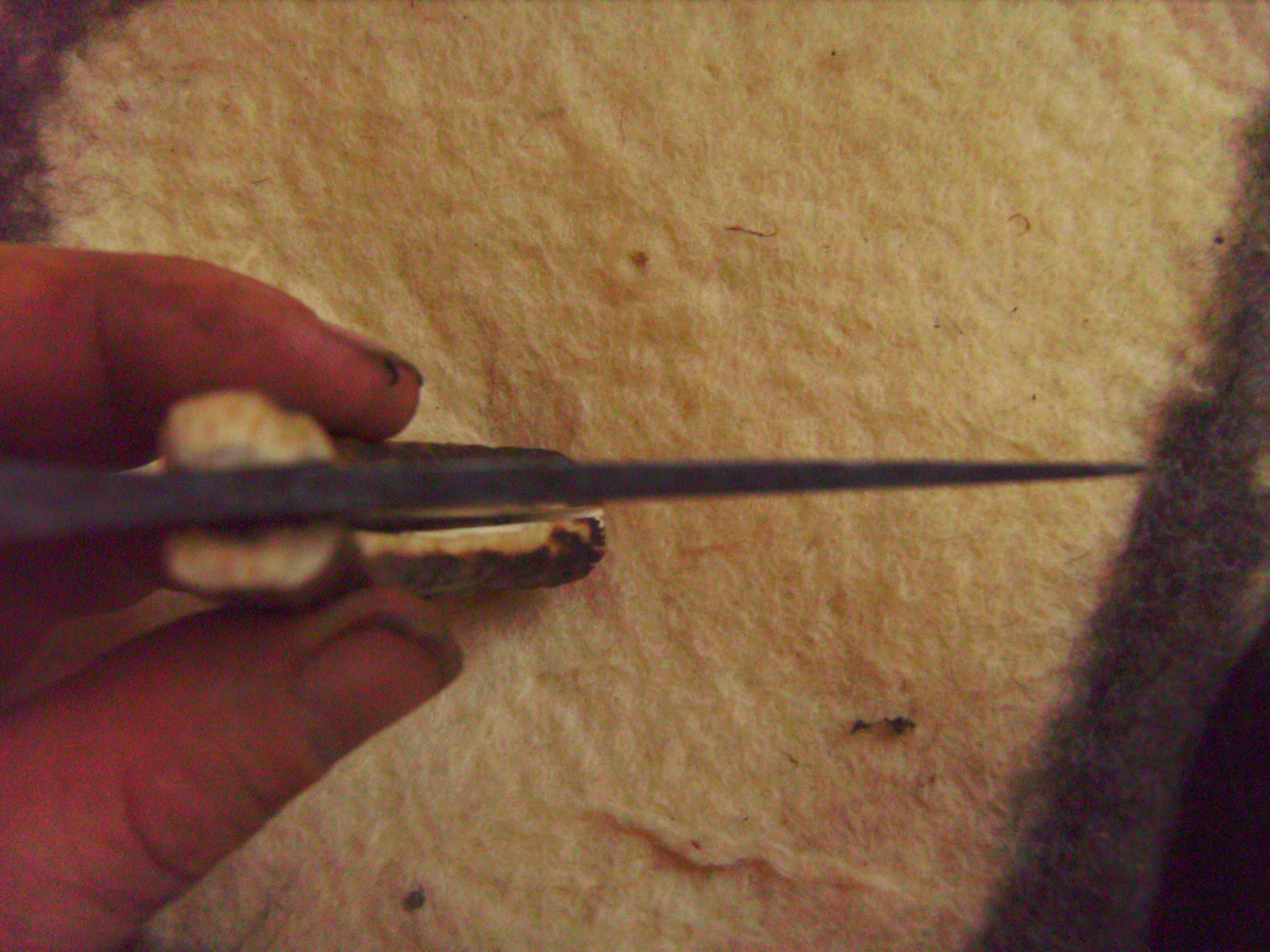
Here it is... I made a new sheath for Úlenkláwe, my "black handled knife". It is a dangler sheath to date, but may get some more attachments to be worn like a sgian achlais.
3 mm vegetable tanned leather, hardened with a mixture of dragon´s blood, alcohol, beeswax and resin, yet to be hot-waxed. It is wet-formed around the knife and keeps it in with a snap. I´ll keep you posted!
Those are the adventures of Mr. Fimbulmyrk, in bushcraft and blacksmithing, mountainbiking and hiking, reenactment, writing, singing, dancing, stargazing and having a piece of cake and a coffee. Pray have a seat and look around you, but be warned - the forest´s twilight is ferocious at times.
Posts mit dem Label Kopis werden angezeigt. Alle Posts anzeigen
Donnerstag, 25. August 2016
Freitag, 5. Februar 2016
Some thoughts on the Sica
Now this is the blade I featured some time ago, a not-so-authentic version of the Daco-/Gallo-/ Roman sica knife. Arguably not so authentic is the semi-integral bolster, but I simply love it. But then there are sicae and other knife shapes found from the Roman empire or from Celtic and Iberian finds, e.g. a Sica from Botorrita, with a short socket where the handle was fitted into, just like with some modern-day gouges, so the look might be excuseable even for reenactors;-). The reason why there are no semi-integrals found (at least not with these relatively simple knives) and even full-tang knives are relatively scarce (abundant only in Roman and Celtic countries, with the exception of iron age seaxes in Germanic culture, that presumeably had an Eastern provenience, another interesting topic), is that iron, and even more so, steel, was costly and was obtained at great pains. It tells a big story that in ancient Rome full-tang knives were quite common.
This one, however, does not at all claim to be a detailed reconstruction. It is made from an ancient chisel I found in the woods and shows a very weird spark analysis, might be Tungsten-alloyed steel such as HSS. The Sicae (or Kopis) knives I have made so far were not having that much an offset in the blade, and I thought to give it a try to test out the extreme. I have, for now, put a piece of antler on it to check out the balance while I contemplate what buttcap to fit. Balance point should be on the index finger.
Having played with it I must say that for everyday tasks such as cutting meat and slicing onions you have to think along a different train of thought. The blade gives you fierce cutting ability with a good purchase when you use it in a drawing motion, as you do with a sickle, so to say. The forward orientation of the tip gives you the possibility for a more pushing motion in a pressure cut. The shape of the blade really shines in two aspects: Woodcarving and slashing. The blade is ideal for delicate woodcarving in my book. I also tested the chopping prowess and again had to apply a different mindset. It will not work when you use the same motion as with a straight, say, drop-point knife. Is it less capable then? Not in the least, because when you use a straighter knife shape, you always have to adapt to the natural arcing motion of your wrist. With a Sica you have to keep in mind that this is not necessary. You can chop softer wood with a slashing motion by keeping your hand where it is and your wrist tight. Of course, it is no Khukhuri, but I was amazed.
The Sica in ancient Rome had a somewhat sinister reputation as the preferred weapon of back-alley cut-throats, and, having handled it, I can relate to that. It would also make a very effective fighting knife, if you knew how to handle it. The tip is always forward, and the sickle shape makes for amazing slashing capability. What fascinates me with this, is that the blade´s shape is most ancient and dates back to the earliest bronze age. And it actually follows a whiplash line, and I can´t tell it any other way, also feels "whippy". The "sweet spot" or "purchase spot" lies along the line of a Golden Ratio spiral, and, while there are always some liberties taken if you apply static geometry to a dynamic process, I strongly suspect that this has something to do with the "springy" feeling when slashing. By the way, if you analyse the ideal curve of the application of force in some martial arts, you also get the impression of a similar dynamic (whiplash line e.g. in Qi-Gong). Of course, yeah, I admit it, I am a bit obsessed with that whiplash line thing, and might be I see spectres everywhere, but I can´t think of a better model for explaining it, and it works for me in martial arts and even mountainbiking, so, hey, I don´t get paid for this;-), so I can cook up any theory I´d like.
The culprit is, it was a great experience again to actually be able to do some work with a most ancient blade form. You can talk about endlessly about who has written what about it and when, but only if you rebuild it and use it will you be able to understand, and the enlightening effect feels that good I think I am getting addicted to it.;-)
When the knife is ready, I guess it deserves a "name" and a story, and I will see how it fares in the woods... watch this space!
Labels:
Celtic,
crucible steel,
Dacian sickle,
design experiment,
experimental archaeology,
Knifemaking Tribal Smithing Bushcraft Survival Mushroom Hunting,
Kopis,
reenactment,
Roman,
Sica,
Tungsten
Donnerstag, 14. Januar 2016
Sica and the 440C mishap
Also on the bench these days are two obsessions of mine... the lower knife in the pic is another experiment with handle ergonomics and blade layout. I had one strange billet still lying around from the days of Matthias Zwissler, and it seemed to be monster Damascus. Okay, I looked forward to it and forged it out into a seax blade, a small billet and this bush design. When forging it, it proved a bastard with just a very small forging temperature window, and blimey was I glad to have a power hammer at hand! So, I looked forward even more to it, and normalized it for drilling and grinding, and did all the usual stuff I do to carbon steels, but-bummer, it did not work. I dulled my cobalt drills, and even my glass drill I normally use for weekend project blades that are already tempered did not move any material at all. So, back to the drawing board, some more annealing, and when I was at it I thought... well, why not punch it through, and with a bit of help by Moritz, hot-punched the holes, did some annealing (5 hours at about 600 ° C or so), until I could work it with a file all over. Then I ground it into shape and gave it a selective quench in pre-heated lard. Off to the polish then. It worked down my water stone, so I used the diamond strop instead. And grinding. And grinding. And when I was done grinding I did some more grinding with little effect. I was becoming eager and wanted to do a quick etch with salt, vinegar and citric acid. No pattern showed. Okay, I said, give it a coffee... no effect. But it was only after I had left it in 24 hours (normally ten minutes or so...) that I realized that this was no carbon steel. Since the only stainless steel Matthias had ever used was 440C, I guess the knife is 440C. Spark analysis shows a carbon content of 07-1,00% or so when compared to spring and file steel. First stainless steel for me, and I am surprised and pleased to see it gets a fine edge and seems sturdy enough to take a beating. Might be more stainless blades then for me in the future... I plan to fit some striped maple or elk horn handle with fibre liners and mosaic pins to it and give the blade some engraving and polishing. We´ll see.
The next one is a very interesting style of historical knife. I found a historical piece of crucible steel in the woods that once seemed to have been a cold chisel, and it has a carbon content of about 0,7-1,00%, too, when compared to file steel and spring steel. I have always called this blade shape a "Kopis", but morphologically it is more correct to call it a Sica, a knife made famous by Dacian people in the iron age. There is a whole world of variations, the one thing in common is that they offer one sickle-like edge (the word "sickle" derives from Roman "sicula"-tiny sica). The earliest examples from the Hallstatt period (from 890BC) are often strongly curved with little or no straight tip section. Later on the tip section was becoming more pronounced for some examples resulting in a shape more like the blade I forged. The integral bolster is not authentic, at least I do not know any examples of this, and this would be logical if you keep in mind how precious iron, and more so, high-carbon iron of good quality had been at the time.
Look at these excellent articles (in Romanian language):
http://www.enciclopedia-dacica.ro/index.php?option=com_content&view=article&id=709%26Itemid=377
http://www.enciclopedia-dacica.ro/index.php?option=com_content&view=article&id=734%26Itemid=402
http://www.enciclopedia-dacica.ro/index.php?option=com_content&view=article&id=741%26Itemid=409
http://www.enciclopedia-dacica.ro/?operatie=subiect&locatie=armele&fisier=observatii_asupra_unei_variante_de_falx_dacica
It is a most fascinating type of knife and I plan to do more of that stuff... watch this place!
Mittwoch, 18. März 2015
What I did while Nick was busy;-) and the long way home
The other day Nick had called if I´d come to go smithing with him;-). Turns out there was a birthday party scheduled that Volker forgot to mention, so surprise, surprise for him... but he put up to the task, for I was being late. He has an altogether different style of working with the kids, but that´s the point of it all- we all have. But in all those years we are working for the smithy, I have just received one negative feedback. Some four thousand customers, however, came and come back for more. The one negative feedback was quickly mended even so, and that customer now is one of our sincerest and oldest friends now. This feels very good, and Nick, working for us for, wait, is that two years now? puts up to the task in a very hearty and friendly way. Of course, there´s always room for improvement when the smithing is concerned, but that is so for anyone of us.
He addressed the parents politely, but also with a firm stand, and treated the kids with friendliness and respect, but also a strong position. Great!
I tend to criticize Volker a lot, I must admit, but I must say, he´s had a hard life and has one still. At 67 years old, he works up to 14 hours a day, 7 days a week, no weekend, for a ridiculous salary. Some of it is all his fault, but even then you have to admire him for his endurance and the friendly manner he has for everyone. He simply loves the kids. He may be absolutely crap for a blacksmith, but he does a great job with the kids. I have rarely seen a kid that did not leave with a sparkle in his or her eyes. I have rarely seen a kid not returning to the smithy. Not necessarily because of the blacksmithing, but because of Volker. He is subject to the city marketing of Witten, and recently opened his mouth and spoke his word that he was not to be treated little better than a slave. Of course, there´s now a right riot going on, with intrigues and a frenzy to modernising the Bethaus smithy and putting a scheme onto it that will not fit. I am currently searching for an alternative location just in case, for I learned this lesson far too well. And of course I will want to provide for my friends also, and this includes Volker.
Was it a lazy day for me, then? I did four projects with the kids and the parents alike and some tutoring on making Damascus, and that was all of it. Then I retired myself to the murky boundaries of the shop;-) and did some filing and fitting and filing and fitting some more... and this is what came out:
Viking age friction folder. Stag, brass rivet, and Zwissler seven-bar Damascus steel from tank cannon and tank bearing steel.
Crude, of course, but that´s how it goes when you try to forge as much in shape as you can...
I am a bit proud of the swan´s neck. The lever is a bit longer resulting in a very secure hold when opened, and I offset the slot a tiny bit to aid in keeping it in when closed.
The blade´s spine is going from 3 - 1 mm resulting in a slicer. The blade is selectively tempered with the quench line including the rivet hole to add durability. It has a convex bevel, and the blade is 80 mm long.
I admit I just forsake my principles with this Kopis knife after the Novgorod find. The handle is reindeer antler like the original. But, rummaging in my attic, I had come across this meander design bronze bolster. Now those meandrous design features are not authentical, neither to the Novgorod, Kiev or Birka finds. The culprit is, I am making this just for myself, and I just liked it. So I put it on.
The file steel and crucible steel show a beautifully rustic pattern and, having done a superficial test already, I can say they can take a beating. I guess I will do a video test about it soon.
The spine´s 4 mm thick, the bevels a mild convex one. The blade is exactly 120mm long, making it a legal carry.
I did five projects that day...
Top to bottom: A mysterious little something for the lovely magic troll, may her beard grow ever longer;-D, the aforementioned Kopis knife, a blade from ancient spring steel with a stag antler handle, the aforementioned friction folder, and another Rus replica with deliciously smelling Corse juniper wood (smells like exotic pepper!) and reindeer antler (not so deliciously smelling...) for a handle, Damascus blade from 1.2842 and crucible steel I found in the woods, 100x4mm.
It was simply great to have some time for projects like these... and I need this from time to time.
After work we had some delicious meatballs and potato salad and a sip of beer with Volker, Sylvia and Uwe. All too soon time had passed chatting and I was on my way home.
My heart was filled with warmth and content, as I rode home through the night. But as it turns out, the story is not yet at an end:
When I passed the Nachtigall mine, my rear tire went flat. As I opened my rucksack, I realized I must have had lost my spare tube and repair kit. And my rucksack, loaded with some 50 kg of tools and steel and knifemaking projects, tore. So, out in the cold, I took out my sewing kit and fixed the bloody thing, muttering curses and insults to myself until I realized this was not taking me anywhere. So, I took the pack, strapped my helmet to it, and started to walk. It was a journey of 13 km through the dark, pushing a bike with a flat tire and a pack that weighed me down with every step. My working shoes chafed me raw, until I got enough of that and walked the last 5 km barefooted. Even so, I had developed some blisters soon that made a funny popping sound, exploding from time to time;-), weird;-). Knowing that to cry would not get me anywhere, I took out the Balistol from my pack to disinfect them and went on my not-so-merry way.
And guess what? I would not have thought this during the toiling along, but I arrived home two hours later. I was still breathing. The blisters subsided in one day. I opened a bottle of black beer, called my love, had a chat and a good night´s sleep. Message: Nothing is as bad as it seems.
Donnerstag, 26. Februar 2015
Progress on my Rus reconstruction - and Lúgra Móros
The first steps towards my new Rus knife have been made, and I realized in the process that the Kopis knives I love so much actually have a historical background. One of my all - time favourite and ritual knives, Lúgra Móros (the moon-mare) is very close to a Novgorod find without me intending. In fact, I was always having the opinion, it was more of a Celtic design (hence the Old Gaulic name), but it seemingly also has roots in the Achaemenid Kopis but also in the younger Pishqabz. I wonder a lot of things these days. Could it be that the Varangians who served as a Byzantine palace guard served as a cultural vehicle to submit Persian or general Oriental weaponry and culture to the North? Or was this style of edge line original to Viking culture? What with an Irish influence) Quite certainly an Anglo-Saxon influence can be dismissed. I am fascinated by the thought that the Varangians, when returning home to Kiev or Scandinavia, brought Oriental wares with them (this is well documented). I also wonder whether Varangians also came in contact with Iranian and Oriental Martial arts? Plus, it is safe to say that at least one Russian martial arts and combat style of the medieval ages that was a predecessor to Systema originated in the Ukranian region around Kiev / Novgorod. This is a speculation of course. But a fascinating one...;-)
Anyway, the design of my Rus blade went a bit off the mark of the original drawing, but it is still somewhat historically accurate, for it mixes characteristics of the several Novgorod finds. The deviation is due to my forging it out of memory and not making a scheme out of brass or wood beforehand. This will happen next time. As is, the blade is 115x5mm in dimensions and made out of 45 layers of historical crucible and file steel. A first etching only revealed a tiny bit of pattern, but it is forged out in Masame technique to show the strands better. Below is a small whittling / neck knife I made for fun.
Labels:
#Tribal knifemaking,
Achaemenids,
damascus,
En-Nep,
Knifemaking Tribal Smithing Bushcraft Survival Mushroom Hunting,
Kopis,
Rus,
Systema,
Varangian Guard,
viking knife
Montag, 26. Mai 2014
Úlenfang es baren;-)-úlenfang is born
Nu es et sao wiet: De Úlenfang es baren. Un ek hebb lang simulaiert, bu ek dat dingen namen sull. Was et béo-chaoineadh? Ne, dat kan ik nümmes utspreken, met dise snaaksche spraoke Gälsch, un denne maakt de Wickerske;-) wider ökel van mi.. Sao bin ek to de sprake van mine hiäme kommen un nenn dat dingen nu Úlenfang. Nu kan man fraogen, bat dat allt sull, un seggen: Bat dem ein sine Úl es dem annern sine nachtegall. Hat dat aber allt auk en vordel: Goldemaar het mik dat eisen gebben un kan mik darbi auk verstaon;-), un dan kan hiä auk op platt den Namn verstaon.
Un borümmes de Úle? Kan ik iu ein döneken vertellen. Als ik nu latse mandag in steingarten was om mid de bekloppten dat Flitzepeed - Training te maken, hebb ik de Uhu saien in de wand, un hiät hiä ein bussard in de klaven! Un ik will ennit un nümmes kenn mid deze klaven maken... un de kneip es en dorstig lemmel, sao vil kann ek seggen. Maot ik nog ne Úl binnen tellichen, dann es et daon.
Translation: Now it´s done: Úlenfang is born. And long have I thought how I should name that thingy. Was it béo chaoineadh? Now, that, I cannot pronounce, with this funny language Gaelic;-), and then the magic trolll will make fun of me again;-). Thus I took the language of my home and have taken to call it Úlenfang (Owl´s fang). Now you ask, what the fuss is about that name, and say: One man´s owl is the other´s nightingale. But there´s one advantage (in the bargain): Goldemar had given me the iron, and while he can understand me ;-), now he can understand the language, too.
And why the owl? There is a story. When I was at the rock garden last Monday, I saw the eagle owl nesting there, and it had a bussard in its claws! And while I would not want to make any further acquaintance with these claws, this knive has a thirsty blade, that much I can safely say (it already cut me twice..). Now I still have to do the owl carving in the handle, and it is done.
Note: This is the language native to my homeland, which dates back to the old saxon language and is still spoken in many villages of the Sauerland region. By the way, the "Sauer" in the name has nothing to do with being sour, but with *Dhiudha, Theudo->People, reduced to "Siuer- / Suer - land", i.e. the "land of the people". Some have the theory that by the "people" the "niflungar" / "Nibelungen" are meant, the "little folk" native of the region, dwarfs and elves of a very ambivalent character. There are many tales giving them credit as skilled and stealthy helpers of blacksmiths, but also warning of the imminent danger in having contact with them. If you have ever stood atop a Sauerland mountain after the rain and you see the mists arise from the green hills around you, you can feel their presence still. They live in the deep woods, their plants are oak, holly and yew, deer and fox and hare, owl and raven do not shun their step.
Concerning the language again, if you look closely you will notice many similarities to modern English, and the similarities are even more obvious when you compare it to Anglo - Saxon (the language e.g. of the Béowulf epic poem of the early medieval ages). vertellen->to tell maaken->to make was->was and so forth. It also shares many characteristics with the Dutch language.
Now to business: Blade is ancient crucible steel I found in the woods, as you can see it shows a pattern and a strange hamón. Blade is 12 cm long and has a distal taper from 8 mm to the tip.
The tang is riveted against a flower out of mokume gane that has to be polished and etched still. When I filed it, file dust gathered in the epoxy leftover around the tang, and, following an impulse, I put some more on.
Here you can see the taper of the blade. The handle is reindeer antler.
It´s still a work in progress, and I am taking my time with it. It has a kind of spiritual aspect as well making it. It is for me as well as for the Niflungar, for I have changed sides long ago;-).
Labels:
Beowulf,
crucible steel,
Knifemaking Tribal Smithing Bushcraft Survival Mushroom Hunting,
Kopis,
Mokume Gane,
Old Saxon,
owl,
Platt,
Plattdeutsch,
Sauerland,
Siuerland,
Suerland
Mittwoch, 5. März 2014
Toodling around the bush;-)
The other day I was feeling the need again, that itchy, scratchy need to get out and put in some singletrack miles. Also there was the birch sap rising at mild temperatures and I saddled my steed and put some tools into my daypack and a fresh container bottle, made myself a flask of tea, and then I made for the hills. The sun was shining, and at first I was thinking about heading straight to the grove, but then decided otherwise and took in some much-missed singletrack riding. It is funny, I do njot often realize I miss it,l but when I am finally on my bike again and headed down a technical singletrail , everything fallos into place again. I contemplated a bit about that, while I was riding up a steep road that mends into a fireroad, and that I have ridden since I was a child. I took this route home from school when I was kid quite often. Now my time at school was not exactly an easy one. I was better at school than most, I had different questions, I was not very good at sports how it was teached (I hated football or basketball or gymnastics, and even though I rode mountainbike races already, even worldcup races, I always failed at school sports;-)), and, generally I was a strange kid, growing up in the woods as I did. Mountainbiking up that trail always had a kind of katharsis effect from all the mobbing and mocking and violence I had to suffer. I struggled up that road, and where it ends and goes on as a fireroad into the woods, I used to stop and relax, and it always was as if a great weight was taken from my shoulders. 23 years later my life is not exactly easy, and will never be, and sadness is a companion on my trail. But as I took my feet from the pedals of a way different bike, with a loooong high-mech suspension fork and no drum brakes at all;-), I felt the weight of it all subside, and I breezed in the early spring breeze freely. I often think about mountainbiking in general quite critical these days. Most mountainbikers I know behave like right morons. This is a development I witnessed since quite recently. Noone respects hikers, horseback riders, or hunters anymore, in fact it is deemed an act of coolness to ooze out quite some language into their faces. Slowing down before hikers is uncool, and tearing up the landscape with manmade stunts off the trail, is no longer a no-go, but commonplace. Okay, so I have built stunts myself, on abandoned trails, and had fun with them. And it´s not really a great damage done, if it´s done properly and with respect to nature and fellow human beings. But this new generation of riders (with quite a lot of old-generation riders in it also) simply does not care a shit, to a degree that they even get bodily against people pointing out it´s not okay to do this or that. I always try to talk to people politely and to find a solution, but I have given up on trail access issues, for the worst enemy of legal trails are the mountainbikers themselves. And if you add politics to the issue you got a brew that will drive the sanest man mad. So the taste of mountainbiking has become a bit of a bitter one, for on many outings I meet with hunters, pedestrians and equestrians, and simply because I talk to them, even if it is difficult at times, politely and with respect, I get a right shower of the foul, of their bad experiences with bikers, and I often have to admit that they are right. I feel ashamed and cannot but try to make things right others have made worse, and continue to do so.
I will continue to follow my heart on the path of my soul, and this involves riding as well as being a part of nature. And I do not think it´s a contradiction. Tire tracks will heal with time, even stunts would be okay, but you have to know where, when and how you do it. If you love nature, you want to get to know more of it, and if you know, you will have your fun in a manner that does not ruin too much. But this is not a post for the morons. It´s a post about silent joy. It´s a post about feeling flow on a singletrail as well as sitting on a stump and having a sip of tea, savouring the sun, and a gentle breeze in early spring, listening to the birds singing and feeling the sap rising. The morons will never understand. They are too busy posting the weight and mass and colour of their morning shit on facebook or what´s app to simply sit back silently. Language? Quite truly so, but that´s the only jargon they understand.
I have always been different to them, I never had a part in their business. Mountainbiking has been my vehicle into the other world, to get there faster, there, where I was born and where I belong. I am a different being, and have more in common with an oak or birch or a hare or fox or the wandering hunter´s moon than I have with their world. As an infant, my lullaby was the song of the breeze in the soft treetops of spruce and fir, and the hooting of owls and the cry of the buzzard was more important to me than the latest top ten pop song.
I will no longer partake in a world where I don´t belong, at least not more than I must, and I will become stranger and wilder still.
I arrived in the grove with all thoughts run out, as it well should be, for these thoughts are poison. Death it is to insult a poet, death, to love him, and to be a poet means death also. He who knows must not ask, he who asks, knows not. So, I left all these thoughts to the breeze and the light and the eraly scent of spring, wafting through the birch grove ever so gently. Down I sat with my back against a birch tree, and sipped my tea.
I took out my two latest projects, two Kopis knives, that will fit in the concept of "Grimsarksberarmál", a poem and a story I have in the making, given by the wandering moon and a feather of the cat-owl;-). The topmost knife is made from Zwissler damascus with a wild pattern, which I know nothing of, but it took a good temper. Below is a knife out of Wootz steel I found in the woods.
"Beyond the dream road through the iron wood
Lord of the forest made love to a faerie:
Silently the moon´s reflection in the water."
The hours passed in thought and without thought, and in reflection and meditation (others call that drinking tea;-)). Then it went a bit cold, and I went over to the birch I tapped and got me a bottle of sap and fixed a fresh one to it. Oh the loot:
And I rode home with freed shoulders.
Labels:
Birch sap,
birch sap tapping,
dreams,
freeride mountainbiking,
Kopis,
Mountainbike riding,
responsible mountainbiking,
stories of the woods,
woods,
Wootz,
Zwissler Damascus
Mittwoch, 11. September 2013
On the bench these days... Wootz / Bulat-blades from steel I found in the woods
I can tell you, I nearly fell on my south, when I learned the "crap steel" I found in the woods actually was refined Wootz! In the etch you can see the characteristical carbide distribution...Click here for a scientific article on Wootz / Bulat / Pulad steel.
Even if it were not this kind of steel, there´s be no harm done, for it makes for a blade that wickedly sharp and holds an edge very well. Okay, so it got some dents, when I slammed it full bore into an iron rod, especially to the rear, where it did not hit the tempering concoction fast enough, but no harm done... when´s the last time you used a knife to chop through iron rods?;-)
I fitted a stag antler handle that´s currently being tanned.
The spine´s rather thick at 5mm, the blade´s 95 mm long. I love the Kopis design, for it makes for a smooth cutting motion!
And my hadseax is there, finally, and talk of being snobbish, the damascus is of ancient file steel and Wootz steel... as I have learned now. It is wickedly sharp, flexible and boy, I simply love it.
If you look closely you can see hints of the wootz structure in the layers.
Okay, I have to remove that glue;-)!!!
The blade´s 105 mm long and 3,2 mm thick, has a high convex bevel with a very slight curve. The handle is bog oak from an old mine with a lovely burgundy colour. Fitting and bolster are brass, the white piece is reindeer antler that will see some carving. Watch this space, I am back...!(that a threat?);-)
Dienstag, 3. September 2013
News from the shop and the deep, deep woods...
Long time, no post, and a load of things that have happened. Suffice to say, life´s not getting easier, but I refuse to give up;-). Something very great first, however: It was not a week after Willy and the magic troll learned my camera had gone the way of all earthly things that they both respectively gave me a camera they had to spare. No high-end pictures, but pictures you´ll get, first from projects going on. Topmost is the new Nessmuk I started some time ago, fitted with ramshorn scales. Spring steel, selective temper and scales I am a bit disappointed of, for they are looking a bit crappy still. Then a knife I am very fond of, a danascus from ancient file and crucible steel. Brass, reindeer antler, yew from the old garden of my old home, and a copper buttcap. You can see the quench line very distictively and the blade, even with a rather thick convex bevel, is hair-poppingly sharp.
Then a fully integral compact bush knife proto with a tempered buttcap that can be used to hammer nails home (which I tested;-)) and a thick tang that even without scales can be used with no harm to your hands. The blade supports my weight;-). It´s made from spring steel with a selective temper. The tang is drilled out to achieve a better balance. Guess it will get some stag scales or something like that...
Next in line is an integral Kopis/En-Nep out of crucible steel I found in the woods. Not tempered yet, I am still about on the finish. By the way, I have, except for drilling, used no power tools.
"Found in Myrk´s wood";-), another integral loosely modeled after a German hunting knife. I am really fond of it, crucible steel from the woods again, 90x4mm, burned stag antler, riveted against a brass buttcap. The handle will see a carving, maybe of an eagle owl, which is of some spiritual significance to me.
Then I made a lanyard mojo for rún iarann, an EDC utility knife out of Zwissler damascus, tank cannon and tank bearing steel, and bog oak with a burgundy colour. Silver, agate, brass, and a merlin´s tail feather.
Talking of "Myrk´s wood", you asked for it, and here it comes: Another unlikely Fimbulmyrk tale:
Last week I was completely burned out from work, work and more hard work, deaths in my family, a distance relationship, no resources at all, and having no actual perspective in the so- called "real world", you know, the one that destroys nature for money, toodles and plays around with genetics, bionics and warfare and generally knows no god but the ego... coming to think of it, it in itself has no perspective, but you know what I mean.
So, what to do?
Off with me into the deepest woods I could find. Searching for counsil and comfort by the trees and the spirits. It wasn´t long into the hike that I realized buzzards were circling ahead, some five or so, crying madly as I have never heard before. Following them I ventuered ever deeper into the woods. There it was I found a buzzard´s skull, and paying my respect, I took it with me.
Now I am currently researching the local legends about the elven or dwarven king Goldemar / Volmar, the mythical builder of Volmarstein castle and counsellor of Neveling of Hardenberg, lord of Hardenstein castle, a trickster and a mythical figure presumeably dating back to an older local deity. At one point I had a strong vision, when I encountered a herd of roe deer, a HUGE one, in fact, with some twenty roe deer all in all, heading into my direction. I then imagined rather savagely looking dwarves with features more "trollish" than anything, led by one dwarf with an antlered crown of brambles, blackthorn, and ivy riding on their backs. Vivid imagination can do that to you, yap*ggg*, and it is a rather adventurous way to become a part of the myth yourself. Of course, it is difficult to keep your feet on the ground afterwards, but, to be honest, what would I win if I did so? Wading in the muck? So, I have decided long ago, I´d rather have an interesting and somewhat psychologically dangerous life than none at all wading through the swamp that others created for me to live in. When out now in the woods, where he might as well have been sighted, too, as a local legend of the "Hünenpforte" might hint to, I was in a pensive mood about all those stories and tales of old, and I thought about the wanderer, coming from Schwelm and meeting a dwarf (king?) there, providing him with a fox as a guide through the underground to the giant´s passageway in Hohenlimburg. This is another story which I have told here.But as I wandered in a mood of contemplation and fancy, there it lay, half submerged in the rotten leaves of an autumn gone by, autumn itself in its waning paleness: The skull of a fox. It was a shock, for the outside and the inside world melted into each other, and, I cannot tell it any other way, the otherworld opened for me. I therefore do not exactly know;-) if this was a vision, but the next shock was about to come: A giant boar, with bristles as hard and strong that "an apple might stay stuck upon them" passed along a ridge of the terrain, as real as it can be, but with something more about it. If I have to explain this, I will never succeed, if you understand this, I don´t have to explain anything. Okay, I said, laughing at myself, while I was staying where I was (you do not want to cross a boar in autumn, do you? Not with an at least adequate weapon at hand...;-)), and payed him my respect mentally. All the while the buzzards were still crying madly above. When Mr. boar had gone on his merry way, I went on mine, following the cries above. Even deeper in the woods I found another treasure; as I rounded a callused spruce tree and climbed over a fallen beech that had sprouted new trunks from the fallen stem, I came to a very peaceful place. There a spring rose from a meadow, and above there stood an ancient hazel tree. Into the trickling creek it threw its fruits, green and nourishing. And the water flowed on endlessly, for joy of being and for the fruits of the hazel of fine mast falling into it. It was a place of great peace and comfort. It felt like home, I cannot tell it any other way, and there I rested in meditation, and the hours just flowed, but I did not notice. I realized that I had somehow fallen out of time there, when I learned it was becoming quite late already. But I simply walked on afterwards, following the trail of deer and the trail of my myth within... the story that dwells and thrives in all of us, the dragon that we all could ride - if we dared. This dragon is wild and savage, too, it´s not all light, but sometimes very dark. It can bite our head off in a flash, but we are able still to make our peace with it. We the can thrive as a dragon, and the fire in our spines will carry us over the storm-ridden skies into a golden dawn, where we can find words to create ourselves, to invent our life. Thus was the path into the green, into the twilight wood, the realm, where the one with the antlered crown walks, hunter and prey at the same time, the goddess´ strong-horned consort... thinking this, I was actually not surprised to find a piece of a roe - deer´s skull with a piece of antler on it.
Oh yes, I returned to civilization. I took the bus, and bought a beer, and some junk food. But my imagination has run wild, and I´m aware and proud of it. It is hard to regain your composure afterwards. It is always an act of balance, and chance is, you can get mad by being as I am. Maybe I am mad, but I have not done harm to anyone, and won´t, if I do not have to at all.
But it´s better to be mad than a moron.;-)
Labels:
crucible steel,
dwarf king,
elves,
En-Nep,
fairy tales,
file steel,
goblins,
Goldemar,
Hünenpforte,
Integral,
Knifemaking Tribal Smithing Bushcraft Survival Mushroom Hunting,
Kopis,
legend,
myth,
Volmar
Mittwoch, 10. April 2013
How do you spell catastrophe? First Hammer - In of the season @Industriemuseum Ennepetal
On Sunday there came a day I had looked forward to for a long time: The first Hammer - In of the museum season. Traditionally, it´s always a great time to be had with a lot of knifemakers, in part from all over Germany, and the folks are always good-tempered. There are minor questions to be asked, but all in all, we never had any problems amongst ourselves. We enjoyed ourselves doing the best we could for the museum. For free, if you don´t count the cake and coffee and one or the other sausage...
The times they are a-changing, or so it seemed that Sunday. When we arrived at the smithy, way before the event SHOULD start we were greeted with a sneer and a "MORNING! Slept well, did you?". The Thursday before the week before, Willy made a contact at the session of the museum staff´s board just to make sure everything was fine and we did not miss out on anything. Our Email-addresses and phone numbers are well known (or so they should after giving them out at least ten times). When we arrived at the smithy on Sunday, we did not know what to say. We were pleased to see a HUGE anvil, and a new coal forge and a paraphernalia of tools to use and expo material to show. What we were not pleased at all with was that it was literally strewn all over the place hindering our interaction with the public, making it almost impossible. Ok, we made it work as best as we could. Then, it was the traditional fire alarm bleating along after just one hour of forging, and noone competent to turn it off. The fire brigade came by, was not amused and went away, and still the alarm was blaring on. Ok, we made it work, as we always do.
Then one of the staff members came by to announce that we were trespassing the museum rules by not being a member (I am not, three clubs and institutions are way enough, but Willy is) and therefore hindering insurance. From my job I know that it´s often a matter of goodwill to make that work. Ok, I think that guy had a hard day anyway, so no harm done, for he´s normally a friendly guy to boot. But all along we heard some ranting about this or that. The icing on the cake, however, was still to come, when the head of the museum came by leading a group of visitors through the museum. I had worked four weeks in a row on a referate about iron culture and -history in the region, including the history of the "Brackersfelder knopmetz" (readers of my blog know that topic), and I started right away with the things I prepared. I was being interrupted rudely. He then started to talk about a vice that´s ion use in the smithy and that one of his ancestors used to make them, and then started on how casting was superior to smithing (which is frankly absurd, for those two are entirely different processes). Ok, then, I took a deep breath, it´s okay with me, less work for me in the future. To calm down, I wanted to get me a sausage and a coffee. When at the barbecue stand, I was being told that they couldn´t be free anymore for I was not a member. Okay, I said, took another deep breath, turned around to the bakery, and got me a delicious sausage-in-a-bread.
I don´t exactly know what´s going on, and that´s my problem in the first. We work there for some four years now. We did a good job, or so we were told. Many tools and three forges and several of the anvils in the smithy are our own. All of the hammers, tongs, most of the steel, and even some gold, silver and mokume gane left over from out time with Mathhias Zwissler. Turns out those materials last mentioned are all gone. I wish the new proprietor good luck with them, okay. We can´t help it anyway, but it sucks, and it was a learning process taking everything of value home with us, meaning, always riding with 40kg worth of smithy on my back 30 km all in all. Which sucks also.
And another thing is extremely strange to see. The staff´s always running around with a deep frown, while in the smithy, for the most part, there´s always some mischief going on, laughter and even some queer singing;-). We do what we like, we are free, and we love to tutor kids and adults. Why can´t they just leave us be? Okay, that´s naive, for they are Mammonists, and we are deviant from the norm. We make knives and tools, and that´s a factor, too.
Our piece of cake, however, was that this was the case that day in spite of all the mayhem going on. The circumstances were as bad as could possibly be, and I guess, the photo below shows the mess the smithy was in. But we shrugged, took the hammer to hand and just pounded on. Marcel and Volker came along, and we had some fun playing with fire and steel. Marcel is a hobby knifemaker I got to know at the Bethaus smithy, and Volker, a friend of his, is a learned artisan blacksmith, a chastity belt smith in fact, which we had a good laugh about him always making a spare key just to keep himself busy;-).
He did extremely well at knifemaking, though, forging a belt knife (chastity belt knife?;-) HUH*ggg*) out of file steel. We just showed him the turn on tempering, but it worked out well enough!
Marcel had some extremely difficult projects for a first - time smith, requiring a lot of sledge work and quite some welding.
In spite of all the havoc, I still had some time left for my own little projects, including the folder I forged recently. I had to quench, quench and quench some more the elven damascus knife I made recently which turned out to be no damascus at all.DOH!;-) Okay, next one will be better and out of real steel.
Daniel was there, too, and he has made some HUGE progress. Here he is preparing some spring steel for a Birka knife he started and where I tutored him a bit with tempering and grinding.
There also was a historical automobile show as usual, and I took a rest taking photos. There also was a musical performance by a friend of mine, Dr. Mufumba, but I missed it for the problems with the fire alarm.
...
...
...
...
...
...
...
...
...
...
Daniel forged a knife and some artwork that day. Then Nick came by with his lovely wife.
All the while we had a chat, the guys kept on pounding. These are the projects Marcel made. A big kitchen knife and a piece of damascus steel by Peter John Stienen we drove out for him.
I modified my favourite hammer with a bigger punch to make for a sturdier handle fitting base, the elven knife that did not become hard enough, a leaf handled Kopis out of spring steel....aaaand a striker inlay for my folder.
For Nick and his wife I made some pouch mounting rings out of mild steel, and Nick and myself forged a blade out of cold-rolled file steel together. Turns out he was quite inspired by the En -Nep I made a long time ago and wanted one, too. While we were working together (good job, mate!), I learned that he was acquainted to Willy´s daughter... strange ways life goes, really!;-)
The one thing they cannot take from us: The roaring forge. The dragon´s breath in our spine. The hammer in our hand. Our pride. And our skill. The deity could, but what for?
They have cut the sinews of blacksmiths, they have enslaved them and stripped them from their privileges. But those smiths of legend have always learned to forge themselves wings. We strive to learn the name of iron, and iron does answer in the fire.
Like this, see? Those are the works of Daniel. The knife is spring steel, 1,2 mm or anything like that x85 mm blade with a selective temper.
They have mobbed him, tried to keep him low, have made fun out of him. But he´s right now making his way, and he succeeds at it. The roaring forge will be in his heart, and iron listens to his hammer now. They will never succeed in breaking him.
This is the En - Nep we made for Nick, and a spare ring that went not so well.
Then we went over to the café to have a mug, and we even DID get it still. Cake was all gone (Why don´t you take a break a bit earlier? - ´Cause we were busy, ma´am). We chatted a bit, and Walter came by. Now Walter certainly is a good guy, and he got horsed around with as badly or even more bad than we, and he said he wanted to talk about it in the managing committee. We do not believe it will do anything good, but if he inists, we thought, we might as well let him do it. We just don´t believe in the managing comittee anymore. It was a bit strange. We talked about things that really mattered, and they kept on ranting their bureaucratic rants and uttering their personal complaints. Okay, so what, you might say, that guy´s also ranting about in this post, but I guess there´s a difference. I do not stop there. We just made it work and had fun nonetheless. We worked hard, but we love what we do. We do not care a runny shit about who has what position or not, and who has what permission or not. We work for others as well as for ourselves, and we will not let them bring us down. Not an iota of an inch. We simply have that responsibility for others, as well as for ourselves. And that is their problem, not ours. We will do our best, as we always do. And our work is appreciated by other institutions. So, when in doubt, they will have ten smiths and half a smithy less.
Then, suddenly, the mayhem was over, and I rode out into the woods to have some rest and a bit of contemplation.
...and a lovely, lonely cuppa tea, of course. It felt like taking a deep breath after being sick a long time, and I simply took in the silence, only broken by the tweeting of birds and the wind in the leaves still left from last autumn in the oak tree above.
Oh, and here´s a better inkling of how the folder´s intended to be. I plan to fit a striker as a spacer in the back that will also serve as a lanyard hole.
I also found some more spring steel by the roadside. Perfect.
I did some stumpsitting, and fortified my resolve.
They will never break us.
The times they are a-changing, or so it seemed that Sunday. When we arrived at the smithy, way before the event SHOULD start we were greeted with a sneer and a "MORNING! Slept well, did you?". The Thursday before the week before, Willy made a contact at the session of the museum staff´s board just to make sure everything was fine and we did not miss out on anything. Our Email-addresses and phone numbers are well known (or so they should after giving them out at least ten times). When we arrived at the smithy on Sunday, we did not know what to say. We were pleased to see a HUGE anvil, and a new coal forge and a paraphernalia of tools to use and expo material to show. What we were not pleased at all with was that it was literally strewn all over the place hindering our interaction with the public, making it almost impossible. Ok, we made it work as best as we could. Then, it was the traditional fire alarm bleating along after just one hour of forging, and noone competent to turn it off. The fire brigade came by, was not amused and went away, and still the alarm was blaring on. Ok, we made it work, as we always do.
Then one of the staff members came by to announce that we were trespassing the museum rules by not being a member (I am not, three clubs and institutions are way enough, but Willy is) and therefore hindering insurance. From my job I know that it´s often a matter of goodwill to make that work. Ok, I think that guy had a hard day anyway, so no harm done, for he´s normally a friendly guy to boot. But all along we heard some ranting about this or that. The icing on the cake, however, was still to come, when the head of the museum came by leading a group of visitors through the museum. I had worked four weeks in a row on a referate about iron culture and -history in the region, including the history of the "Brackersfelder knopmetz" (readers of my blog know that topic), and I started right away with the things I prepared. I was being interrupted rudely. He then started to talk about a vice that´s ion use in the smithy and that one of his ancestors used to make them, and then started on how casting was superior to smithing (which is frankly absurd, for those two are entirely different processes). Ok, then, I took a deep breath, it´s okay with me, less work for me in the future. To calm down, I wanted to get me a sausage and a coffee. When at the barbecue stand, I was being told that they couldn´t be free anymore for I was not a member. Okay, I said, took another deep breath, turned around to the bakery, and got me a delicious sausage-in-a-bread.
I don´t exactly know what´s going on, and that´s my problem in the first. We work there for some four years now. We did a good job, or so we were told. Many tools and three forges and several of the anvils in the smithy are our own. All of the hammers, tongs, most of the steel, and even some gold, silver and mokume gane left over from out time with Mathhias Zwissler. Turns out those materials last mentioned are all gone. I wish the new proprietor good luck with them, okay. We can´t help it anyway, but it sucks, and it was a learning process taking everything of value home with us, meaning, always riding with 40kg worth of smithy on my back 30 km all in all. Which sucks also.
And another thing is extremely strange to see. The staff´s always running around with a deep frown, while in the smithy, for the most part, there´s always some mischief going on, laughter and even some queer singing;-). We do what we like, we are free, and we love to tutor kids and adults. Why can´t they just leave us be? Okay, that´s naive, for they are Mammonists, and we are deviant from the norm. We make knives and tools, and that´s a factor, too.
Our piece of cake, however, was that this was the case that day in spite of all the mayhem going on. The circumstances were as bad as could possibly be, and I guess, the photo below shows the mess the smithy was in. But we shrugged, took the hammer to hand and just pounded on. Marcel and Volker came along, and we had some fun playing with fire and steel. Marcel is a hobby knifemaker I got to know at the Bethaus smithy, and Volker, a friend of his, is a learned artisan blacksmith, a chastity belt smith in fact, which we had a good laugh about him always making a spare key just to keep himself busy;-).
He did extremely well at knifemaking, though, forging a belt knife (chastity belt knife?;-) HUH*ggg*) out of file steel. We just showed him the turn on tempering, but it worked out well enough!
Marcel had some extremely difficult projects for a first - time smith, requiring a lot of sledge work and quite some welding.
In spite of all the havoc, I still had some time left for my own little projects, including the folder I forged recently. I had to quench, quench and quench some more the elven damascus knife I made recently which turned out to be no damascus at all.DOH!;-) Okay, next one will be better and out of real steel.
Daniel was there, too, and he has made some HUGE progress. Here he is preparing some spring steel for a Birka knife he started and where I tutored him a bit with tempering and grinding.
There also was a historical automobile show as usual, and I took a rest taking photos. There also was a musical performance by a friend of mine, Dr. Mufumba, but I missed it for the problems with the fire alarm.
...
...
...
...
...
...
...
...
...
...
By the way, sorry for the lousy pics! My camera had a hard day, too;-).
Daniel forged a knife and some artwork that day. Then Nick came by with his lovely wife.
All the while we had a chat, the guys kept on pounding. These are the projects Marcel made. A big kitchen knife and a piece of damascus steel by Peter John Stienen we drove out for him.
I modified my favourite hammer with a bigger punch to make for a sturdier handle fitting base, the elven knife that did not become hard enough, a leaf handled Kopis out of spring steel....aaaand a striker inlay for my folder.
For Nick and his wife I made some pouch mounting rings out of mild steel, and Nick and myself forged a blade out of cold-rolled file steel together. Turns out he was quite inspired by the En -Nep I made a long time ago and wanted one, too. While we were working together (good job, mate!), I learned that he was acquainted to Willy´s daughter... strange ways life goes, really!;-)
The one thing they cannot take from us: The roaring forge. The dragon´s breath in our spine. The hammer in our hand. Our pride. And our skill. The deity could, but what for?
They have cut the sinews of blacksmiths, they have enslaved them and stripped them from their privileges. But those smiths of legend have always learned to forge themselves wings. We strive to learn the name of iron, and iron does answer in the fire.
Like this, see? Those are the works of Daniel. The knife is spring steel, 1,2 mm or anything like that x85 mm blade with a selective temper.
They have mobbed him, tried to keep him low, have made fun out of him. But he´s right now making his way, and he succeeds at it. The roaring forge will be in his heart, and iron listens to his hammer now. They will never succeed in breaking him.
This is the En - Nep we made for Nick, and a spare ring that went not so well.
Then we went over to the café to have a mug, and we even DID get it still. Cake was all gone (Why don´t you take a break a bit earlier? - ´Cause we were busy, ma´am). We chatted a bit, and Walter came by. Now Walter certainly is a good guy, and he got horsed around with as badly or even more bad than we, and he said he wanted to talk about it in the managing committee. We do not believe it will do anything good, but if he inists, we thought, we might as well let him do it. We just don´t believe in the managing comittee anymore. It was a bit strange. We talked about things that really mattered, and they kept on ranting their bureaucratic rants and uttering their personal complaints. Okay, so what, you might say, that guy´s also ranting about in this post, but I guess there´s a difference. I do not stop there. We just made it work and had fun nonetheless. We worked hard, but we love what we do. We do not care a runny shit about who has what position or not, and who has what permission or not. We work for others as well as for ourselves, and we will not let them bring us down. Not an iota of an inch. We simply have that responsibility for others, as well as for ourselves. And that is their problem, not ours. We will do our best, as we always do. And our work is appreciated by other institutions. So, when in doubt, they will have ten smiths and half a smithy less.
Then, suddenly, the mayhem was over, and I rode out into the woods to have some rest and a bit of contemplation.
...and a lovely, lonely cuppa tea, of course. It felt like taking a deep breath after being sick a long time, and I simply took in the silence, only broken by the tweeting of birds and the wind in the leaves still left from last autumn in the oak tree above.
Oh, and here´s a better inkling of how the folder´s intended to be. I plan to fit a striker as a spacer in the back that will also serve as a lanyard hole.
I also found some more spring steel by the roadside. Perfect.
I did some stumpsitting, and fortified my resolve.
They will never break us.
Labels:
artisan blacksmithing,
Blacksmithing tutorial,
blacksmithing with children,
En-Nep,
file steel,
Friction folder,
Knifemaking Tribal Smithing Bushcraft,
Kopis,
Leaf handled knife,
striker
Abonnieren
Posts (Atom)
Beliebte Posts
-
A current hyperfixation of this here neurospicy conker is making pouches from bark. Pretty satisfying, since I am slowly getting the gist. ...
-
This post is a very difficult one to me. There is a blogger whose blog I follow. He has many valuable thoughts and has inspired me ...
-
When at Erich´s, my would-be father-in-law;-)´s place, he showed us his competition recurve bow. Erich is German official handicapped pers...
-
On Saturday, I had an appointment with Pamela and her boyfriend, René. René is one of my oldest friends, and Pamela, his girlfriend, is a...
-
We were at Drui´s home in Prichsenstadt for holiday, and I was very impressed. Her garden is full of wild herbs and plants and green, and...
-
I tend to be bit lazy when leatherwork is concerned, but not because I do not enjoy it. Yesterday I found my resolve and made this belt po...
-
The other day I rode out to my favourite creek to do some dipping and crafting, and I got some... nooootions. 😉 You know, my beloved mag...
-
So, this is a belated holiday notification. I have been to Prichsenstadt, Würzburg and marburg, and did I have fun? Boy DID I! And you can...
-
Well, this is a really old and treasured knife I have had since the 1990s, a Helle Fjellkniven in H3LS steel. I have used this really slic...
-
On Saturday it was a bladesmithing day again. You know that kind.... you wake up, see that the weather´s foul, and then you sit there dri...