Donnerstag, 16. Juni 2011

Crafts fair at the Bethaus

 Last weekend we worked for Volker at a crafts fair he organized. We didn´t get any payment, but a lot of great food and even more fun out of it and a chance to actually play around a bit again;-). A small utility with runes on, reading:

UBARWARI
(I defend against Evil, after an actual find) and
GALD(r)TE(ju)
(I bring magic)

I hit my fingers two times while engraving, so, mind you, the runes are baptized in blood!;-)


 Made this hot punch for Volker. Punch is file steel, handle is iron.
 Daniel had a go at this kitchen knife from a BIG file. Great spiral, one of the first he managed. He´s always getting better, and I like that fact very much.

 We put ourselves to the challenge to make a fire with wet tinder;-) we found in the woods nearby.
We worked with children both days, making handprints in  airdrying clay. Was a bit messy, for we had no tools. So we had to whittle them;-).
Kids were coming continuously, but sparsely, so no stress at all, and we had fun, as had the kids apparently.
Fuzz stick to light a fire with wet tinder;-).
And we got the fire going! Had several tries, though, but we would not go hungry and cold in the woods;-).
Degasing wood on top of the fire.

New Forge by Kai

 Kai was being sick (even more so than usual;-)), so I dropped by. Of course, he could not keep his feet still, so he showed me his new forge, and we did some burrrrnning;-). It´s made from Ytong material with firebricks and  apipe tuyère system.
 That´s an air blower from a camping shop, usually in use to inflate matresses!
Now this is sweet: The valve to regulate the airflow. Works like a cinch, and a great idea, if you ask me...

Progress on my Shillelagh

I have worked on my Shillelagh, and this is how it goes: In a creativity and artist´s shop I came across a little bronze disc (presumably for amulets;-)) with a complete Old runenordic Futhark inscribed and got it to fit it in the knob of the handle. Drilled it with a Forstner drill, fixed it with dual compound glue and an upholstery nail. The Futhark serves as a functional rune-energy;-)-item, as was presumably a custom in historical times, too, if you follow the magical theory. It could also have been in use as a mnemnonic device to help remember the staves of the runes. This left aside, I find it attractive.

Then I removed the bark and carved out an oval with a frame. The rune you can see is a so - called "bind-rune". Bind runes were found at Rök (Rune Stone) and on many artifacts. It might be that they were simply used to save space, such as abbreviations in our modern times, but also to express semiotic ideas, for runes always were ideograms, too. Of course, one could go as far as to postulate a magical use, too.

It´s very cool, for since I do not study runeology any more officially, I can do the heck what I goddamn please and state it´s for magical uses;-) and no teacher telling me otherwise;8-).

Hey, it´s artwork;-)! And it tells: Thurisaz, the thorn (of the blackthorn), the black giant, gives the twilight under the Yew´s (eihwaz) branches and leaves. The giant´s axe (or sword) of blackthorn´s needles fends off Evil and keeps the (runes) secrets (Straif) of the staff.

I made fun of my teacher, Prof. Dr. (em.) Else Ebel, "but I don´t mean it mean", for  I owe  her a lot actually. I recommend anyone interested in runelore reading a decent book beforehand before delving deep into the magical side of the art. I would recommend KLaus Düwel: Runes, Frankfurt a.M. 2001-2005, which gives an exact, academically correct overview on the topic.

Donnerstag, 9. Juni 2011

Working on my blackthorn Shillelagh

 In winter I got myself two blackthorn shanks for a quarterstaff and a shillelagh. I really like the symbolism of the wood, and of the Shillelagh. To me it is a symbol of stubornness in the face of desaster, of rebellion against injustice and tyranny. To those not familiar with the concept: A Shillelagh is a traditional Irish weapon, typically made from oak, blackthorn or holly. It´s got its name from the Shillelagh village, where once there were dense oak forests. The forests were cut down by the English, so the inhabitants used blackthorn instead, as was commonly  used beforehand, too. Blackthorn grows in very hostile conditions,
and blackthorn hedges make for a very enduring brush landscape;-) and an effective means of keeping someone out. It also makes for a very effective wood to whack someone with, too. Shillelaghs were even "loaded" by hollowing out the top knob (made either from a piece of branch or rootwood) and filling it with lead. In modern Irish martial arts, stickfighting (Bataireacht) is taught again. When Ireland was occupied by the English, the Irish people were forbidden to carry weapons. Even the shorter original Shillelagh, which is now called a "shamrock" (Seamróg), was forbidden to carry. So it got a bit longer and just became a walking stick (which was not forbidden). Traditionally the wood was cut in December, smeared with butter, manure or resin to keep the wood from cracking, and hung up, tip up, with a copper ferrule fitted to prevent splitting, in the chimney for three weeks, therefore gaining the black appearance.

In my opinion, the blackthorn in itself has a lot to do with the Irish (and Scottish) and maybe Celtic psyche in general.It´s hard, enduring, yet shows a lovely blossom. The fruit are sour and bitter when not treated properly, but delicious if you know how to handle them ;-).

The Ogham meaning (Straif: begining of secrets, death, winter tree), and the modern Runic connotation, i.e. Thorn, thurisaz goes hand in hand with this fascination. I just wanted to make a Shillelagh, and to treat it with the respect it deserves. Not primarily as a weapon, but as a walking stick and as a mythological inspiration.

It has dried out nicely, but showing one crack along the knob. I filled it with some dual-compound glue. I left the bark on, and heated it with a hairdryer, applying a mixture of beeswax, resin, and boiled linseed oil. gave it a good burning with the hairdryer again. Then I polished it with some 1000 grit sanding paper and steel wool (0,000). I will forge a tempered tool steel tip for it and maybe make a bronze cap. I will carve some runes into it I have yet to find, and this Shillelagh´s name I have to find still, too.

Another funny day at the smithy

Last Sunday it was a forging session at the Industriemuseum again. Willi and Daniel showed up, to pound some metal and have some serious fun. Mr. Rothenberg came up, too, and I finished his knife. Might be he was a bit afraid of it afterwards, it was getting SHARP!!! Seems something went well with the heat treatment finally!;-) Daniel threatened Willi a bit, and they whacked each other with some red - hot tongs ... seems to be their kind of humour, I guess;-).
 Finished my Celt-Tac bush knife. The scales are pink ivory, as I found out, the hollow pins are copper tube from the plumber´s shop. I really like it, it´s a cutter, being thin and with aconvex razor edge to it. Situated around it are the well known axes made by Willi.
 A halfway decent photo of Willi´s left-handed foraging sickle. All silver steel.

 And the same in a right handed version: White paper steel, Mammoth ivory, and Bubinga wood.
That´s a wardrobe hook Daniel made. The pidgeon´s ever getting better at the trade!
 That´s a viking style kitchen and utility knife made by Jens Nettlich, three layers of spring and file steel, with the cutting layer "shoed on", meaning, a v-shaped layer of file steel is forge-welded over a centre of spring steel.
 Some ancient axes we got as a donation from visitors. The first in the row is a three-layer laminate in an ancient Westfalian form.
 Can´t see why people keep calling us weirdos...
 Willi forging a miniature axe from 6x6 mm stock. Insane!
 Daniel repairing some tongs he managed to bend... his nickname is "Beché" for a reason... man, that guy hits like a rock, and I don´t ever want to cross him any!
Besides pounding steel so hard he bent the tongs, he made these wall hooks.
 This is another knife by Willi I really like a lot. It´s a Hubertus blade made from 440C. the handle is yew, cut across the grain. The rivets are copper, and it features a sunk lanyard hole. The sheath is made by Willi, too, and meticulously finished!
 That´s a Hungarian cane axe Willi made. In Poland it´s common, too, and it´s called a Poszanka (don´t have a clue if the spelling is correct). I really like the design and the idea, and I´d like to make one myself, if it were not so haphazard to explain to the police. Willi is a bushhead, too, and a little less concerned about those things, what with living on the countryside and such.
 FLLLLAAAAAIIIIIIIISSSSSCCCHHHHH!!!!! SCHNAAAAAPPPPSSSS!!!!!;-) Had one smoky mess of a BBQ for food, and a whole lotta fun all the while!
 If you see this guy approach......


RUN!!!!;-)
 Forged a "viking" style loop tang that went quite well. Someone will get it to some special occasion;-). Made from spring steel.
 And the final touch to my little bush full tang. Did I mention I messed up the drilling? I completely messed up thedrilling. No, really, I messed it up. The drilling, that is. I messed up the drilling.
 Willi gave this "belgischer Brocken" EDC sharpening stone to me, and I am very fond of it. Thanks a lot, my friend, it is very appreciated!:-)
 That´s Willi´s interpretation of the viking style loop tang. By the way, it´s not quite correct to call it a viking knife, for the design is much much older, and there are no actual find from the viking age, but the one example from a women´s grave in Birka dates to the Vendel age. This one is silver steel.

 I rode home by bike, and it was raining hard. So I decided I´d ride through the forest, because there I´d get less of a soaking;-)
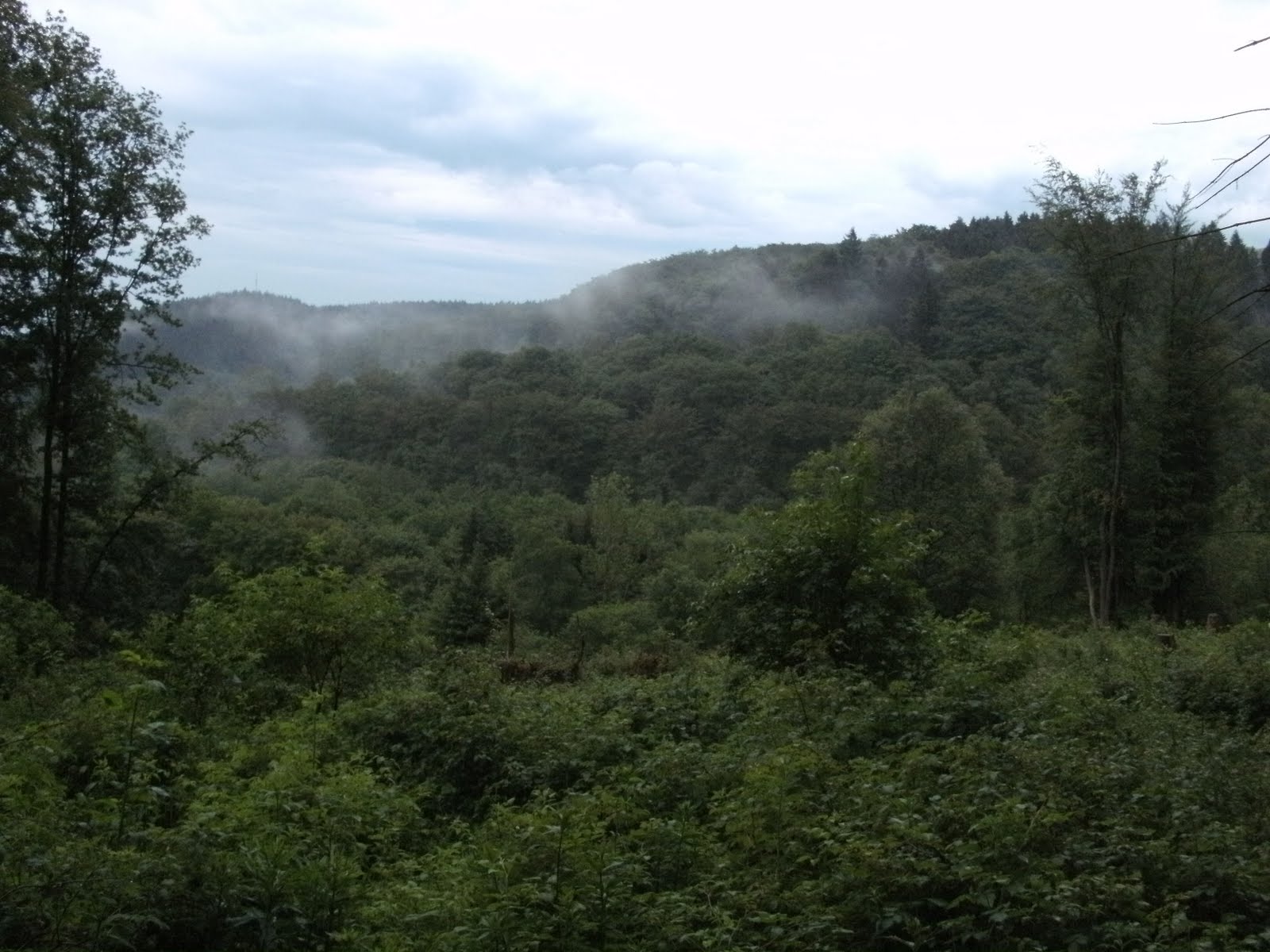
Those beloved hills of home.
And my beloved mud beast. I actually owe this bike a lot. It gets me places, it is a great and fun alternative to a car, it gets me airborne and gets me earthed back to my spiritual roots. It makes me feel alive. Riding bikes and blacksmithing has always been a part of my life, and I hope it will continue to be this way.

Another Foraging Hike near my home

 I recently set out for another walk to bring in some holly blossom primarily, and to just smell the roses.

First, I went to the bank;-). Same place, same tin cans, 2,00 € for free.
 I spare you the details, for it was the same old trail I have unnerved you with so many times;-). Brought in this bag of holly blossom (Sambucus Nigra, Holunder in German). I really love to make syrup from them. This year I have the notion they are even more aromatic than the years before.

Take the holly blossom, remove the leaves and clean them thoroughly. Put them in a wide glass, and cover with white refined sugar. Add slices of one lemon with the peel on (must be non-toxic;-)). Add another layer of holly, cover with sugar, cover with orange slices, cover with sugar, add holly blossom and so on. The last layer should be sugar, and thicker as usual for as to keep the oxygene off.
Let it rest for three days. Strain the mass and warm to 75 degrees Celsius.
Thoroughly desinfect a vacuum glass and warm it by pouring boiling water in. (Remove the water;-)). Put the syrup in while it´s still hot, put the lid on and fill it up to the brim. Put the glass upside down to cool.
 You can also add one layer of sweet woodruff, tastes even more delicious. Drink it with soda and ice in summer, it makes for a great delicious drink!

If you use pectinous sugar, you can make a gelée from it, which is absolutely great on white bread with butter.

You can add one handful of raisins to the strained syrup, heat it to 75 degrees, let it cool ´til 37 degrees, and add brewery yarm to it. Put it in bottles with a fermentation valve on (you can use a childrens balloon or even a condom, too, fix it with a zip - tie around the bottle´s neck). Let it rest for three weeks in a dark place, put the bottles in sand while the mead ferments. Then fill the mead in clean bottles, and put a cork in, which you can seal with beeswax. The dried blossoms are good against the cold and bronchitis, when drank in a tea mixture, too.

And, good against witches, I am afraid...;-)

Came across this plant, too. It´s achillea millefolium, common yarrow (Schafgarbe in German). It´s good against digestive problems and colics, and menstrual problems too.

Oh yes, and I have heard it tell, it might be good against witches. Did not help against me, somehow...;-). Got some for tea and a Theriak herbal tonicum.
The sun was sinking, as I went home, and it was quite the otherworldly experience.... It was all misty, for it had rained beforehand.

Samstag, 4. Juni 2011

How do you spell catastrophe-how the knife of Mr. Rothenberg was born...

 Last week I had my first forging tutorial on schedule. Mr. Rothenberg came around to forge his first custom knife. We agreed on file steel, and a wooden handle made to fit his hand. At first he wanted a "groot" upswept skinner point, but we discussed it and agreed on a drop point for its versatility. We started at 10 a m, and did fairly well. Then something extremely weird happened. I had the file steel precisely at forging temperature, when my student hit it with a hammer, and it just exploded as if we drove Borax out of a damascus! This was just the first of many events soon to follow. It started to rain, but no harm done. Thunder groaned above, and lightning flashed. Still no harm done, I love that. I find it adds scenery;-). Finished forging
just before lunchtime. I wanted to do a bronze bolster. heated the bronze, quenched it to be able to cold-work it with a chisel, all business as usual, eh? Not. Seems it was powdermetallurgic bronze from a bearing. It went all boom and lay there in shards.Even the drilling machine with a HSS cobalt drill fitted would not drill it. So I called it a day, told my student it was things going all off the path and offered to forge a scroll for a bolster. So far, so good. So WHAT? Made it, first one broke. Second one: Broke. Third one, worked. Made a steel plate to rivet the tang against, and fitted the handle (some aged oak from the beams of my old home). We did a quick burning fit. Then I quenched and heat - treated the blade. During the process, it was raining hard, lightning flashed, and the thunder groaned overhead. Hard to refrain from growling "Thor!", I can tell you...;-) I heat treated it higher than normal and longer to make for more elasticity, for it should be a backwoods knife.


Then we tested the blade. I let it fall, tip first, on a concrete floor. Carved annealed steel and spring steel with it. Everything fine. Slammed it, broad side up, across a round piece of wood. Did the same on the anvil. Everything fine. It was only just when I tried to slam it into a round piece of mild steel rod, that the tip fell off.

So I sent Mr. Rothenberg  to lunch, for I guaranteed him a serviceable blade after the workshop. While he was eating, I forged the blade anew after the outlines of the old one and made the fittings and handle to ... er ... fit?;-). When he returned, I heat treated the blade even more conservatively. After an even more severe test, we mounted the handle with dual compound glue, and filed it with a rasp and file to fit his hand, doing it nice and slow.

I sincerely apologized for all the mess, but sometimes it´s the thrill of solving the problems that make out the character of a work. We still have to put a razor edge to it, and will do it in "my other museum";-) with a belt grinder. As is, it cuts, but not too well. Mr. Rothenberg liked it nonetheless, which I am very glad of! It was fun to work with him, even if many things (he were not responsible for) were not ideal at all.

I learned a lot on this afternoon. First and foremostly, I will not offer to make a complete knife on one day, except viking style scroll knifes, bush knives or other all - metal designs. I will prepare some stock to simplify the process. And I´ll call it a day when it starts to rain cats and dogs and dinosaurs...;-).

Children´s Birthday parties at the smithy with Volker, Michael, and Daniel

 So, some two weeks ago, I went to the smithy again, for there was work to be done;-). Daniel dropped by, too, and helped out, too. I really like this: Daniel is 17 years old, Michael an Volker are in their sixties, I am a mid-thirty guy, and we all work together without so much of any ado whatsoever. The kids had fun, too, as you can easily see! This is Daniel doing the finish on a miniature horseshoe.
 Michael at the forge... need I make many words? Those two know their trade. Sometimes (and on that day especially), things go awry a bit, but that does not keep them from successfully making kids happy and fascinated, and that´s what it´s all about in my book. They just keep the fire burning!;-)
 That´s quite some work bench, eh? Not many smiths have an old cocktail table for a tool bench, I guess;-):
 The girls wanted to have fun, too;-). Michael is forging
 one of the kids´favourites, a snake out of rebar.
 OOOOHHHH, and what might be hidden in the forge for Fimbulmyrk????;-)
 The En-Nep from last time, tempered, engraved with a chisel, and drilled for scales...
Did I mention I messed up the drilling on this one? I messed up the drilling on this one. Did I mention...;-) Anyway, no harm done, really, it´s just for myself to try and test it out, and there will be some scales to go over the mess...;-)

Another foraging stroll

Two weeks ago I went for another stroll after work. I just took the bus, had a coffee at an old smithy that now´s a restaurant, damnit;-) and a piece of cake, and then went into the woods to make for the long way home. In the woods there are many ancient crap deposits of the farms over there, and look, what I found: Those are railroad bolts of a high carbon content, aproximately 0,75 % after the spark analysis.


 I take this to be a feather from an Eurasian Jay, but might be mistaken... I took it behind my hatband, for I like the colours very much!
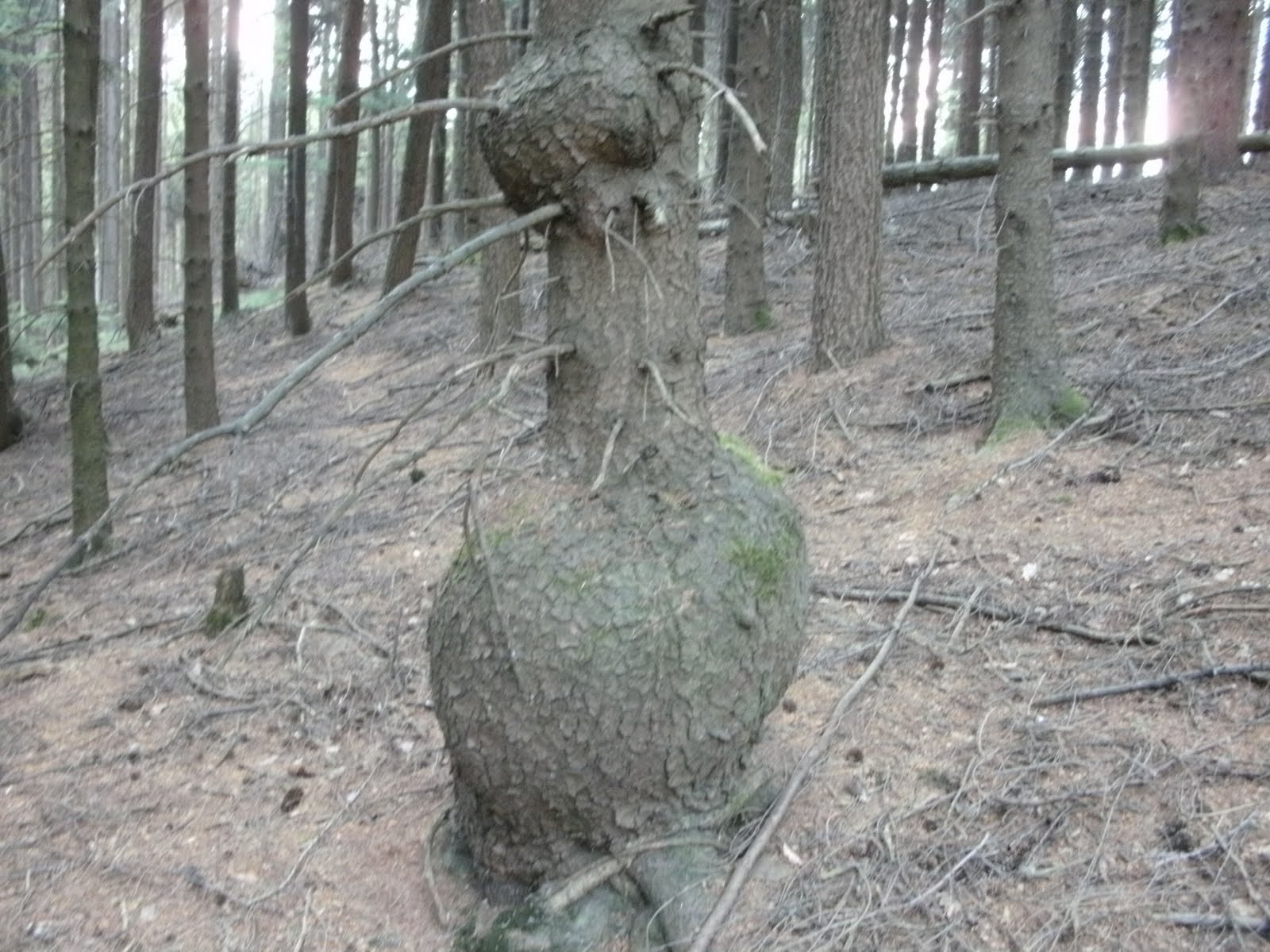
 TANK BURRRRRLLLL!!!!!;-) Now that´s a burl, is it?
 European larch hips. Taste great, have a very high content of Vitamin C, and, if you pour honey and schnapps over ém, make for an interesting drink that´s good against the cough and the cold...;-).
In another deposit I found this railroad bolt, some C 75 content, too. How they come to be disposed of there I can´t tell, but I do not complain any;-). 

Oh, and greater plantain (spergula mersonii, in German: Breitwegerich). Makes for a great herb against bronchitis, as an antiseptic in wound treatment, you can eat it in a salad (did that!;-)), and got some common plantain (plantago officinalis, in German: Spitzwegerich), too. This last herb is even better against bronchitis. I use the sap and cook it with honey, add thyme and salvia and some gin to preserve it and dissolve the etherical oil of the plant.

Once again I came home with quite a loot! Sometimes I am not quite sure if it might be just the hunt;-)

Beliebte Posts