Posts mit dem Label crucible steel werden angezeigt. Alle Posts anzeigen

Mittwoch, 9. Januar 2019

A new concept knife for myself....

 Alas, long time, no post again. Not because I had nothing to say or nothing to do, in the contrast... This is one of my latest and most time - consuming projects. On a dark new moon´s (sickle moon´s night, to be exact) I wandered home from a visit at my old mother´s and found a  tiny piece of ancient chisel... enough to make this "Jagdnicker" style knife from it. I like the idea of the Drudenmesser (http://www.fuhrmannsmesser.de/html/drudenmesser.html) an apotropaic style of knife that was common in the Alpine regions of Germany, Austria, Switzerland and Northern Italy. It served the purpose as a ritual knife to ward off the "Drud", a mythological figure in folk lore which was sometimes a human witch and sometimes a "night-mare", in the sense of the word. Only that the witch is me and the apotropaion I really need has to work against a very special kind of nightmare-some human beings. And I am NOT talking about necessarily sticking a pointy object into other people, not at all, to be precise. But having been a subject of mobbing, deadbashing and other totally socially acceptable demeanour by my fellow human beings has made me feel more at home in moonlit woods than in the neonlight of cities. Humans, generally speaking, are this planet´s nightmare. So the concept is situated in my local mythology. How would the apotropaic knife of the fair folk in my local mythology look like, I ask?   
 The owl is a nocturnal creature, swift and silent, as are the Dhiudha na nIamparai...
 And the fox is a psychopomp in their spirituality. Dhiudha who practice spiritual exercise (magic) and a special kind of "magical" martial art are called "*vautiskibareannai" (borne by the fox/vixen) in the Dhiudha language round these parts... sorry for the blurry pics...


 The fox is an ambiguous creature, sometimes cuddly, sometimes cruel, but always wild and striding in the night.
The knife is selectively tempered. I estimate the hardness of the edge to about 58 HRC. Handle is stag antler (flea market find). Blade length is 100 mm, tapering from 4-2 mm. The grind is a convex bevel, 1mm abovethe edge it is 0,3mm thick. The steel offers a very fine grain and a structure of refined steel or crucible damascus (Wootz). It will be in for a buttcap and sheath now... Mine, all mine... :-P

Mittwoch, 14. Juni 2017

WIP - collaboration through the times

 There´s a lot of stuff going on these days, and I find little time to forge or make anything for myself... but still I fit in whatever I can, when I can. This is the knife from the last post. I reworked the carving a tiny bit and tried out something new.
The carving has been stained in a coffee/tea/onion peels concoction and dyed in dragonblood varnish. the white area had been coated in beeswax beforehand and was polished afterwards. So far I am content with the outcome, even if there´s still alot of polishing to be done. I´ll keep you posted! ;-) I threaten! ;-)

Mittwoch, 22. Februar 2017

On the bench and no philosophy-promise;-)!

These are my current projects for a change. Above there´s a knife project I really like these days. I have done  a lot of research on German knife culture recently. I like studying different bladesmithing cultures but found I knew too little about our own traditions. Plus, I like the German hunting knife, the so - called "Jagdnicker" as an all round companion for the woods- simply out of practical reasons. It has been a design that has been around for centuries and used for bushcraft and hunting chores as long as it has evolved. I plan on writing something about this style of knife soon. In the meantime you can have a look at my pinterest pinboard : German knife culture, where I put together everything I found concerning the topic.

Anyway, the Jagdnicker is made from an old lathe chisel I found in the woods, presumeably HSS or refined steel. Handle will be Sambar stag. The blade is 95mm long, and 6mm at the base with a convex bevel and a selective temper.  
Below is the bushcraft knife that has been around for quite a while. Wootz with elk antler scales fitted with mosaic pins. The quench line shows quite nicely. The blade is 115 mmx5mm and has a balance point on the index finger.
I also made some file work for the tang... I like it and it´s now waiting for a sheath.
More details on the Jagdnicker design.
As is, I look forward to those two knives, and I will keep you posted!

Mittwoch, 1. Februar 2017

On the bench-bushcraft knife from magical sorcery crucible steel

 I just finished the etch and polish on the bushcraft knife that will be my very own, and... tadaah, Chrismas;-)...this came out:
The blade shows a very fine structure similar to Wootz patterns. Not only does it contain tungsten or stuff (spark analysis), but it also shows these beautiful curling patterns I like so much...

Messed up the original scales, so I think it will get some elk or stag antler scales, maybe with red G-10 liners.

Blade is 115x4mm with a high convex bevel and a tapered tang with filework. Balance point with scale will hopefully end up on the index finger.

I´ll keep you posted....

Donnerstag, 26. Januar 2017

On the bench...

These are some current projects I am working on. On top is the "hobbit day knife", an EDC and snack knife from file steel and rebar. Below is a crucible steel (with a wootz-like pattern) snack and bushcraft knife. Next below is the tanto from magical stainless sorcery crucible patterned steel which now has assumed a mirror polish, as has the lowest in line, which will become my new personal carry bushcraft knife. It´s going real slow at the moment, for I can´t use the shop extensively and on top of all the regular madness my mother is severely ill at the moment and I have to tend to her. But I try to fit in some time and I actually appreciate taking my time. That way it was possible to do my first mirror polishes in years! ;-)

As I threatened before: I will keep you posted!

Donnerstag, 25. August 2016

New sheath for Úlenklawe

 Here it is... I made a new sheath for Úlenkláwe, my "black handled knife". It is a dangler sheath to date, but may get some more attachments to be worn like a sgian achlais.
3 mm vegetable tanned leather, hardened with a mixture of dragon´s blood, alcohol, beeswax and resin, yet to be hot-waxed. It is wet-formed around the knife and keeps it in with a snap. I´ll keep you posted!

Mittwoch, 11. Mai 2016

OTB-new project knife

 This my latest conceptual work. I found another chisel in the woods, and on the detour, I met a fox in the moonlight... so I came up with an idea for a byknife for Úlenklawe named Maandevos (Monn-Fox)
The chisel had a carbon content of...yeah... that´s not that easy to say... for it contains a lot of Tungsten. I can tell you: Forging was not exactly easy. It´s a fully integral design that shall be engraved and inlaid... but engraving proves to be a bit arduous...;-) even if it is thoroughly annealed now...
I am a bit proud of my forging... seems I got something right.:-)

Donnerstag, 10. März 2016

On the bench...

Just a quick follow-up, because I am short of time these days, and I want to notify you I am still alive;-). Lotsa projects going on....

From left to right: A flower pot heart from mild steel, bushcraft whittler from train wagon leaf spring steel, hiking and snack knife from Zwissler Damascus, tank cannon and 100Cr6, heart for the flower pot, Bush Puukko from crucible steel, a longer camp knife from crucible steel and another heart pendant.

I keep you posted!

Freitag, 5. Februar 2016

Baltic / Slavic all-metal knife

This is a knife I recently forged that was a bit inspired by the Biskupin find from the 7th century. No file work yet, and it´s still waiting for a grind, and it is a bit longer than the original at some 100mm blade length, but I must admit I simply love those double scrolls. It is made from crucible steel I found in the woods and tempered selectively. Might be I will do it a bit less authentic and go for some scales, but we´ll see. As is, the all-metal design would make for a discreet carry. The balance is a bit awkward for me due to the weight distribution towards the rear, but we´ll see.

Some thoughts on the Sica

Now this is the blade I featured some time ago, a not-so-authentic version of the Daco-/Gallo-/ Roman sica knife. Arguably not so authentic is the semi-integral bolster, but I simply love it. But then there are sicae and other knife shapes found from the Roman empire or from Celtic and Iberian finds, e.g. a Sica from Botorrita, with a short socket where the handle was fitted into, just like with some modern-day gouges, so the look might be excuseable even for reenactors;-). The reason why there are no semi-integrals found (at least not with these relatively simple knives) and even full-tang knives are relatively scarce (abundant only in Roman and Celtic countries, with the exception of iron age seaxes in Germanic culture, that presumeably had an Eastern provenience, another interesting topic), is that iron, and even more so, steel, was costly and was obtained at great pains. It tells a big story that in ancient Rome full-tang knives were quite common.

This one, however, does not at all claim to be a detailed reconstruction. It is made from an ancient chisel I found in the woods and shows a very weird spark analysis, might be Tungsten-alloyed steel such as HSS. The Sicae (or Kopis) knives I have made so far were not having that much an offset in the blade, and I thought to give it a try to test out the extreme. I have, for now, put a piece of antler on it to check out the balance while I contemplate what buttcap to fit. Balance point should be on the index finger.

Having played with it I must say that for everyday tasks such as cutting meat and slicing onions you have to think along a different train of thought. The blade gives you fierce cutting ability with a good purchase when you use it in a drawing motion, as you do with a sickle, so to say. The forward orientation of the tip gives you the possibility for a more pushing motion in a pressure cut. The shape of the blade really shines in two aspects: Woodcarving and slashing. The blade is ideal for delicate woodcarving in my book. I also tested the chopping prowess and again had to apply a different mindset. It will not work when you use the same motion as with a straight, say, drop-point knife. Is it less capable then? Not in the least, because when you use a straighter knife shape, you always have to adapt to the natural arcing motion of your wrist. With a Sica you have to keep in mind that this is not necessary. You can chop softer wood with a slashing motion by keeping your hand where it is and your wrist tight. Of course, it is no Khukhuri, but I was amazed.

The Sica in ancient Rome had a somewhat sinister reputation as the preferred weapon of back-alley cut-throats, and, having handled it, I can relate to that. It would also make a very effective fighting knife, if you knew how to handle it. The tip is always forward, and the sickle shape makes for amazing slashing capability. What fascinates me with this, is that the blade´s shape is most ancient and dates back to the earliest bronze age. And it actually follows a whiplash line, and I can´t tell it any other way, also feels "whippy". The "sweet spot" or "purchase spot" lies along the line of a Golden Ratio spiral, and, while there are always some liberties taken if you apply static geometry to a dynamic process, I strongly suspect that this has something to do with the "springy" feeling when  slashing. By the way, if you analyse the ideal curve of the application of force in some martial arts, you also get the impression of a similar dynamic (whiplash line e.g. in Qi-Gong). Of course, yeah, I admit it, I am a bit obsessed with that whiplash line thing, and might be I see spectres everywhere, but I can´t think of a better model for explaining it, and it works for me in martial arts and even mountainbiking, so, hey, I don´t get paid for this;-), so I can cook up any theory I´d like.

The culprit is, it was a great experience again to actually be able to do some work with a most ancient blade form. You can talk about endlessly about who has written what about it and when, but only if you rebuild it and use it will you be able to understand, and the enlightening effect feels that good I think I am getting addicted to it.;-)

When the knife is ready, I guess it deserves a "name" and a story, and I will see how it fares in the woods... watch this space!

Oh the loot! ;-) Or: The adventure of steel processing

I went foraging for steel again in my local woods, and was stunned to find a treasure hoard again. As you say-one man´s trash is another one´s treasure. In this case it applies in the truest sense of the word. A lot of the steel I keep finding there is ancient crucible or extremely high carbon tool steel or saw steel. I found a chisel with a kind of octagonal shape, and having already processed one of those, I strongly suspect it is made of a very funny kind of steel. Spark analysis on the Sica blade showed dark-red, almost invisible sparks-but with bright-white sparks at the end, and, compared to file and spring steel, very funny shapes. Fact is, I can´t make heads nor tails out of it. Might be Tungsten in it or any such like, but what matters most to me is that the blade I forged from it keeps to a good temper with a very fine grain and a high amount of flexibility. So I look forward to the next.

Yeah, I know. I might not be that good with metallurgical theory. I make knives that have to work, and if I want to work with stainless or other stuff I should know my theory better. Yeah, I know, but DO I? Do I have to?

I have to admit that a lot of my tempering is done very intuitively. Of course, sometimes I get it wrong and have to do it all over again or worse yet, the knife breaks when testing. But, honestly, the last time I broke a knife is 3 years ago, and I have made a lot of them in the meantime, and the times when I get it wrong (with steel utterly unknown to me) I can count on three fingers.

I do not want to brag about my oh-so-extraterrestrial capabilities in bladesmithing, because I am not that good. What I want to say is, that it is possible. I forged a blade out of 440C intuitively and it stood up to some severe pounding while keeping an edge well. I daresay that´s what it´s all about. To be honest, I thrive on the adventure. There is something very archaic about bladesmithing and I find it more intelligible when you do it intuitively. It is like getting to know the NAME of iron. Not just the word, but what it really means, if that makes any sense. It is like I can tell you the word blue, but you have to feel it to know the blue sky on a warm summer´s day.

Patrick Rothfuss in his novel "The Wise Man´s Fear" (which I strongly recommend!) tells the story of a teacher of the arcane teaching "names". Not what we commonly think, but the actual names, not the sign, but the meaning, if you get my erm... meaning;-). He states that he will throw a stone at a given time with a given force and asks his pupils to calculate where the stone will fall down. Several well- educated people then start to make calculations, drawing diagrams and the like. When time is out, the teacher just opens the door and calls on a messenger boy, and without further notice, throws the stone. and the boy catches it on an instinct.

I know a lot of accomplished blade- and blacksmiths who make great knives, strictly according to the book of rules. Some make very durable knives, but some don´t.

And then I know several old Russian blacksmiths. One of them even could up until recently not read the newspaper or write his own name. He uses scrap steel, even rebar for his knives, and they are standing up to an abnormal degree of abuse with amazing edge-holding capacity. Viktor used rebar, too, and mild steel, and scrap and junk steel to amazing effect, too. They taught me one thing: That there IS the name of iron. You could put a piece of rust-pitted steel into their hands, and just by touching it they knew what to do. When asked, they failed to give a satisfying answer and just said that it had to be that way. Mielenko knew his numbers well, but was capable to tell the carbon content by the sound the steel made on the anvil, by weight and resistance alone. None of his knives, he told me, has ever failed.

I am a poet. A lunatic, if you so will, beloved of the moon. I tell a lot of crazy tales. Only on a secondary level am I a blacksmith, bladesmith or even bushcrafter. Might be it is like a kid once told me that in a different world or different time I´d be called a wizard. I like that, of course, but we live in 2016, and the world's not at all a place for wizards or warriors or even blacksmiths.

I have been on this path for a long, long time now. I know the wind and what lies therein. I know the sun and the moon and the stars and I love them. I love the earth and the trees. I listen to creeks and the murmur of the wind in the "soft, round tops of the pines and firs". They tell me of another world, a world of meaning, without signs, but names to be learned.

And with each piece of iron I find in the woods, I tell a new story, and learn the name of iron and fire. My knives are always more than just a blade and a "been there, done that", at least to me. It is not just a thing you covet and because you can´t afford it, you make it yourself. Their names are an armour I wear in the everyday mayhem of our world, even if their blades lie in my drawers. They are the gift of the woods, tormented by man and crooked and weird and powerful. Beyond the dream road through the wood of steel - lord of the forest makes love to his goddess; beautiful is the image of the moon in the water (to corrupt this famous Bujinkan meme;-)).

Every time when I go foraging for steel then, it is a kind of spiritual experience. It is an initiation as well as a lesson in humility. When you find, you find. If not, you find not. But if you do it according to the meaning of it all, chance is, you will find a treasure.

Mittwoch, 25. November 2015

Progress on my En - Nep

 So, this is the En - Nep I started some time ago. Made from ancient (150years+) leaf spring I found in the woods, 10,4 cm long, 4mm thick.
 The layout is drawn along a whiplash line making it very whippy indeed in chopping and, together with the recurve edge line, makes for a very slicey blade in spite of the thickness.
 The balance point is on the index finger. It feels very light and dexterous and point-centered.
 Theoretically you could whirl it around your index finger. I tried;-).
The blade tapers towards the tip. Scales, by the way, are elk antler, fitted with mosaic pins. The bevel is a high convex one, and the temper is---selective of course.

Donnerstag, 10. September 2015

Finds from the master cutlers of Yore

Just a short bimble away from my home there is a garbage treasure trove, and there is not one hike I return from without a bag full of treasure. This time it was particularily stunning. I found a whetstone of exactly the right grain, and three ingots of crucible steel. I have yet to learn how to process it, but you can bet on it-I will learn. I have enough now to start experimenting with it.

For a history of the steel finds and cutlery, look here.

New bushcraft whittler in the making

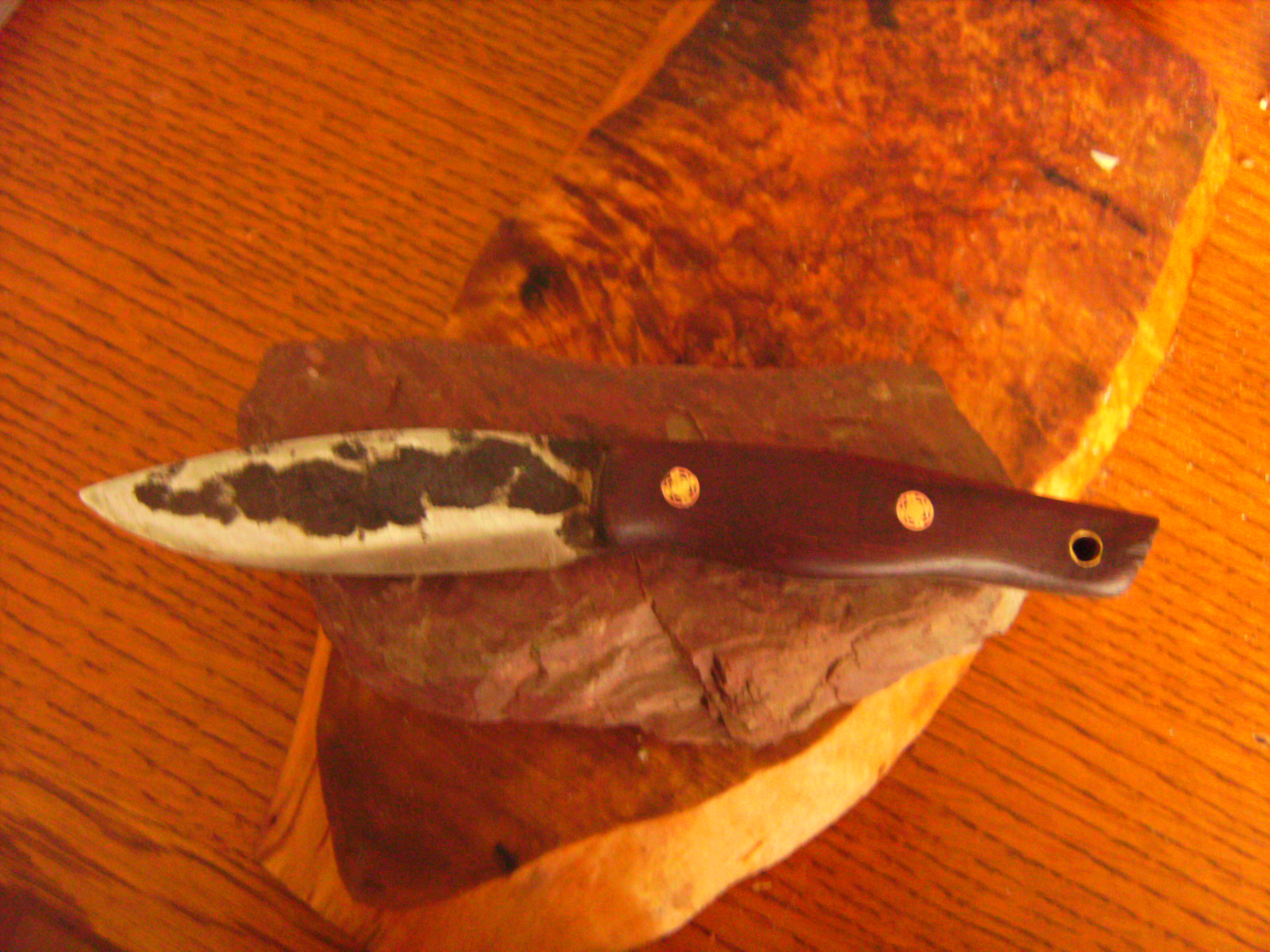
 So far - so good, this is the new whittler for the woods. It´s made from ancient (150years plus) leaf spring steel I found in the woods, and bog oak from a coalmine in the Muttental, Witten, an ancient coalmining area. It has a rich burgundy colour due to lying submerged in water which was rich with iron oxide for more than a hundred years. I put it together with mosaic pins and a lanyard hole. The blade is 90x3,8mm with a selective temper, the hardness is about 58 HRC. It has a high convex bevel. The balance point is right on the index finger, making for a light and lively knife in your hand. The handle is a bit short, but I had to compromise this, because it shall ride in a pocket via clipper sheath.
Still a lot of polishing work and then it´s off for the etch.

Hope that brings out the pattern of the steel...;-) my other knives from this steel show a strange scaly pattern. I find it more interesting if a blade has a bit of a structure.

That little monster will get a clipper sheath to ride in a pocket or on the waistband of some baggy, comfy pants I love for being in the woods.

I find it fascinating to go to the edges (pun intended;-)) of knife design, and in this case it is experimenting with the relation between lightness, comfortable carrying and serviceable length. The knife certainly is not a big chopper, but is designed to be a little-everyday-task and whittling knife and a companion knife for a set.

Dienstag, 18. August 2015

New bushcraft knife from salvaged steel and wood

 This is a new knife project that is almost entirely courtesy of the woods and the deep earth; it is forged out of ancient spring steel with a carbon content of roundabout 0,75-0,9%, and presumeably nothing else. How funny this is if you are accustomed to modern spring steel with its relatively coarse (yet normally fine enough) grain, is illustrated by the story of its making. When I first tempered the blade I treated it quite conservatively, as I always do. If you don´t overdo it, it´s even better for the blade if you quench and normalize it one time more. It turned out soft, or so I thought. Knives from this old steel always tend to feel fluffy while they actually are not. Okay, I thought, there´s enough carbon in it, so I lost a bit of a patience and treated it like "bam", not quite gently. Culprit is, it was too brittle, so when I tested it, the tip broke off. It then sat in my drawer for a while until I thought, well, there´s still enough of it left, make it work.
At a recent hammer - In at Kai´s (by the way, thank you again, bro!), I reworked the blade and did some heating the blade. I simply wrapped a wet rug around the handle and heated the blade until it showed a golden hue. Then I ground the edge line and spine line down a bit and redid the edge bevel, and here it comes.
Blurry pic, I know... but you can see there´s a hollow forged in for balance. The blade now comes in at 90 mm. The handle is made from ancient bog oak from an ancient mine in the Muttental and is some 150 years old, put on with modern mosaic pins. The steel is approximately 100 years old. I like the fact that all materials were given by the woods and earth which will be its natural habitat.

I will make a clipper sheath for it, and it´ll be ready to rumble...;-)

Freitag, 25. Juli 2014

Carving on Úlenfang done-for the most part, that is...


So, I did the carving of an owl ornament I wanted to do on Úlenfang´s reindeer antler handle. Fitted some mosaic pins, too, for eyes. I am not too fond of the outcome, especially when I compare it to the magic troll´s art, but then I have never said I am an artisan, did I ;-)?

But it grows on me, and I have to refine it some, still, and there will be some runes added. The eyes give  a bit of a mad expression to the owl... and this suits me*ggg*. Overall, I love the knife´s balance and rock-solid feel. It just falls into your palm and fits snugly there. The carving gives you a good orientation in darkness. The blade (ancient crucible steel I found in the woods) cuts and slashes extremely well, and this steel gives a very, very fine edge with hair-splitting sharpness to be achieved. The Kopis shape makes it also very able for woodworking tasks. I guess I will forge another;-)...

Montag, 26. Mai 2014

Úlenfang es baren;-)-úlenfang is born

 Nu es et sao wiet: De Úlenfang es baren. Un ek hebb lang simulaiert, bu ek dat dingen namen sull. Was et béo-chaoineadh? Ne, dat kan ik nümmes utspreken, met dise snaaksche spraoke Gälsch, un denne maakt de Wickerske;-) wider ökel van mi.. Sao bin ek to de sprake van mine hiäme kommen un nenn dat dingen nu Úlenfang. Nu kan man fraogen, bat dat allt sull, un seggen: Bat dem ein sine Úl es dem annern sine nachtegall. Hat dat aber allt auk en vordel: Goldemaar het mik dat eisen gebben un kan mik darbi auk verstaon;-), un dan kan hiä auk op platt den Namn verstaon.

Un borümmes de Úle? Kan ik iu ein döneken vertellen. Als ik nu latse mandag in steingarten was om mid de bekloppten dat Flitzepeed - Training te maken, hebb ik de Uhu saien in de wand, un hiät hiä ein bussard in de klaven! Un ik will ennit un nümmes kenn mid deze klaven maken... un de kneip es en dorstig lemmel, sao vil kann ek seggen. Maot ik nog ne Úl binnen tellichen, dann es et daon.

Translation: Now it´s done: Úlenfang is born. And long have I thought how I should name that thingy. Was it béo chaoineadh? Now, that, I cannot pronounce, with this funny language Gaelic;-), and then the magic trolll will make fun of me again;-). Thus I took the language of my home and have taken to call it Úlenfang (Owl´s fang). Now you ask, what the fuss is about that name, and say: One man´s owl is the other´s nightingale. But there´s one advantage (in the bargain): Goldemar had given me the iron, and while he can understand me ;-), now he can understand the language, too.

And why the owl? There is a story. When I was at the rock garden last Monday, I saw the eagle owl nesting there, and it had a bussard in its claws! And while I would not want to make any further acquaintance with these claws, this knive has a thirsty blade, that much I can safely say (it already cut me twice..). Now I still have to do the owl carving in the handle, and it is done.

Note: This is the language native to my homeland, which dates back to the old saxon language and is still spoken in many villages of the Sauerland region. By the way, the "Sauer" in the name has nothing to do with being sour, but with *Dhiudha, Theudo->People, reduced to "Siuer- / Suer - land", i.e. the "land of the people". Some have the theory that by the "people" the "niflungar" / "Nibelungen" are meant, the "little folk" native of the region, dwarfs and elves of a very ambivalent character. There are many tales giving them credit as skilled and stealthy helpers of blacksmiths, but also warning of the imminent danger in having contact with them. If you have ever stood atop a Sauerland mountain after the rain and you see the mists arise from the green hills around you, you can feel their presence still. They live in the deep woods, their plants are oak, holly and yew, deer and fox and hare, owl and raven do not shun their step.

Concerning the language again, if you look closely you will notice many similarities to modern English, and the similarities are even more obvious when you compare it to Anglo - Saxon (the language e.g. of the Béowulf epic poem of the early medieval ages). vertellen->to tell maaken->to make was->was and so forth. It also shares many characteristics with the Dutch language.

Now to business: Blade is ancient crucible steel I found in the woods, as you can see it shows a pattern and a strange hamón. Blade is 12 cm long and has a distal taper from 8 mm to the tip.
 The tang is riveted against a flower out of mokume gane that has to be polished and etched still. When I filed it, file dust gathered in the epoxy leftover around the tang, and, following an impulse, I put some more on.
Here you can see the taper of the blade. The handle is reindeer antler.

It´s still a work in progress, and I am taking my time with it. It has a kind of spiritual aspect as well making it. It is for me as well as for the Niflungar, for I have changed sides long ago;-).

Freitag, 22. November 2013

On the bench - a variety of ancient crucible steel blades and some thoughts on steel and mythology

 I have altogether too much projects going on to date, but I am always afraid I will not be able to use the smithy in winter, so, better too much lying around than nothing at all. This is a most current project I am very fond of. I forged this "Iscian" knife on Samhain eve out of steel I found in the woods. The pattern does not show yet, but I guess it´s a very high carbon steel at least, maybe Pulad. I found this ingot in the woods near my home, and it was very hard to process. It had to be forged at a temperature of about 950 degrees Celsius, give or take 20-50 degrees, and you had to go very light on it. So it was a light hammer and much patience that even made the material for this blade. But it paid off. This blade sings, I can´t tell it any other way. I edge - quenched it with a very conservative tempering, and still the edge has an estimated hardness of 62 HRC, while remaining springy enough to emanate a faint ringing sound even when you just take it up. In bad fantasy novels swords sound like that;-). I love that.
 I forged a double scroll that did not quite turn out too well, but I guess, you still need room for improvement;-).
 I have to work on the grind still. The blade is still thicker towards the tip. As is, I will either fit yew, blackthorn, stag or bog oak scales to it, and I am thinking of inlaying three thorns of blackthorn into the handle... but we´ll see.
 Out of the same steel I have forged a set of knives which I find ideal as a backwoods kit. Top to bottom: Nessmuk, 115 mm long blade, Kopis, 160 mm long, and a whittling knife with a 90 mm blade.
 Top: Spine thickness at 4 mm.
 The Kopis has a thickness with a taper from 6 mm at the handle to 2 mm at the tip.
 The whittling knife is rather thin at 3mm.
 Below the knife blade you can see some of the material, and if you look closely, you can see a certain structure or even layers in it.
Like this, see? I know, I can rant on endlessly about steel and carbon contents. This ingot has an estimated carbon content of about 1,3%, which made it difficult to forge at best. I look forward to these knives, and is a very intense experience. The objects made from this steel emanate a strange energy. It is an almost mystical experience finding and seeking this material in the backwoods, cleaning and processing it and turning the scrap metal into a knife that is more than just a tool or even an object of the arts. It is like telling and living a story, and is more than just metallurgy. I find it very hard to explain, but the singing of that Iscian on top of this post is more than just a result of the quenching and tempering process. It is a violent song that the trees have found for the torture of the woods, for the pollution and waste that has been done to the forest. It is not altogether a positve energy. It is dark and vibrant like the dark side of the woods, like death and decay and the opening of gates better left alone. But open they do, and Samhain is the very essence of this. This Iscian will be the "opener of the gates", the guardian at the gate of the turning wheel.

But, mythology set aside, I hope that these knives, or rather objects, will be poetry for me in the years to come, and they have opened up a new path for me. Not the path of the sword, which I always believed I was on, but that of a more sublime symbol.

"Knife, and chain, and bow- cauldron, speech and goblet, too. Staff and jewel, ring and mask."

And I look forward to complete them this winter.;-)

Beliebte Posts