Posts mit dem Label Knifemaking Tribal Smithing Bushcraft Survival werden angezeigt. Alle Posts anzeigen

Dienstag, 9. Juni 2026

An iron age garment -does it work in the woods?

Some time ago I took out the old sewing kit.  I had this felted wool cloth lying around not doing anything for ages,  and I wanted to save it from the moths.  Also,  I have been pretty intrigued by an iron age garment used by Irish and Scottish woodsmen,  but also widely used in Rome,  Greece and Scythia,  Dacia and across the known world,  as Cuculla,  lending its name also to the Genii Cucullati,  personifications of the Asclepian Digits, and the Flamen Digitalis (according to C.G. Jung). In Eiriks Saga Rauða there is a mentioning of two Irish or Scottish fast runners who were dropped off at the Turtle Island coastline to look for resources.  They had minimal equipment and were clothed with a garment called "kjáfal", a sort of open Poncho,  fastened between the legs with a loop and toggle.  I wanted something between those two concepts,  and obviously will not wear it as only piece of clothing (although it would work) and wanted a bit more warmth,  so I stitched together the sides.  
The garment is really comfortable and offers a lot of freedom of movement,  while providing a lot of warmth. You could wear it in winter as only piece of clothing,  if you stayed active,  and Irish and Scottish scouts were famous for that.  
It offers a great insulation due to the air pocket created by the wide folds.  
Also,  other than a German Wetterfleck or Weather coif,  it doesn't make you thread on the hem. 
Also,  I really do like the Strider or Dhú Síthe vibes... 😜

Need to seam the hem,  and I want to sew in some secret pockets.... 🤪😜


Samstag, 30. Mai 2026

Nice and satisfying carving project: Carving a tea infusor

The other day I came across some wild bamboo that is invasive to Germany,  so out came the pocket knife.  I sawed off a section,  carved off the bark and smoothed out the rings.  With the awl I drilled two holes at the end. 
Next came some holes in the bottom. Take care not to drill too deep.  
Actually,  I did drill some holes into the sides later on, since it works a lot better.  
Then I carved a stick for a handle and to remove the tea from the infusor after use. 
Then I tried it out.  

 I made a Video of the process,  too.  
I hope that you enjoy the project as much as I did,  and I do trust you will best me! 


Take good care! 

Donnerstag, 22. Mai 2025

Another simple carving project: Carving a comfort bird

Recently I stumbled across a really great tutorial on YouTube, by The Maker Experience (Awesome guy, go check him out!) 

And of course I tried it out! It worked a cinch, although I did some of the steps in a different order.  
I made some in hazel and some in cherry, hoping to add a bit of my own flavour to the idea. 
Projects like this are really awesome.  You can accomplish them with a simple Swiss Army knife. 
Have a cuppa, sit in the woods, listen to the birds and whittle away.  
It doesn't need a lot of your time, just a half of an hour is enough for some nice results. 


 You can always do better, as you can see in the picture, and you will make some good progress relatively fast.  

And there is a punchline, of course.  Because, while not on a primary level, making pretty and good things is political. 

Why that, you ask? 

Woodcarving and greenwood work is scientifically proven to be beneficial for your mental health (https://www.churchilltrust.com.au/project/to-investigate-the-mental-health-benefits-of-green-woodworking-in-therapeutic-settings-for-veterans et al). It offers a sense of calm, of self-empowerment, and of achievement.  In a world that floods the zone with horror and bullshit in order to keep you in a state of learned helplessness in order to steal your sovereignity, your dignity and human rights from you, everything that enables your resilience is resistance.  Add to that the soothing effect of being in nature, and it can really help you heal. Try it, you won't regret it. It certainly helps me keep what little sanity I still have, and it never fails to soothe my soul.  

Maybe it can help you, too.  

Take good care, and thanks for dropping by, as always! 😊


Samstag, 6. April 2024

Thoughts on the Trollstein knife


 So I am in a really fascinating process of recreating the Trollstein knife,  a knife that had been found in the glacier melt near Trollsteinen in Norway in March 2023 by Secrets Of The Ice archaeology. 

Now people who know me know that while I have a strong fascination with all things historical and archaeological,  I also want to know how those things worked and whether or not they would still work. I believe in check, check and doublecheck whether a technological Innovation really benefits our everyday- or not. We have been sold a lot of BS (and that is getting worse), nuff said. 

What we have here is a real knife used for a kind of bushcraft we cannot even imagine. For while,  to be quite honest,  for most people including myself,  it might be a leisure activity or maybe even a lifestyle,  they most certainly not even called it any special name at all then, because it was simply life reality in those days. 

In our time we have very specific things we want from a knife. And while it is a good thing we are able just to walk inside a shop and buy the latest tool with a steel of precise specifications, we tend to dismiss anything that the industry doesn't hype. 

The original (see my previous post) is roundabout 1400-1600 years old. You can bet that it saw some pretty hard use before the owner lost the tool,  and it suffered a huge load and immense force and pressure from the ice drift. The tang and handle are bent. That's the damage it suffered. And it is pretty much good to go. Put an edge on it,  and it will cut again. 

We like to put knives to extreme tests and even destruction. That is pretty okay and understandeable. 

The test this knife has been through is the most extreme I could think of and it is neigh on impossible to duplicate it. Not that it would make any sense at all,  but it is a fact.  

Thing is,  if I posted the knife in a lot of bushcraft groups,  I can imagine the kind of arguments that would arise instantly. You know,  "but batoning " and "survival " and "tactical settings". Hard use,  you know. Not that sissy reindeer hunting,  woodcarving,  building traps, butchering and processing firewood and what have you. The knife doesn't even have a full tang,  mind you! 

Fact is,  I have built these two first knives to see what they are capable of. Or better yet,  what I can do with these knives. They are not as close as I would like them to be,  but about as close as I can get without handling and measuring the original. The first one is made from file steel and quite close to the original as far as the blade is concerned and the general shape and layout of the handle  are concerned. On the second I stuck more to the shape of blade and handle cross section,  but added bronze bolster and peening disc and a bit of a finger notch. That blade is made from 80CrV2 with a selective temper,  an awesome steel that I am just coming to terms with. Balance point on both knives is on the index finger. 

Using the knives I can safely say that I cannot say much,  and in the best of ways. Everything simply falls into place. And this is not due to a special achievement on my part. The design simply does everything. It is awesome for food prepping,  cutting meat and Slöjd. No,  it is not the next hyped survival knife. But if you know what you are doing,  it really COULD be a one-tool-option.

It almost certainly was for the hunter who lost it in presumeably the 6th century. That is humbling. 

Donnerstag, 14. März 2024

Review of a Casström Woodsman

Last summer I had ordered a Casström Woodsman bushcraft knife. It being a design by Roger Harrington I had been sneaking around that knife for ages now. I had handled the old version,  which was made from O2 steel, almost a decade ago. Fact is,  I loved it then,  but also did not quite understand the concept. 

When Casström announced that they had launched a new version in Uddeholm Sleipner steel,  I decided to give it another try.  Now Sleipner is quite an interesting steel. http://localhost/en/products/uddeholm-sleipner/ is the spec sheet. More than 50% better resistance to abrasive wear than D2(1.2379), not that I would be too fond of D2,  but still. Also a finer edge possible,  and a lot more positive aspects. The steel is an allen of Iron, Manganese,  Molybdenum,  Silicium,  a wee bit of Chromium and so forth. Technically it is relatively stain resistant,  albeit no stainless steel. 
The blade is 88mm long and offers a rather thick spine at 3,9 mm, with a low slightly convex Scandi bevel. It is therefore possible to do food prep or slicey tasks,  but it is of course not optimal. The edge had a really microscopic microbevel and was able to split a fine hair out of the box. It was possible to shave your beard with it out of the box. The blade also offers a  90° really sharp spine. It is possible to use it for debarking branches or create fine resinwood shavings for fire starting. After almost a year of really hard work all it has needed was a leather strop. 
Rather thick spine,  you see... but it actually does the job of food prepping,  too,  if you cut at an angle. Batoning is obviously a cinch with it. 
The long handle also allows for more leverage when using it for mild chopping tasks. It is made from stabilized birch burr and really beautiful. It comes with a small,  but sturdy lanyard included. 

The sheath is absolutely stunning. When new,  retention was so high it was neigh on impossible to draw the knife,  which is a good thing. The seams are made with sturdy yellow twine,  the welt is good and thick. Even after half a year of wearing,  it still has some crisp to it. 
The belt loop accomodates standard common jeans belts,  but also military issue belts and is stitched and riveted in place. 

 All in all,  the knife does do most tasks exceedingly well. Edge retention is almost otherworldly,  and it gets really frightening sharp.  It really excels at most woodworking tasks involved in bushcraft,  and is also suitable for delicate carving in the woods. 

A classic bushcraft design with mythical edge retention and sharpness. As of today,  it is not exactly cheap. You pay up to 199,00 € , if you want a Firesteel. In my opinion, and you know I do not say that lightly,  I could have saved a lot of money had I bought it earlier. 

Btw,  also available in British bog oak... 😜If you can afford it,  buy one.  

But wait until you read my review on the SFK 10 Forester,  which is coming up soon...😜

Mittwoch, 14. Februar 2024

Carving a bone needle

I had decided to make a neck pouch from the Amadou I recently harvested,  and I thought, well,  why not make it a challenge and make it with stuff procured in the woods. I still had that hare rib, so I decided to make a needle from it. Sourced ethically,  by the way,  taken with permission. 

I drilled the hole first with the awl of my trusty Victorinox Outrider. Take care not to apply too much pressure,  the material cracks easily. 
Carving the sides,  really carefully, I actually reverted to a fine sandstone. Make sure to get rid of all the marrow and to remove all the dents and nicks. 

 Et voilà....bone needle. 


Not sure about the twine,  though. I am not good at that sort of stuff,  so I will maybe just take twine I have. But we will see how it all turns out. Maybe some nettles...we will see. 

Samstag, 15. April 2023

Experiment with Hyourougan

Hyourougan are so - called "hunger pills" in use by the famed Shinobi of ancient Japan. They are actually a military ration for scouts and spies, half power bar and half medication. It is fascinating, because as soon as you manage to leave behind the prejudiced Western view of "Ninja" throwing Shuriken all over the place, a whole world opens up, a lifestyle even, that has to offer a lot for modern day bushcrafters and outdoorspeople. In fact, a lot of the stuff we do is actually quite similar to the Shinobi lore. 

Let me put something straight first, though. I have, while I have received a tiny bit of training in Bujinkan art long ago (three weeks immersion all in), I am not even a beginner in the art, and I do not make any such claims. I have never received any formal training. Recently a Sensei told me that my lifestyle were similar and that I were on the right track with my mindset. This was an honour, that I want to live up to, but he also told me that I am a bit fat and clumsy. And he was right, of course. I am not a Shinobi and I do not want to make such a claim. 

Next thing I have to put into perspective is that these Hyourougan are not cookies. They are an emergency food. There are a lot of different recipes from different schools of Nindo, and this is an educated guess at best, and we modified it according to our understanding, which is based upon more than a decade of learning and transdisciplinary scientific research, but as of today can only be limited. 

Our version of Hyourougan is rather strong and if you take blood thinning medication or have cardic or cardiovascular problems whatsoever, please consult a doctor beforehand. We would you would rather obstain from eating these altogether. We disclaim all liability, and for the same reason we will not offer you precise measurements. Also, the recipe makes for an aphrodisiac, and we also disclaim all liability for any adverse effects caused by this either. Actually I tell you a story for entertainment purposes, or at least I would like you to see it that way. 

That said, it has been quite a journey. I first heard of this food in 1990 and have been fascinated ever since. I dismissed it as a myth and an exaggeration for years, because, well, while I love a good story, the world is full of supposedly top secret martial arts manuals and self-proclaimed masters who learned their art from the last descendant of the family in a hermit's cave near the mountains of Shambhála. But in the early 2000s, I heard of the Bansenshukai, and while it is disputed whether or not it is a fiction, in that case it is an informed one and serves a good purpose in that it can help to question one or the other prejudiced view of the "Ninja". It was there that I first heard of Hyourougan. 

Actually the concept of a food like that, easily transported and high in calories and maybe medicinal properties, is pretty commonplace. From the 1700s hardtack to modern energy bars, from Tolkien 's Cram and Lembas to German "Lebkuchen" and "Panhas", from Black Pudding to Native Turtle Island Pemmiigáan (I hope I got that right) to modern political food substitutes, the examples are legion. I spent years in academic libraries to find out more about it, and I do not regret one minute of all the work. And do not get me wrong - I still have not seen one tenth of it. 

It was with the advent of the Internet and academical online catalogues that I got that bug bad again and realized those "hunger pills" were for real, and that there are several recipes around. Actually I must admit that learning Japanese, as I first intended to in order to be able to read the originals, turned out somewhat of a bummer, because I really had to struggle on top of all the other struggles. Cudos to the magic troll, by the way, who has been at my side all these years and has always supported my weirdness. I sincerely hope that this is mutual. I hope that I live up to the respect and love. 

Actually, not being able to read Japanese lead to us having to heavily rely on secondary sources, and so we had to evaluate the information with our knowledge of plants and their chemistry. Since we do not need to write a literary evaluation or essay, but the whole point was recreating the food in the first, we took several original recipes in order to understand the principle of it. Yes, that is a rather alchemist approach, but well, you are reading the rumblings of the madman Fimbulmyrk in the first. ☺️ 

By doing this, we identified the principle of these rations as follows : Compact, light to carry, very sustaining, and invigorating. This in turn led to an assumption of the following nutrients :Carbohydrates, Proteins, Vitamins, Minerals and contents with antiinflammatory and regenerative properties. 
So, I guess you heard enough mumbo-jumbo for now and are maybe stoked to learn what is in that green goo. ☺️ 

The base is a mixture of glutinous and Yasmin rice, a lot of nettle seeds, a lot of ginger, pepper, turmeric, cinnamon, green tea (Matcha), a sensible lot of Taiga Ginseng, finely ground, mixed with Sake, sesame oil and paste, peanut butter and honey. 

Actually it is important not to overheat the mass, so we just rolled some balls and cookies from it, which we dried at 50°Celsius in the oven for two hours. 

The Japanese sources counsil to take three cookies per day to keep you going in an emergency. 

I tried them, of course, and I found it important to drink enough water with them. Both the Ginseng, the nettle seeds, ginger and turmeric have diuretic properties, so it is important to drink enough water. 

Plus, the ingredients stimulate your sexual energy, if you so will. It is taught in several schools of Meditation how to transform this energy into "power". If you are not capable of doing this consciously (which I can), you will not be able to use the food to its full potential but just be left more or less horny. Also, if you are a woman, it will not work that way. Nettle seeds are then only highly nutritional for you. If you want to try this, you would have to add about double the amount of, say, seeds of the wild carrot. Also no suggestion, by the way, and mentioned exclusively for entertainment purposes. 

The Shinobi also carried a sort of candy, named Suikatsugan, in order to suppress thirst, which might be necessary if you have no water, because the Hyourougan can make you a bit thirsty. 

The next experiment will be making a milder version of Hyourougan, and after that we will try out some Suikatsugan. ☺️ 

Watch this space! 

You can also give our Instagram Account a visit in order to get some Info on new experiments, which will be published here. 

 It is Acweorna_Craft. 


Thank you for your patience and your visit! ❤️ 


Mittwoch, 15. Juni 2022

Salt flask WIP


In the woods I found me a piece of deer shank (taken with permission, of course) and thought I would make me a salt flask. I sawed off the joints with the saw of a Victorinox locksmith SAK. 

I fitted a piece of elm into the bottom, leaving it a tad longer to facilitate carving. Since it was fresh elm, make sure you really have to whack it in (you might want to wrap the bone really tightly with wire or cordage before, because it might split. If you possibly can, use dry wood for the bottom.

Glued it in with pitch glue. Carved a stopper from boxwood with tarred cordage for a seal. Carve a recession into it, fill that with tar, wax or glue and wrap the fibres or cordage around it while the glue is still hot. Let it cool, cutting off the excess cordage or fibres. 

Et voilà. 

Salt flask. ☺️ 

The decoration is made from charred elm bark in kólrosing technique. 

Now off to decorate that bone. ☺️ 


Dienstag, 14. Juni 2022

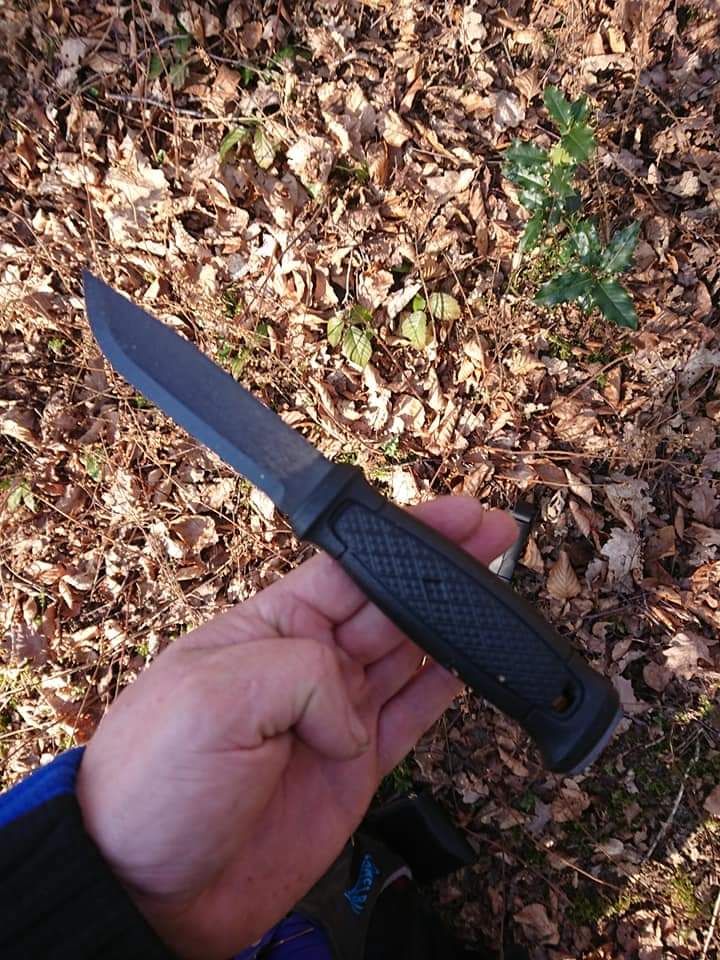
Mora Garberg review


 I got myself a Garberg Carbon, courtesy of www.westfalia.de, who offered me a deal I could not resist. And actually I was a bit shocked by its performance.


Do not get me wrong. I am a knifemaker myself, and while I do not do beautiful, and am my own worst critic, over the years I have learned to make some pretty decent blades for myself. I also do quite a bit of bushcrafty things, nothing fancy, and I am living that way, not doing it, if you get my meaning. I do a fair bit of woodworking and whittling, too. I own a great many knives, and the Garberg always reminded me of the Fjällkniven F 1, and I have next to no funds, so I always was a bit reluctant to buy a knife with a similar concept to that knife.


I was wrong. How wrong I was. ☺️


The first shock I was in for was when I was first given the package. Now I own quite a few Moras, and maybe that sounds nuts, but all of them have that special Mora feeling. You all know what I mean. While they still feel rock solid, they have that light "carry all day without noticing" feeling and the a very nimble balance. When I first took up the Garberg, I nearly dropped it, it was far heavier than I expected. This is not a criticism, by the way, I was just taken unawares. Balance point is a bit behind the index finger. Mora could better this by machining out the hind part of the tang a wee bit more to bring it a bit further towards the index finger to make it even more dexterous, but this is complaining on a very high level. 


The package, by the way, comes with a sustainability certificate. That is Mora for you. Gotta love them.


Straight out of the box, sharpness left something to be desired, but just three strokes on a strop fixed that. After that it was scary sharp. Not just shaving, hair popping away in every direction. Awesome.


I harvested Chaga with it and rammed the tip into a piece of aged birchwood and levered it out sideways. It was not even warmed up by that kind of abuse.


I chopped antler with it. Now keep in mind that this is a Scandi grind with just a tiny micro bevel. You don't do this to that kind of grind. You simply don't. It came out with no dents or cracks or anything at all. It lost some sharpness, and that was all. You could still do these beautiful wood lock shavings with it afterwards, and in aged boxwood, which is very hard.


Actually I carved some twenty spoons with it, processed tinder conk, harvested Chaga and used it in the kitchen, used it as a chisel and a prybar. Of course it is not a kitchen laser, but it is still possible to make see - through onion rings and make short terms of taters, veggies and meat. Of course, due to the thickness of the blade, carrots and celary are split rather than cut, but if you adapt a bit, it also is an awesome knife for field cooking. The black coating is as good as new after all this abuse. 


To date, I did not have to put anything abrasive near it. Edge retention is very, very good. 


The handle to me is a really comfortable outright treat. Due to the almost symmetrical shape it also excels at in-reverse power cuts when whittling, which hints of an extraordinary performance when skinning. The blade shape would also excel at that.


The sheath comes with a rather coarse diamond hone and a fire steel. Both the spine and the protruding piece of tang are ground to 90°, allowing to use the firesteel with great efficiency. The firesteel snaps into a thermoplastic holder, with an awesome fit.


If I need to find anything not so good, it is the retention of the sheath. The knife can fall out when upside down. Given that this is a very, very good knife also in a tactical or military setting, I would suggest Mora could add some kind of mechanical retention device to secure it in these settings.


Actually this is the one knife. You can throw a lot of abuse at it and it is not even warmed up. But it is not a sharpened prybar, either. You can still - with some compromise, of course-use it for cooking tasks.


I am not impressed easily. But I am impressed.


I know some of you might ponder whether to get one. Do (If you can afford it). You will not regret it. I am aware that there are other knives on the market, like the Condor Terrasaur or several Finnish products. They might be good in their own right, maybe better and with a better value for money. I have not yet had the chance to handle them. But this here is not a comparison test, just a review. I do not get paid for it. All I can do is offer you my thoughts on this here knife. And given I have spent a lot of dough on knives, had I had a chance to get my hands on this, maybe it would have saved me some money. Actually, of course, there is a huge gap between, say, a perfectly able Mora companion when pricing is concerned. I, for one, understood the moment I first handled this. While a companion is really tough, too, the Garberg is neigh on indestructable, at least you get the impression. Even to have that feeling in the woods is reassuring and, at least for me, worth one or the other Euro more.


As I said, I can really stand behind this product. 

Dienstag, 6. April 2021

That vegan thing .


These are no steaks. 

They are not even meat. 

Yes, you guys got the right Blog. 

Yes, it is me, Fimbulmyrk. ☺️ 

The magic troll, in her usual awesomeness, had made some Seitan. Now do not get me wrong. I have some really big questions concerning veganistic mindsets, as in contrast to vegan food. Some years ago the WHO demanded to substitute every food with surrogates, slowly removing vitamins from daily victualies, and that, while understandeable in the context of ever decreasing Vitamin content in plant-based food, together with claims by the then Monsanto Corporation, now a part of the German Bayer Corporation to dominate the food market with genetically manipulated crop seeds and thusly reaching World dominion (no joke) made me a bit suspicious of buying surrogates, so to say. 

Now do not get me wrong again. I do not buy into any world conspiracy theories and please do not quote old uncle Fimbulmyrk. It is highly probable, but I really have no evidence either. I am deeply suspicious of any hooray about veganism is all. But I am deeply suspicious of any conspiracy theory as well. 

The soy and surrogates food industry takes up nearly as much space as the breeding of lifestock. If you want to do good (and have a tasty meal), buy locally, support small farming businesses, period. 

Anyway, for the aforementioned reasons I always was a bit reluctant to try surrogates. Also, I did not quite get the point. If I do not want to eat meat, I simply do not eat meat. ☺️ 

Now the magic troll, who is an absolute food conoisseur, and, truth be told, so little of a vegan that she gets the golden Patty of honour for veganists on Facebook unfriending her 😁❤️😈, made vegan food and liked it. 

Truth be told, we both are fascinated with all things alchemy, and that Seitan stuff triggered our fondness hard. Also it is dead simple to make, can be made with few and organic ingredients and is rich with protein. 

It is not suited for people with an adversion to Gluten. Because that is what it is. 

You make a stiff dough of wheat meal and water and knead it hard for some 20 minutes. Then cover with cold water, let it rest (I left mine over night) and then, by adding more meal, add some stiffness back to it and then knead out all the starch. Well, you might not get out all of it, but it does not matter. Cook it for some twenty minutes, then press out most of the water with a cheese cloth or something like that. After that, tear it into strings and knead the strings onto each other several times. It will then very much resemble chicken meat. 

Since I am not a vegan, I put smoked sprout heads and tails into strong vinegar together with salt for a fast Garum which, when used sparsely, adds a nice Umami flavour. I also experimented with fried tomato concentrate with fried wild garlic, roasted nettle seeds. Knead it well in. 


 I ate it with fried nettle leaves, fresh wild garlic and tomatoes, fried walnuts with fried nettle, lesser celandine, wild garlic and ground elder. You can also use chicken spice to make it more chicken - like. Actually it can taste very much like chicken with only a tiny hint of meal flavour. The more Umami you add, the less distinguisheable it becomes from real meat.

For me, it is poverty food, because those steaks cost me from 0.3-0.8€for a whole meal. I also want to try and make "hunger pills" from Seitan.


Actually, I will not stop eating meat, of course. But good vegan food is indeed possible. ☺️ ❤️ 

Montag, 14. Januar 2019

How it´s made-Khukhuri making at Nepal Khukuri corporation

Now those who know me know that I am really fond of the Khukuri knife variety. And now I had the privilege to get to know this guy on the web and exchange some really nice chats which gave me a lot of inside info on how it is REALLY done.
(source of all pictures and videos : Ambar Bahadur Bishwokarma KC Nepal)
Mr. Ambar Bahadur Bishwokarma works for the Nepal Khukuri corporation (www.nepalkhukuri.com) in Kathmandu producing awesome knives. The corporation is Nepali-owned and offers decent quality at awesome prices. Most of the time there are three smiths working in a team. 
 The blades are made from high-grade carbon steel (truck springs). The raw material is cut to pieces
 All of the work is made by hand, with very simple equipment, but a lot of skill. I cannot resist ranting about how it´s not the high-end equipment and heebie-jeebie goobalahbah steel that makes a decent knife, but the smith that knows his trade... and from what I can say, these are really highly-gifted guys doing a really great job!


 The rough shape is hammered out with a sledge-all done by hand, mind you!
The bevel and fullers are ground into the shape of the blade... no harm done, though. The blades are then normalized beside the fire.


The rough grind is ever more refined, all with the simplest of tools.


They also make more modern concepts, like this knife design intended as a hunting or tactical layout...
But this is where they really, really shine, in the truest sense of the word. These traditional designs are lovingly accomplished and come with a lovely lustre.
And, as a sneak peep I can show you these two models that will be available soon on their website:

The Khukuri is a knife that has always fascinated me for its history, its cultural aspects, its sleek and slender lines and, of course, its versatility and cutting prowess. One can easily say that if with an axe you´d be better off taking a saw when wanting to cut a branch of more than six cm diametre in thickness... with a decent Khuk´, you will need to think about hacking twice.. maybe. ;-) Cutting and working with a Khuk´ (or one for each hand... ;-) ) in landscaping I can say it beats a chainsaw when delimbing trees (at least when there´s a Fimbulmyrk at its end, and yes, we DID a contest ;-), and yes, we ARE mad ;-) ). But hacking and chopping is not all there is. I will spare you all the martial aspects of non - Gorkha legends, but even apart from that, its history and morphogenesis is fascinating. This will not be the last about these knives you have read on this blog. For sure. I want to sincerely thank Mr. Ambar Bahadur Bishwokama for all the input and information and maybe you think I am going a bit over the top with my enthusiasm about these knives. But in a world that is becoming increasingly brutal, one can not overestimate the value of craftsmanship, and these guys deserve a lot of respect for the work they do, each and every day. 

Here is a video of the process: 

They are currently looking for  a distributor for Germany. So, if you own a business over here (but also in other countries as well), drop them a line. Other than that, you can also get a knife directly via their website.   

Beliebte Posts