Posts mit dem Label sword werden angezeigt. Alle Posts anzeigen

Dienstag, 9. Juni 2015

The works of Lukas Mästle-Goer

 
On Solingen knife expo I had the privilege to meet with Lukas Mästle - Goer, a tutor in Historical European Martial Arts (HEMA), working mainly with the long sword, student of medicine and part- time sword- and knifemaker. He gave me valuable insight into his method of swordmaking. Since his instruction work is mostly based on renaissance and late medieval manuscripts, he concentrates on the renaissance and late medieval sword types also.
 
He makes his blades from billet by stock removal, which is not my piece of cake actually, but, to be honest, modern spring and tool steel is, for the most part hot- or cold rolled blank which actually imposes no harm to the durability of a blade. In this photo he had laid out the design on the billet.
 He cuts it with an angle grinder.
 The edge takes shape by grinding. Here you can see he uses a sketch for construction.
 The fuller is then marked out.

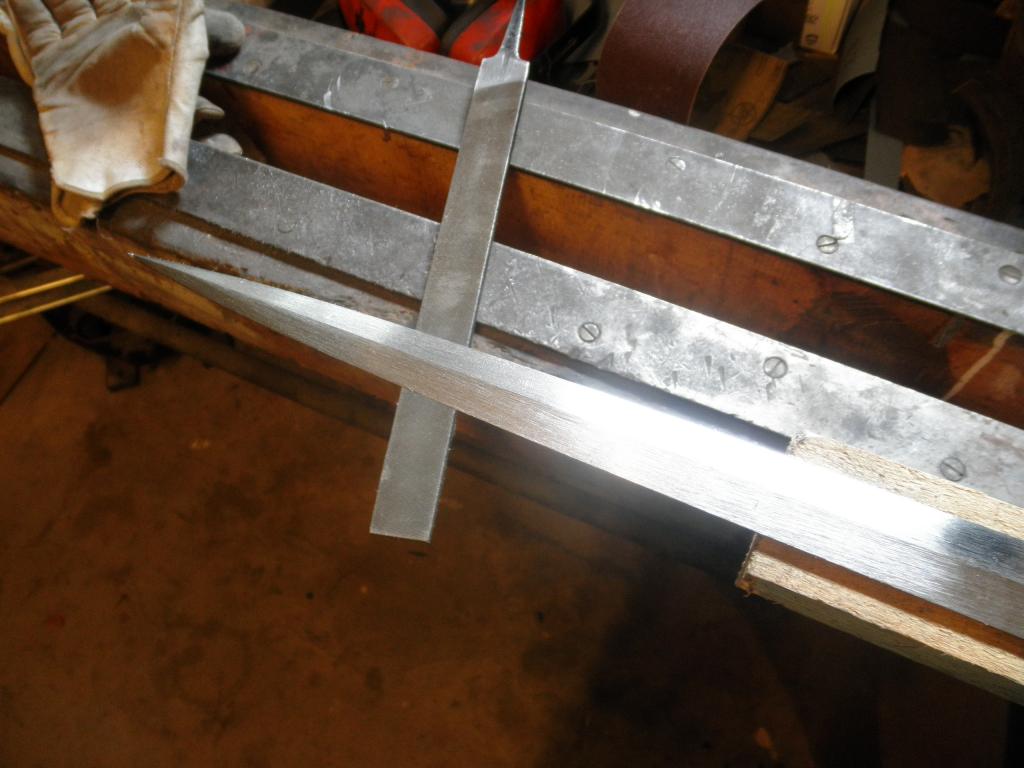
 The last steps are accomplished by hand. The blade is filed, sanded and polished to a high lustre.
 What intrigues me most is that he achieves a great work of art with relatively simple tools.
 
He also makes his own knives:
 
 
I especially liked this small beauty that also would make for a great bush companion.
 

This is his workshop... I´d love to have one, too;-).


All those photos  and the basic information are by Lukas himself. The best part is, this is in no way all! You can follow him on
 http://sbg-sword-forum.forums.net/thread/39790/

 http://sbg-sword-forum.forums.net/thread/41537

http://www.facebook.com/pages/Lukas-M%C3%A4stle-Goer-Swordmaker/


I hope to tell you news soon and wish Lukas good progress. The swordmaking scene is alive and well and this is good to behold.

Mittwoch, 7. Mai 2014

Solingen Knifemaker´s Fair 2014-II- meeting old friends and opening leaden boxes.

 There was a lot to see at Solingen this year. I had already lost Willi, but was quite confident where to find him-for outside, in the beautiful yard of the museum, overshadowed by majestic old trees it was where Achim, Norbert, Gunnar and our old master and tutor, Matthias Zwissler, had their booth.
 So outside I went, and there was some smithing going on as well, and by the great grandmaster of Germany, Fred Schmalz, in the bargain. Mr. Schmalz is well over 65 years old, and is still going stronger than ever, and you can feel he is fed by the fire . There was a lot of tech talk going on, on a very high level, and you could learn a lot about bladesmithing and making damascus by simply standing there and looking. Also, it kindled the flame in myself again.
 But there had been enough morale;-) off to the feeding! I had some sandwiches, some meat balls, a lot of coffee... and whom did I meet at the coffee  booth? Willi, of course, for the blood level in his caffeine was rising and he had to do something against it. Then some cake and a goulash soup, and I was feeling human again... we met Rolf, and Stefan, and a lot of folks from Münster Knifemaking Club, sat under an old tree, had some great food and enjoyed a chat, some weird jokes and Rolf poked me in the ribs with his knife;-) perfect.
 Then we were off to Achim´s booth. Achim has but an email-adress, but I daresay he is one of the most accomplished knifesmiths and metallurgists in Germany, maybe in Europe, but he is very down-to-earth. Here is a batoning test with one of his more simple knives. Here you can find something that is frankly insane from a metzallurgical point of view and requires a lot of knowledge: Stainless Pulad.

The knives he had on display were just plain beuatiful. It is quite a feature to make a Seax with a clean pattern like this. It is certainly not my style, for it is a bit too clean for my liking, and I prefer a more ornamental design. But I have seen him whacking this Seax into a rod of high-carbon steel with not so much of an afterthought and no damage to the blade.

 Top is a Persian javelin, a Leuku, and a dagger. The latter aappeals to me mostly because of the delicate pattern on the blade, but, again, the design´s not my piece of cake.
 This Wootz blade, however,
 just made me want to have it... Above is a big camp knife out of mono steel. What I like best is the versatility of this guy. He can do a lot of styles, and the quality of his blades is legendary.
 Another Seax by Achim.
 Next to Achim was Norbert, another Lord of Metal. And as we came by, he did THIS (Apologies again for messing up the perspective, I promise I will learn it some day):

MAD!!!! These are the results:

 Top is one of his kitchen knives. Below is a knife out of Pakistani damascus.
 Now, this is the "Amilas" test which is not considered very polite amongst bladesmiths, but plagiarism is not polite either;-) and I guess the point is made by this edge;-).
 Then there was a sabre demonstration going on. There were demos the whole day, from Iai-Do to Ken-Do, to Kyu-Do, European Martial Arts (Long sword, short sword and buckler, sabre, rapier, sword and shield), and, of course, the smelting by the guys and the forging by Fred Schmalz.
 They had an Aristotle furnace going...
 As well as a more traditional smelting furnace. To the left there´s Matthias who managed to take a day off from his strenueous life to come to Solingen, and I hope he will be well... but that´s another story and the internet is no place for it.

 This is how the air flow is achieved, just a simple garden hose does the job.
At the forge of Mr. Schmalz I came across a novel kind of flux (at least to me). He mixrd Borax with rust to provide a better cleaning effect on the metal´s surface and a metal reduction effect, as I guess.

So, the visit to the yard was certainly inspiring. Of course, when I went upstairs, my camera did decide my time was out, but I did not agree. I met with Mr. Fazekas, who had his great works of art on display, not much new, but great no less. At the booth of Wolf Borger I got some material to work with the newly-kindled fire..., 1.2842 steel and red G-10 fibre. I met with Gerhard Wieland, and Daniel Boll. But the most intensive encounter I have had since many years was yet to come at the booth of Peter Johnsson. Now Peter was herding ;-) the Arctic fire folks in 2013. Visit their website for the most interesting quest that has given the magic troll and myself quite something to think about for some months, and it turns out the troll was quite close to a winning guess... So I came across one of my biggest idols in the bladesmithing world, and before I knew it, we were hotly engaged in a most inspiring conversation about sword physics and medieval design theories. Peter has a most intriguing theory concerning the architectural design of medieval swords which I find both plausible and inspiring, even if I to date do not comprehend it completely still. Here he treats the proportional design of the Soborg sword, which can stand as an example for many others of the type, and he is currently doing statistical research on the proportions of swords from the early medieval age to high medieval times. What struck him as very peculiar is that the design principles of those artifacts where the same as those applied to medieval churches, cathedrals and cloisters, and bearing similarities to sacral architecture. He gave me a tour-de-force view of medieval architecture of swords and buildings alike, and in no time we were deeply engaged in a philosophical conversation. Now this all might not seem so peculiar, and I am personally accustomed to the feel of a well - made sword in my hand. But there was a bunch of friendly folks around also partaking in the conversation, amongst whom there was a girl. She was beautiful, but you could tell she was a bit withdrawn. Then Peter handed her one of his swords, a Gothic hand-and-a-half sword, one very similar to this one. At that moment it was as if a veil was removed from a shining light. Her eyes sparkled with fire, and Peter just said: "You feel it, do you?". It was beautiful, both to see the girl suddenly radiating, and Peter´s plain and simple reaction. Then we were again deeply engaged in some philosophical discussion, and soon we were nearing spiritual topics, as is not so far-off, considering his theory. Anyway, I saw at that moment something that is often quoted and seldom seen: That which we love to call "the power of the sword". I understood a whole lot of things in this moment, too many to explain in a humble post on a blog in the internet. I understood that there is a deity that is not easy to agnize, and I understood that there are methods to feel it. And that these methods are nothing new, but a secret jealously kept by keepers generally not apt to the task. And that the steel keeps the secret much better than any human master, but that there is a force behind the steel that is greater still. The design principles that Peter loves to relate to are just that: Design principles. But they serve a much bigger purpose. And, what I find most beautiful about this swordsmith is not that he makes great blades. There are others around doing that too. There were a great many lot of them on the Knifemaker´s fair, and a great many very great individuals and characters, too. But I have seen the locks of iron, copper and silver open in the way he talks about agnition, just a tiny bit, but it gave me a lot of hope.

Now I will not take up swordsmithing because of meeting with Peter Johnsson. I will not study the principles of sword design because of it. But what I realized is that I have never stopped on that way, and that it was there the whole time. And it isn´t about the tools or the weapons.

Who knows need not ask, who asks, will get no answer. But I opened a leaden casket to see the locks of iron, copper and silver undone. Those are my very own words, and readers of my blog know that. Peter found some very similar. I hope to stay in contact to him. Period.

There are many more impressions. I could tell you how we sat in the yard again, the Iaido  and Kyudo show with their meditational atmosphere, or the plain recreational violence;-) of European Martial arts. Of great food, of steel and chatting, of seeing new works not only by the masters, but also by my friends and aquaintances. Of how it was all a very friendly, peaceful meeting of educated, even academical people. But I can only suggest to get down here and pay this fair a visit. You´ll see a whole lot of weapons and a whole lot of peaceful atmosphere.


Dienstag, 16. Oktober 2012

Forging the Mc Laren Clan Claymore at pagan fun party

This is a Antenne Witten sequence on the pagan fun party with Clan Mc Laren at the Oktoberfest at the Bethaus / Muttental, Witten:

Click 

Yours truly messing up the forging rhythm just to see if the brutes (Jogi and Ralf)are still awake*ggg*.

A press article on the event you can find here.

I will provide you with a lot of more info as soon as I get the pics and videos myself, including footage on the ritual!

Donnerstag, 30. August 2012

A visit to the criminalistic museum in Rothenburg-torture, pain, the tools of the executioner-and the question of the spider.

 We visited the beautiful town of Rothenburg ob der Tauber, a town with the beauty of a medieval city. A big great thankyou goes to Erich, Drui´s father. Not only did he drive us around like a mad geocacher, but he also paid for our food and drink and it was difficult to convince him we did not want to be covered in edged tool gifts!*ggg* Apart from that, he is, quite apart from his role as a potential father-in-law, quickly becoming a friend in himself. He also invited us into the criminalistic museum. In the iron cage in the pic above delinquents were kept to starve in public. Often, their suffering was prolonged, because passers-by gave them food and drink, which was often soaked or mixed in / with urine or other substances, or salted through. 
 This is a pillary. There delinquents were displayed for minor crimes such as mobbing or beguilement or playing bad music or simply being Jewish or widows or knowledgeable women. They had to wear iron shame masks and were locked there in sight of the public.
 These are the medieval standard measurements valid exclusively in Rothenburg. Rute (3,85 m), Klafter (1,80 m), Elle (0,59m) and Schuh (0,30 m²).

 Must I mention you got put in a pillary if you sold goods with another measure? If some trader from outside wanted to sell his goods, he needed a permit or had to translate his measurements into Rothenburg standard.
 To the right in the picture you can see the woman standard measure of Fimbulmyrk village. If you do not put up, you get put in a pillary and have tow wear my underwear as a shame mask.*ggg*
 And we went into the dark cellar...
 ...of torment and pain. Top is a spiked chair. There the inquisitors put delinquents presumed guilty of witchcraft or sorcery. I must emphasize that it was not primarily the Christian church applying these methods, but first and foremostly mundane law institutions. Torture was a legitimate method of investigation.
 A rack bench. Delinquents were tied to the winch and stretched until the joints and tendons came asunder. Often, the pain was increased by steel spikes on the rack´s surface.

 This is an advisory book for investigators. Especially for sorcery and witchcraft a question catalogue and torture methods were explained thoroughly and in a most detailed manner. What is most terrifying about this is the institutionalization and bureaucracy involved. It made me rethink many opinions I had towards the Nazi regime. The only aspect missing were the gas chambers, and I daresay they would have used them had they´ve been at hand. This is not to say I want to belittle the deeds of the Nazi regime, for nothing like that should happen ever again in Germany at least. But millions of Jews, Arabs, Syrians, Gnosticists, Protestants, witches, wise women, widows, doctors, philosophers, scientists, handicapped persons, the wise, the strong and the meek, were tortured, injured, broken and butchered systematically by the perverts that invented these machines-in the name of God. I feel disgusted about a mankind that uses its intelligence for such perverse implements, and, more so, the manuals for the lackays that carried the mass-murder through. When I read my Bible, I found out that there actually ARE passages in the text that allow to be interpreted that way, e.g:

“If your brother, your mother’s son, or your son or daughter, or the wife you cherish, or your friend who is as your own soul, entice you secretly, saying, ‘Let us go and serve other gods’ (whom neither you nor your fathers have known, of the gods of the peoples who are around you, near you or far from you, from one end of the earth to the other end), you shall not yield to him or listen to him; and your eye shall not pity him, nor shall you spare or conceal him. But you shall surely kill him; your hand shall be first against him to put him to death, and afterwards the hand of all the people” (Deut. 13:6-9).

I do not want to offend Christian belief in any way, and I do not at all want to judge these verses or those many others in the Bible. I respect the belief of Christianity, but in the Old Testament, blood drips from every page, rout and bloodshed and genocide is the very lifeblood that runs through its veins. I can therefore accept that Jesus Christ was seen as a saviour (and to me he still is a great name), giving peace to the Israelites, for they must have been living under a great pressure all of the time, and chance is, they still do. Jesus Christ had sort of a kathartian effect upon Christianity, but even he did not bring peace, but "the sword". Christianity claims to be a religion of peace while the Old Testament at least gives the impression of being more of a book for an ancient wargod. There are, however, moral standards that were a novelty, and these standards could have validity for mankind, if only we would understand.

And yes, the mundane law quite certainly misinterpreted these passages in the late medieval ages. No book has seen more abuse than the Bible or the Koran. But in my opinion, in these misjudgements lie the roots of all the bloodshed, abuse and fascistic mass murder that Europe has seen so far. I have learned in this museum that, however perverse Nazi ideology has been, it was not the first perversion the world has seen in terms of bureaucratized mass murder. Christian church, in the middle ages at least, had not as big a hand in this as some pagans want to make you believe-but clean hands they had not, either.
 
 Another racking implement. Here delinquents were pulled up vertically until the joints gave way.

A window.

 A detailed construction sketch of a thumb screw, 19th century.
 More torture and fixation implements.
 This is a ceremonial judge´s sword. The blade is almost as small as a small-sword´s, and quite thin. it is one-handed. The sword represented the right hand of justice, the force.
 A detail of the handle.
 The blade. Apologies for the lousy photos, we were not allowed to use a flash, and I fumbled my camera settings...

 Another ceremonial judge´s sword. Note the fullers on the blade with an inscription inlaid in gold.

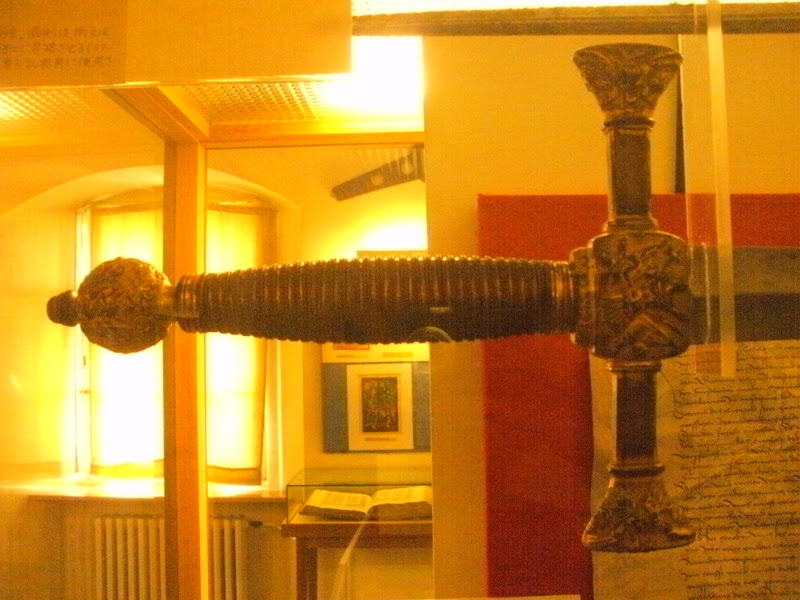
 A ceremonial greatsword. I love that ironwork on the hilt!
 ...and the pommel.
 The blade of the sword is over one m long. here I tried to show that the blade thickness is approx. 4 mm at most, gradually tapering towards the tip. This sword would weigh in at a maximum of 1,8 kg all in one, making it a fast and nimble weapon. The blade will be quite flexible at that. So much for the prejudice of medieval swords weighing in up to 10 kg! Also, this will indicate that medieval swordplay would be no laughing matter and no "Erroll Flynn sword ballett" whatsoever.
 There were different weapons on display, though. Medieval and early modernity executioner´s swords were constructed quite differently. Beheading a person was not easy, and the executioner only had one blow. Often, he would be executed right on the block if he messed up. Executioners often came from the lowest social backgrounds imagineable and were valued on the same level as swineherds, whores and other untoucheables. The head was severed with a chopping, not a cutting blow. Such a blow needed less skill than a cutting one, but was difficult enough to achieve. So the executioner´s swords slowly evolved into hefty beasts with a very forward balance point and a more rigid blade. The fuller only reaches up one quarter of the blade. The tip often misses completely.
 The inscriptions often say: "When I take the sword to hand, I wish the sinner eternal life" or similar religious meanings, or indicate owner- or authorship.
 Below is a rather unusual example of an executioner´s sword with a broad half-moon blade, with no inscription, but a stamped half-moon.


This, however, is an executioner´s hatchet. The inscription is the same as common "Wann ich thu mein Beil aufheben, wünsch ich dem Sünder das ewige Leben" (When I take up my hatchet, I wish the sinner eternal life". The hatchet is in an excellent condition. It is presumeably forged in the three-piece technique and modelled after a broadaxe, which was common as a carpenter´s tool, but stamped with a stylized skull with a cross, indicating that it actually was forged for the exclusive use as an executional weapon. 


 It is interesting that the edge runs at an angle, which might indicate a more cutting motion. The edge grind is convex, the blade is relatively thin.
 Other executioner´s weapons simply carried the name of the executioner or the maker.

This is another example of an adapted weapon of warfare of the 30 year confessional war, a so-called "Flamberg" greatsword. As the example before, it has a very light, flexible, swift and nimble blade with a balance point relatively far towards the handle. It could be used either on the long handle or with one hand on the blade behind the secondary hilt (the two spikes on the blade) in a half-sword technique, making it more apt to be used in a melée.

 The distinctive form of the edges was a functional design. It served to increase a wound channel. These greatswords were often used to break the ranks of pikeneers and billmen. When the poleweapons were cut down, troops charged into the breach.
 Another greatsword adapted as an executioner´s weapon.
 Now the quizzical question. What is the difference between the animal species that created the tools above and the one in this picture?
How evil is man?

Or better question to be asked: What prey did the mundane judges hunt - in the name of God?

The answer is as easy as it is bitter. And it indicates it was not God they worked for.

Beliebte Posts