Dienstag, 15. April 2025

A Bushcraft and Slöjd heaven in the making

Silke had contacted me some weeks ago.  Now Silke is a really awesome human being doing a great job representing a local sustainability centre on a high professional level. She had seen me carving some wood spirits, and it turned out, that she was actually quite fond of them.  So I offered to carve one for the sustainability centre for free.  We met in the woods to discuss the topic... and ended up sitting on a stump carving things until dark.  

Several days later I dropped by the centre and went to work immediately. Silke had said:"Make it your own", and I was pretty much amazed by the amount of trust put into me, and the positively creative atmosphere and flat hierarchy. Silke is the manager after all.  I spare you the ironforge rant, but just let it be said that up to date I did never experience such an atmosphere.  That is not to say that everything is possible, but the discussion culture is a whole different thing to everything I know. We are currently trying to work out a lot of ideas for the future, but first things first.  

I am just super stoked to be welcome for a change, so much in fact that I might have been a bit overwhelming. 

Anyway, I cleared up a spot for carving sessions with kids already.  The plan is to provide an open Slöjd meetup every Friday, with some basic tools and materialbeing available for absolute beginners. This will be complemented with Workshops and tutorials.  The Slöjd meetup will be open for a little contribution, but open for absolutely everyone. We are currently trying to provide a halfway convenient access for wheelchairs also, just so you get the picture.  It will be just that I will be there every Friday after Easter, working on my own projects, but if you drop by, I will do my best to help you with your projects, or maybe even learn from you? Anyway, if you are in the vicinity, drop by and have a chat.  

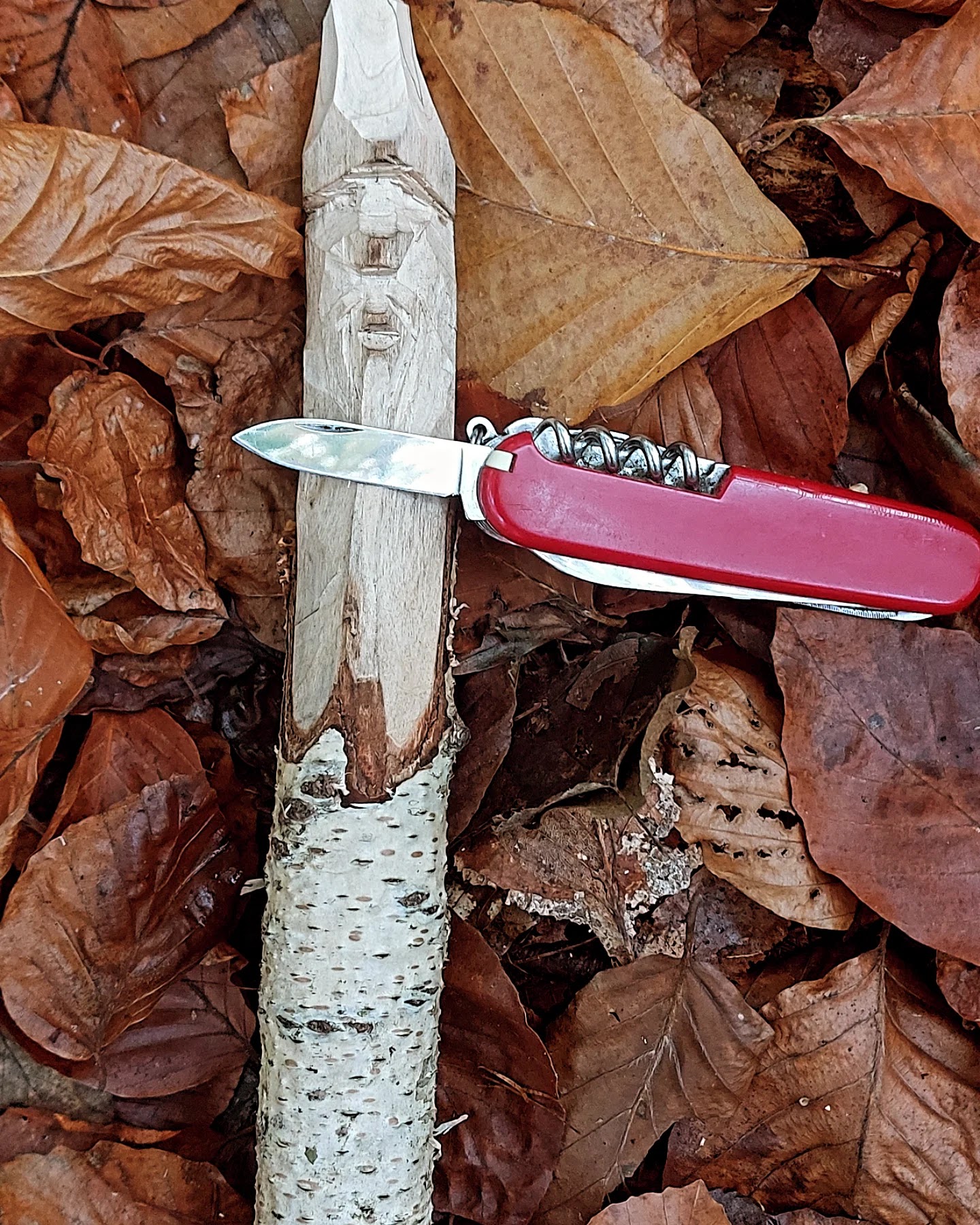
That said, I also worked on said woodspirit (s), because I could not restrain my creativity.  


Prepared wood for a gate and a Lean-to.
Made a mallet for splitting wood for a bench (driving gluts and stuff) 


It was a bit fidgetty clamping the wood for the head, but the woodspirit is a good guy and was eager to help 😉. 

Also prepared a signpost for the gate. 
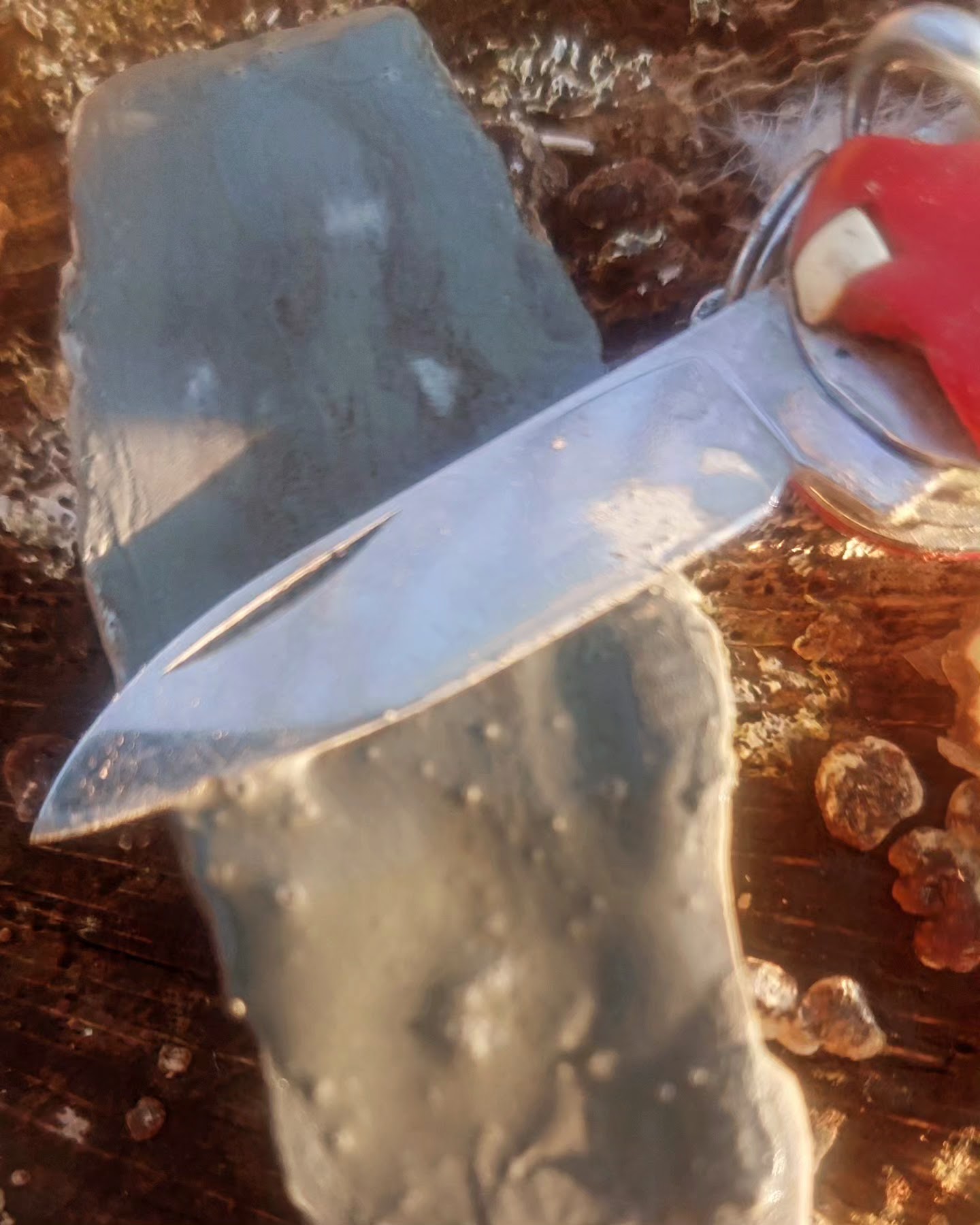
The drawknife I got dead cheap on a local flea market. It is around hundred years old and razor sharp after some TLC.  I don't know what I would have done without it-it really was helpful, and I love it to bits!
Another woodspirit I made. 
When I was feeling too fluffy from the big stuff, I worked on that little cup from birch burr.  


There was a group of young girl- and boyscouts staying at the centre, so I already showed them a simple try stick.  One of the little ladies pointed out a mouse coming around to have a look, and we tried out to carve a mouse together (see my older post). 

This is how it is supposed to work in the future.  Just drop by, bring your pocket or bushcraft knife and maybe a flask of tea or coffee (we are currently working that out, too, however). Sit on a log or we can build stuff together to sit on.  

Really looking forward to it, and we do have a lot of ideas still for the future.  


Montag, 14. April 2025

Lovely early spring cottage cheese

Went foraging the other day and thought I would share one of my favourite herbal cottage cheese recipes with you.  
With the magic troll 's herb chopper, I finely chopped: 

one small handful of wild garlic 

equal parts ground elder, lungwort, chives, onion leek, jack-by-the-hedge, stinging nettle, 

Half a medium finely chopped onion

a bit of dried thyme, Oregano, rosemary, salt and pepper 

A tablespoon of butter, 

A tablespoon of grated horse radish

250 g of cottage cheese 

80g of Gorgonzola 

One teaspoon of squash seeds oil

Mix butter and oil. Add the Gorgonzola and thoroughly mix until smooth. Add the cottage cheese, stir until smooth. Add the horse radish, spices and herbs.  Thoroughly mix.  Leave to steep in the fridge.  Awesome with rye bread or as a dip for vegs. You can also fill mushrooms with it and grill them. 


Sonntag, 13. April 2025

Another quick and easy carving project-whittling a mouse

The other day, a little lady came to the Slöjd meetup and asked whether I could carve a mouse. I had never done so, but we worked it out together.  And I thought I would share it with you.  You start by cutting with the saw of your SAK, one rectangular and the second diagonal to the first, but only half of the depth of the first. 

These serve as a stop cut. You can also use the blade, but the saw is a tad faster and maybe a bit safer. Take note that I left some length to the branch, the better to handle your carving. 
At the first stop cut, reduce the diametre of the stick. 
Carve a tip on that side of the cut.  That will be the snout of the mouse. Reduce the diametre of the branch behind the diagonal cut. This will become the ears and the body. 
With your saw, cut out a notch between the ears.  Be careful, because you are cutting with the grain, and the wood splits easily.  Refine the cut with the help of the little whittling blade.  
Carve the back of the body.  Refine the snout and back and saw the mouse off the branch. Refine the cut with your little whittler blade.  

 Carve the eyes and refine the snout and body.  

It is a really nice and fast project, satisfying also for kiddos.  You can of course refine the carving more, by working out the legs, or give it a more abstract form.  Make it your own! 

Shoutout to little Nele, who provided the inspiration for me to think about it! 

Hope you enjoy it, and take care! 

Making custom firesteels-a really simple and satisfying project

This is another beginner-friendly crafts project you can achieve with really simple tools. 

You can get firesteel blanks from your favourite outfitters. I got mine from the awesome Janet from https://www.nordisches-handwerk.de/handwerk-schnitzen/dalapferde-handwerk-geschenkartikel/fertige-produkte/feuerstaehle/4411/scout-feuerstahl-firesteel-ca.-6-3x60mm

A firesteel is somewhat of a misnomer.  To the kids I explain it a by stating that the material isn't of course steel, but Auer metal, an ingredient in mini fireworks like a sparkler decoration. Technically, it is called Ferrocerium and it is a compound from Iron and the rare-earth mineral cerium, hardened with magnesium and other ingredients. It was discovered by the Austrian chemist Carl Auer von Welsbach in 1903, possibly in residues from Thorium mining. (https://en.wikipedia.org/wiki/Ferrocerium).

A ferrocerium rod is a rather convenient and reliable way to start a fire. Well, a BIC or matches are even more convenient, but sometimes not as resilient in a wet environment. And let us not forget the aspect that they are fun! 😉 

The wet blanket of course is that they are a highly industrialized approach to a rather simple problem. Sustainability works in another shed, so to say.  They can last you for a long time, though, which is sort of a compensation for a bad ecological balance.  

I got myself some small diametre ones, just 6,3 mm. Those make for a lighter and more compact carry.  For the things I do that is more than enough, and they are dead cheap.  But you can get yourself a bigger one alright.  

Making them requires a knife, a saw and a power drill. Actually you can also use a Swiss Army knife to mount them.  

Saw off a little block of your favourite wood.  I used bog oak, birchwood burr, and stag antler.  
Drill a 6mm hole into the handle. With the tip of your knife, remove the burr from the hole. Do not glue the Ferrocerium rod into the handle or use pine resin. That way, you can use up the half that rests inside the handle, too.  Two I recessed to the half of the rod into the handle to make for a more compact carry, the other two I left a bit longer for easier use.  Gently tap the rod with a wooden mallet or rubber hammer. 
On the stag antler Ferrocerium rod I added a lanyard hole for carrying in a traditional bushcraft sheath loop. And just like that- hey presto: Ferrocerium rod. 😉


Mittwoch, 9. April 2025

Restomod of a badly beaten Victorinox Camper- changing the scales

On a flea market some time ago I got myself a cool, but really badly battered Victorinox Camper... but for 3€ or summat.  

Now Victorinox has really changed my outlook on bushcraft knives in general.  Maybe it is because I am getting old, but a Victorinox Ranger really is my most used knife these days.  Rather light, always on board and rather unproblematic with the authorities, it really shines in a lot of applications, if you know how to use it. 

I think that will be a topic for another post.

 Anyway, the knife I got had a bad dent on the small whittling blade. On the detour from the flea market, I did a little bimble through the woods, and picked out a random sandstone and ground it flat against a broken tile also lying around not doing anything, and used it on the small blade.  

This worked out pretty well. I will show you how to use a sandstone as a grindstone in a future post.  The beauty of a SAK, however, is that, while the tempering of the blade is really resilient, while having a more than adequate edge retention, it can be maintained with next to no provisions.  


The other day, I had ordered some new scales. I did not need to upgrade to the Plus scales, but I ordered new goodies in red, too.  I am a fashion victim, too, sometimes, you know? 😉

But, of course, there was a reason for it,  since the scales were a bit damaged, too.  

Those had arrived, and I watched the awesome tutorial by the master of SAKs himself. Look here: 


That said, I changed one thing, and that was adding some detergent to the boiling water.  Removed the tweezers and toothpick, and put the knife into the hot, no longer boiling, water. I took some tongs at the ready to take it out of the water after some five minutes. The scales get a bit softer afterwards. 


Using the small blade on another SAK, i popped off the scales as Felix suggested, getting between liners and scales between the two hindmost rivets.  Worked a cinch. You have to be a bit careful and have a little patience, but the scales come off with a rather satisfying "pop" 😉. 


Taking care to thoroughly clean the liners and working the blades underwater for some time (you can also use Q-tips or a piece of handkerchief or paper towel wrapped around the tweezers), 

Thoroughly dry the liners afterwards. 

Starting with the corkscrew side, handpress the scales onto the rivets. 
Use a towel, some tape, or felt inlays to protect the scales from scratches, you can use a vise to press-fit the new scales in place. 

And just like that, you have a knife that is almost like new.  

This is the real beauty of a SAK.  That knife is over 45 years old, and it is now ready for a good time in the woods again.  

Samstag, 15. Februar 2025

It's that time of year again: Hazel catkin candy!

Recently I noticed that the hazel catkins are in full swing, and so I went out to get myself some for candy, tea and maybe whisky.  
Got a full bag of hazel catkins.  
I took 250g of butter, melted it on low heat, put in 250g of powdered sugar, stirred it in with a whisk and added the catkins.  Put in another 100 g of powdered sugar and added 200ml of water.  Reduced to a brown gooey texture, while constantly stirring on low heat. 
I put the warm catkins aside to dry to a crispy texture.  


Hazel catkins have been used as natural remedies for quite a long time.  They are reputed to have a diuretic and adstringent effect and to enhance blood circulation.  They are sweat-inducing and can be used to fight mild fevers, enhance bile flow and help with liver and gall bladder problems.  If you suffer from allergic reactions to hazel, I strongly advise you not to use it.  

In Celtic folklore, the tree is connected with wisdom, poetry and divination. According to Damian McManus: Irish Letter names and their kennings, Eric 1991, the Ogham name is Coll, with the Kenning connotations "fairest tree", "tree of sustenance" and "friend of nutshells". In poetic mythology, the nine hazels of fine mast at the well of wells of the Boyne nourish the Salmon of Knowledge.  Hence it is the tree of sustenance.  


This is a song by my lovely magic troll, Tríona nì Erc, you might enjoy.  

Stay sane, and until next time!


Mittwoch, 18. Dezember 2024

Some thoughts on flint and steel firecraft

A fire. 

After shelter, it is one of the most essential human comforts. Warmth is crucial for survival, but there is more to it.  Maybe the fact that we love to mindlessly scroll on Tok or elsewhere could be traced back to a primeval yearning- to stare into a fire, without a thought or a worry at all, warm and safe.  I cannot know.  That those platforms rot one's brain and hack your mind is a neurological and psychological commonplace, and it is also a commonplace that this is intentional. 

A fire, however, is proven to have a rather wholesome effect on the human mind. 

Now do not get me wrong.  In my EDC, there are matches, a lighter, a ferro rod and a tinderbox.  And flint and steel, although I am getting better at it, would be pretty much my last resort in a emergency situation.  

But just as a fire is more than just a survival necessity, starting a fire always had sort of a ritual character for me. And of course, you should know how to have the capability to start a fire at the tip of your fingers, with as many different methods and techniques as possible. But that is not all there is.  Starting a fire with flint and steel has a certain beauty to it that is hard to fathom.  

To me, it is a form of reconnecting. That is a pretty big word, but I do not apologize.  

For flint and steel success, you need to know where to find means to catch a spark.  You need to know how to (sustainably) harvest tinder conk and process Amadou and/or make charcloth. You need to not only know where the mushroom grows, you need to know the local ecosystem, you need to know how to process the material.  In order to do that, you need to know why it works. If you know why that might work, you are also capable of learning about the medicinal properties of the mushroom. You will also realize that the mechanical properties of the Amadou lend themselves for the material to be used for a leather substitute. And first and foremostly, you learn how to respect and value your resources, for they are rare and precious. 

Then you light a fire with it.  It is not exactly easy, and there certainly was a learning curve involved for me, and still is. I want to be honest to you: I am not always sure whether or not I will succeed.  I do succeed most of the time, and I still do practice a lot.  It is good fun, even though there is still a certain element of doubt involved. 


Getting a fire going that way feels empowering. 


 Please keep in mind that I am a certified fire brigade assistant and that I have permission by the local authorities.  Because a rather essential part of firecraft that few people show you in those cool 15 second Videos on the interwebs, is how to watch a fire, control it, and put it out, and when not to start a fire at all.  How to be able not to set the whole forest on fire. 

And here is the culprit. I guess some of you got a bit infuriated because of what I said, but it actually wasn't meant as an offence. Quite the opposite. 

Most people cannot know. Because we are not just disconnected, we are being actively separated from nature.  Our primeval yearnings are abused in order to profit. And do not get me wrong, I am not a stranger to mindless scrolling myself. 

Lighting a fire with flint and steel, with a fire drill or other friction fire techniques, is not exactly efficient. If you are in a survival situation, and you got other means of lighting a fire, use them.  But it is great to have a Plan B, C and D. And the most important thing is that it is a really valueable means of reconnection- and empowerment. 

Because there is a war going on, not only on culture, but on humanistic values, and the human species per se.  A war for profit. Don't fall for the fearmongering, though.  Just switch off your phone from time to time and maybe get a campfire going, brew yourself a cuppa trailcoffee or tea and breathe a bit deeper.  Take care of your fire, of course, but I trust you do anyway. 

Never forget: To date we still do have a choice to choose a more wholesome activity over mindless brain rotting.  

All the best to you all! 

Donnerstag, 12. Dezember 2024

A little foraging hack- how to harvest resin


 When you are just carrying a pocket knife into the woods, and you come across that perfect blob of resin, that can be sort of a challenge. Because you don't want to get your SAK all gooey and sticky, of course.  

The solution is dead simple of course.  

I also improvise a way of transporting your harvest back home.  

Spruce, pine and fir and mountain pinion resin has a million of uses. Resin has a lot of medicinal properties. The tree using it to cure wounds in the bark, already hints of its antibacterial, antibiotic and anti-inflammatory properties. Traditional uses of pitch salve and resin ointments date back to ancient Egypt:

"oldest accounts of the therapeutic effects of coniferous resin stem from ancient Egypt, where salve prepared from resin was used to treat burns., In the Nordic countries, especially in Finnish Lapland, ointment prepared from the Norway spruce (P. abiesFig. 1) resin has been used for centuries to treat acutely and chronically infected wounds, sores, pressure ulcers, punctured abscesses, suppurating burns, onychomycosis, and paronychia. Although treatment with resin is an old folkloristic therapy and empirical experience over time has shown the effectiveness of resin treatment, only at the beginning of the twenty-first st century have researchers conducted systematic studies of its effectiveness and mechanisms of action." 

https://pmc.ncbi.nlm.nih.gov/articles/PMC4827294/

But also in the global North, pitch, pitch salve, refined resin ointments and raw resin have been successfully used in the treatment of wounds, skin irritations and ulcers.  (https://www.researchgate.net/publication/6485920_Resin_salve_from_the_Norwegian_spruce_tree_a_'novel'_method_for_the_treatment_of_chronic_wounds)

The medicinal properties are due to a very high content of Terpenoids (which is pretty commonplace, because resin has always been used to make Turpentine and Colophonium, which is a by-product of making Turpentine),  mostly Diterpene acid (DRA). There are several clinical studies confirming the success of said traditional applications. 

The said Diterpenes also make for the awesome properties as a fire-starting agent, because they are highly flammeable.  

Another application of spruce, pine, mountain pinion, and fir resin (or any resinous coniferous plant, actually), is to easily make a glue. When melted with a bit of fat, especially animal fat, and dried manure, it makes for a surprisingly strong bond for e.g. hafting tools. The big advantage over birch pitch is that you could also use the resin unprocessed, as opposed to a rather complex process of destillation of birch bark.  

Resin is something every woodsman should know as nature's multifunctional resource.  

It is important, though, to harvest sustainbly. Don't hurt the bark. There is no problem if you take what is on the surface, and if you use a wooden spatula, you can not hurt the tree. 

That said,  I hope to provide you with a recipe for my ointment soon.  

All the best, thanks for watching, and take good care! 

Freitag, 29. November 2024

Another assault on democratic structures and human culture per se

Recently the magic troll and myself had the utmost privilege to attend a lecture organized by the MCAW (Marburg centre for Antique Worlds) and held by this very honoreable Gentleman. 
Professor Dr. Müller-Karpe offered an archaeological perspective on the topic  of war and peace and provided rather detailed evidence, beginning in the paleolithic, that. - in stark contrast to the narrative used by altright, conservative and centre-right to centre-left political forces, even the greens worldwide and some of the left and extreme left- war is in no way necessarily a natural state. There is no evidence whatsoever of warfare for the most part of human history. The first evidence of weapons of warfare, i.e. stone maces, is found in the late Mesolithic and Neolithic. Warfare seems to be linked to the concept of immobile personal property. So, if you permit this abbreviation and summary, because this is only part of the culprit of this post, there is no way war would be a natural necessity, but a lot of evidence that war is linked to the accumulation of immobile personal property. 

Now Professor Dr. Müller-Karpe, whose merits in examining central and near eastern archaeology might as well be one of tthe reasons that modern archaeology works the way it does.  He might as well be the proverbial giant on whose shoulders the next generations of archaeologists stand. 

I personally hold him in exceedingly high esteem for his kind, but firm way of teaching, his passion for the subject, and his firm scientific values. 

He most certainly deserves his meriteable discharge and a life as a pensioner, and I feel obliged to thank him very much for his kind acceptance of my person into his lectures, and to wish him all the heartfelt very best for his leisure. Which might not be that leisurely at all, because of course, he will not stop investigating our history. Because you do not become a scientist, you are one.  

The same applies to one Professor Dr. Rita Amedick. As head of the Institute of Classical Archaeology, she is one of the giants on whose shoulders the upcoming generations of archaeological scientists stand. Her merits for the subject have made the subject what it is and paved the way to important discoveries that would further our understanding, not only of our past, but also of contemporary challenges our society is faced with. 

Enter the economists and presidial administrative employees, whose only concerns seem to be to render the humanistic sciences more cost-effective. Which is a contradiction. This shall be undertaken by removing both professoral positions, to replace them with lesser-qualified tutors in a position of  half-employment. 

Plus, personally, and please take note, that this is just my personal opinion, based upon the information I have, I cannot help but assume a rather dystopian political agenda behind the endeavour. Because, while officially and on paper, the subject will not cease to exist, the quality of academical tutoring and mentoring will suffer in such a way that dedicated studying 
will be made difficult, if not impossible. 

That said, please remember my referring to the emeritation lecture of Professor Dr.  Müller-Karpe. Keep in mind the current atmosphere of political warmongering and the provided, rather commonplace, evidence, that the scientific evaluation offers quite the opposite of the narrative used by altright propaganda worldwide and you might come to similar assumptions as myself. 

But enough of this. The Archaeological Institute in Marburg is in danger.  If you want to help, I would like to propose you sign this petition. 


That said, while researching potential international partnerships, we came across another rather disturbing development.  

In the Netherlands, there is a current move by political forces and economical administration to axe e.g. the humanistic sciences at the university of Utrecht. This includes not only foreign languages like French, English and German, making Dutch studies mandatory, but also cultural studies like Celtic culture and language (https://www.facebook.com/share/p/14ttPKU5tb/).

If you want to protest this move towards a dystopian future, please consider joining this petition as well: 


The thing is, that these developments are not limited to cultural and archaeological sciences.  During the pandemic, an atmosphere of science denial and pseudomythology became part of public and political discourse.  Antidemocratic forces from the entire spectrum of the political landscape are trying to acquire the sovereignity of discussion. And we are talking about heads of state suggesting drinking Chlorox in order to cure an infection with SARS-Cov.19.

I know that a lot of you guys might not be students or in any way part of the academical context, and you hopefully know that I have a lot of respect for every craftsman. I have learned a lot from masters of crafts, but also from professors, martial arts masters, hobos, bums, travellers, artists and musicians. 

And this is my point.  This is only possible in a society, where such an exchange is possible.  Freedom isn't free.  

A vast percentage (more than 40%) of people in leading political positions or leading economy are suffering from narcisstic or psychopathic mental disorder.  The outcome can be barbarism as yet unheard of. 

The foundation of democracy is humanistic education. Remove humanistic sciences and this education is no longer possible, removing one foundation of democracy. 

Given the recent introduction of the "legal reason" in Germany, the removal of the benefit of doubt, and the invulnerability of home, as a context, this paints a rather worrying image.  Add to this the current assaults on personal data security and the inflationary distribution of fake news, and you can only acknowledge that the time to act is now.  

The good thing is, that not everything is lost...

yet.  


I sincerely hope that you get my point.  Maybe something I stated sounds a bit bold.  But trust me- I would very much love being wrong. I would be grateful, whether you are 100% agreed with me or not, if you found it in you to support these causes by signing those petitions. It is not about preserving an ivory tower. It is about protecting a pluralistic, open, inclusive, humanistic and democratic society.  About defending human society against fascism.  

Thank you, and all the best. 


Donnerstag, 7. November 2024

Quick and easy carving inspiration-carving a little dwarf with a Victorinox SAK

This is a really nice carving inspiration I came across on the Greencraft Bushcraft YouTube channel: 

https://youtu.be/Bcv2hZcZrcw?si=FfyR4utixpuBizIF

I find, that the basic technique involved, can be applied to a lot more projects. So, this was sort of an epiphany. 

Because it starts with putting an angle on the stick, it makes carving anything with a face so much easier and faster. In fact, those are just about 15-20 cuts you have to make.  

Carve a notch for the nose. 
carve two more to define the nose and mouth. 
Make a cut to define the hat. Define the nose further. 
Work on the eye area. 
Define the eyes with a chip carving technique. 
Refine the eyes by scooping. 
Define the moustache.
Carve a hat.
Refine the beard. 
Have a cuppatree.  😉

Play safe, watch that video tutorial (because it is awesome), enjoy your cuppa, and take care.  Giving your hands something to do helps a lot.  Carving is especially good for you: https://www.sperorecovery.org/5-psychological-and-social-benefits-of-woodworking/

https://www.semanticscholar.org/paper/A-phenomenological-study-of-the-therapeutic-of-Hamilton/86900b3562de26705a83036dad2976c241fe792a

 All the best, see you next time!

Beliebte Posts