Posts mit dem Label sheath making werden angezeigt. Alle Posts anzeigen

Donnerstag, 30. April 2015

The new sheath for Gládhustrók

 I figured one thing: A Viking bling sheath looks great. It´s even a comfortable carry around the camp or the fair. It keeps the blade securely in, it´s very sturdy and simply looks great. But there are distinct disadvantages. It´s a bit clumsy when dangling from your belt. If you have to move through the thicket, it gets stuck to branches and thorns, adds heft to movements to which you are not accustomed. In martial training it can compromise your movements. So it´s better to keep any weight close to your body, and any accelerated mass as little as possible. Since our ancestors were no complete idiots, I strongly suggest that those sheaths found in the burials were especially made for special representative occasions, such as one´s own burial, for instance;-). Vikings seem to have been quite the show-offs. But then they certainly could in the first place. But they were no tarts, either. Surviving in a world where you can´t simply buy fast food just over the street, where you had to work hard for your welfare means you need knowledge or you´d die. So it was well esteemed to be skilled, and someone who did not have enough skills was called "ósnotr madhr", "mind-challenged man" (I refer to the Eddic strophes in the Hávamál).

Men had to be skilled in martial arts, crafts and arts, knowledge and cunning. One was estimated far higher for cunning than mere fighting prowess, and it is a mistake to assume Vikings would storm a city if they could help it. Recently this prejudice was fed again in the media...:-/ (I refer to this TV production, whatsitcalled, you know, the one with the underwear model in a starring role and that Taekwondo gurrl with the steel boobies that can actually bend a round shield... or wait, was the shield maybe not made from wood, but hard foam?*ggg*...).

So one can safely assume, that, when working and hunting or even "raiding":-P, Viking men would not actually carry that much bling looking like a chrismas tree, but a more subdued attire.

I made a more simple sheath for actual working with this knife due to my experiences with a bling sheath, and I want to ask the question if Vikings actually wore them in battle or when working or if they used a more subdued and maybe more practical kit. I know that the custom in Norway even today is to have one finely made knife for special formal occasions and one for hard working in the woods. I will do some further research on the topic. Maybe I just messed up with my interpretation, and other people have different experiences, too.

Anyway, I made a simple sheath, with a "classical" belt loop. This fact posed another question: Since there is no archaeological evidence for a sturdy belt loop, I asked myself, why this was the case. The line of thinking around the advantages of a sturdy belt loop centers around the fact that this way a knife is easier to draw with one hand. It requires a sturdy base in a wide belt. All this adds up to a picture where a knife user sees an advantage in having
a) the possibility to draw the knife with one hand.
b) a firm and sturdy mounting on the belt
This leads to assuming that
a1) the user needs the other hand to work with
a2) the user needs the other hand to aid in different actions, maybe a defensive movement
b1) a fixature of the hips and lower back support or keeping the weight close to the body
b2) a sturdy base to draw fast.

The layout of a sturdy belt loop is especially popular with hunting knives, but also fighting knives, so much in fact that many modern sheaths are made from Kydex(TM). A flexible mounting, as with many Saami knives and most bushcraft knives, has the advantage to aid in some movements and when sitting down. That way the handle will not constantly poke into your ribs. It´s more comfortable.

My theory now goes towards a different reception of knives in general. For personal defence and attack people in the Viking age used an axe, a long seax, a spear and shield. Rare are the documents that actually hint of the use of a knife as a weapon. I can remember one saga, but have forgotten the title (I think it was in Grettir´s or Hrolf Kraki´s saga, but am not sure), where the protagonists are assaulted at a feast. It was customary to store the weapons at the clothing room, except for the table knives, which often were highly decorated. The assaulted guests in the saga had to defend themselves with their cutlery, and this was considered shameful.

Even if a sword is suspended from a belt chain, it can easily be drawn with one hand, and it even more so goes for polearms like axe or spear. A seax, however, is a different matter. It can be a bit of a bummer to get a seax carried at the back suspended from two flexible loops out fast and smoothly enough to draw and cut in one fluent motion, which is crucial for fighting.

So I think knives were seen as tools. They even had a  pseudo - ritualistic character, for they were by nature playing a pivotal role at the feast, which was considered as sacred. The receptions of an afterlife in the often ill-received Valhóll (Valhalla) being an eternal feast give testament to this. The handles of those knives found are often decorated with concentric circles (a most ancient ornament dating back to the Neolithic age), zoomorphic or anthropomorphic or simple knotwork ornaments, triangles and other geometric decoration, which one could easily interpret as having an apotropaeic function due to many consistent ethnographic comparisons. Even in the 20th century ethnological field research documented many customs in Finland involving a Puukko serving this function. This function, however, was not generated by the use as a weapon or the cutting ability, but by the material aspects of the artefact. It was iron itself, as the story in the Kalevala, the Finnish National epic poem indicates. Iron (Rauta) had a soul, and "väkirauta" was the "folk of iron" invocated in many forms of agricultural magic. In early Christian Germany, up to the 20th century, the knife fulfilled many aspects of a feasting ritual,  especially in giving thanks before the meal to God.

I personally think now, that it is safe to assume, that if the Vikings deemed the feast as such a kind of ritual service (compare giving thanks before the meal), that the richly decorated knives were carried at the feast to be used as a maybe not even structural, but essential tool. This is of course a commonplace, since the host did not provide for cutlery in that time, so you needed a knife to cut the meat and for eating in general. Quite certainly they were not seen as weapons, and it was seen as a last-ditch resolve, if not a shame to use a knife for defending oneself.

So back to the sheath. It´s a modern approach, then. To me it´s more practical (and not because I need it for fighting;-), whoever thinks a knife fight is romantic has never really thought about it and might want to get a good psychotherapist). I also have tried something new that Willi brought up and Nick inspired me to: I used to use water soaking for modelling and reinforcing, but have tried to do this with pure alcohol (Pure Ethanol, Spiritus). That way you don´t have to add layers of duct tape to the blade that gets thrown away afterwards, it dries far quicker and makes for a more controlled soak when modelling. Then I added three soaks of a mixture of spirit alcohol, beeswax and linseed oil before heat-waxing it to a firm and sturdy sheath that actually locks around the handle. I personaölly like it... 

Donnerstag, 30. Oktober 2014

Sheath for my new Hadseax

 So,  here we go... of course my new beast needed a garage, and here it is. Top grain naturally tanned leather, 3 mm, with a bit of modeling.
Apologies for the lousy photo..... but I guess the point is made;-). If you so will, inspired a tiny bit by the viking Mammen style of knotwork patterns, and I am not yet sure what story lies underneath, if you get me right;-) I know there is one, hidden in the pattern...:-).

Montag, 24. Juni 2013

Nick made a sheath for the small chopper

 Nick mailed me some pics of the sheath he made for the small "khukhuri"-style chopper we made to publish it in my blog. And here it is!

It´s made from leather of unnown provenience to make for a diagonal carry. From looks alone I would have to say, that, from my experience, I suspect it will get top-heavy and slide out, for it looks as if there were no straps to hold it in. But, with no tutoring at all, a fine first try, mate!

For all you newbies out there wanting to have a try, too, here´s an excellent tutorial on sheath making:

Click here

Mittwoch, 31. Oktober 2012

Modifying an old knife - and a new bushcraft style sheath

 I had this knife lying around that did nothing anymore after the blade chipped after testing it hard, but the concept still appeals to me, so I figured I´d do something about it. I annealed with an industrial "hairdryer". To do it, I wrapped the handle (the tang was not tempered at all in the first place, other than that you cannot do it) with a big piece of cloth, which I wet through. Since the blade had a selective temper, I just heated the part which was tempered until it was completely blued and let it cool, while constantly renewing the moisture in the cloth. I repeated the process three times, constantly checking the temper with file and mild steel rods along the entire edge. I have now tested it, and it has an even temper of about 59 HRC. The handle still is yew with mosaic pins and double lanyard holes;-) which I buffed up a bit. Then I went on and made a new sheath for it, for the old one was more of a suitcase than a sheath. By the way, the blade is a laminate three layer with tank bearing steel for a cutting layer and wrought iron-crucible steel with titaniumcarbide and silicium xilite (ferrum noricum) by Matthias Zwissler that I forged into a blade. The spine of the blade is 7 mm thick, but, having a high bevel convex grind and a wide blade, the knife still cuts well.
The sheath. I used a technique Joel introduced to me, mixing iron oxide with linseed oil to achieve a light brown tan. The sheath is wet-formed and hot-waxed around the knife and I am quite pleased with the outcome. The carving shall represent a Celtic boar;-).

Mittwoch, 10. Oktober 2012

Sheath for my mini Nessmuk;-)


I made a new sheath for my mini integral bolstered Nessmuk the other day. I am really fond of this knife, for it is compact and sharp and gets the job done quite good. Silver steel, convex bevel, 85 mm, deer bone handle (I found in the woods), burned and waxed to finish. The sheath is made from naturally tanned leather with a knotwork triskell bird design. The stitches could be cleaner, as usual, I was too fast again, but since no seam on any sheath has ever come apart in years of hard use, I guess I got something right nonetheless. Yap, there´s still a lot to learn, and I keep practicing;-).

Dienstag, 31. Januar 2012

Soulriding into the frosty realms;-)

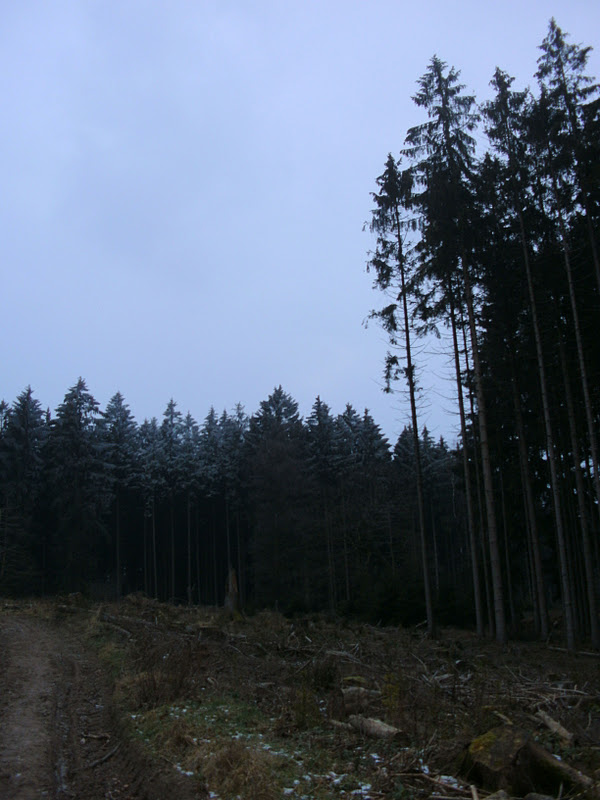
 Yesterday the woods called out loud, and I answered by bike;-). Had to change my brake pads beforehand, but then it was venturing out into the forest. I love going by bike not only because it takes me places, but for the riding in itself, too, obviously. I had to take the road some kilometres, but then it was a long single- and doubletrack up the hill. Peace. Silence. Solitude. Into the dark spruce woods I ventured, and the higher I got, the more the frost had bitten into the trees´crowns. The ground was frozen solid, and what was formerly mud was rock-hard and dry, making for fun riding where the ground was smooth and hard work where there were swampholes.
 And the woods were dark, and a gentle breeze moved the crowns of old spruce and fir trees. I have loved this song, the song of the wind in the treetops, ever since I was a little boy. It was the first sound I heard consciously, and it will always be a part of my soul. If I could utter one wish, I would like to die my death hearing this song, when it is time. Of course, I hope, it will be some time coming, still, for life is still great!
 I found the scarf underneath those blades in the woods. I have made a sheath for Lugra-Moros, and its poem is also ready. Also, my Nessmuk has a garage, too, now;-). Bit crude, as always, but then I did not draw anything beforehand, DOH!*ggg* And it gets the job done, keeping the blades out of harm´s way. The Nessmuk sheath has an inlay of felted wool, by the way.
 Who was it that said there can be an entire forest in a cup of tea?*ggg* I rode to my favourite place, and had a cuppa tea, and sat on the root of a birch tree, put on extra clothes and a blanket, closed my eyes, and gave in to reverie and meditation.
 I sat there for one good hour. Then I lowered my saddle, put away my stuff, strapped my rucksack on tight, donned gloves and helmet and bested my personal best down that singletrail by 3 seconds. Time stands at 29 seconds now, down the Steinbruch trail.;-). Time to beat, Jandark, Kai and the others!*ggg*
 This is the place, a peaceful, silent place above the lake.
 The trees are slowly awakening!

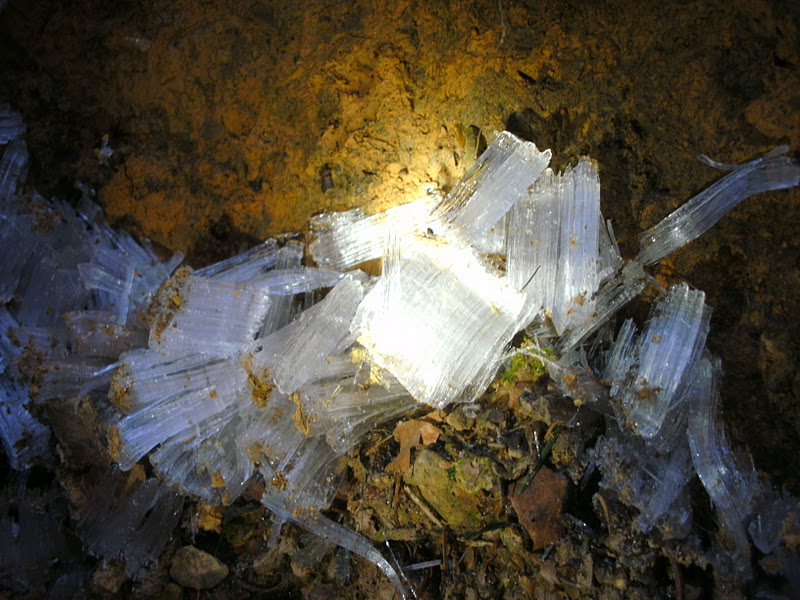
 And the winter solstice hints that the light is always growing stronger. I want to give to you the hope that night is waning and spring is on the way. These ice crystals I found by the trailside hint of that, too, at least in my book;-). They bear the light in their cold heart as well as the darkness. They will melt, and they dissolve the light into thousand colours.
 No life without death, I thought, no spring without winter, no fire without earth, no earth without fire, no water without air, no air without water. Or fire, or stone.
 This light shines in the darkness. It is the star that is hidden beneath the roots of the mountains.
It is the star that is hidden in the crystal, which in turn is hidden inside my soul. And that crystal will not melt.


Dream mode over and out*ggg*, all in all, a great ride of sic et non, of contrasts and of harmony. 
Perfect for me....;-)

Mittwoch, 7. Dezember 2011

New sheath for my other damascus "rún iaránn":-)

 This is a knife I really like, especially for salami and bacon and snacking in general, and you might be vaguely familiar with it. Zwissler seven-bar damascus and bog oak found in a mine near the Bethaus smithy. But for this one I had no sheath, too, and an unreally great evening crafting with propably the best friend I ever had. Thanks, drui, for the great time!
 The sheath is top-grain veggie-tanned ;-) leather wet-formed around the knife. I had quite a hard time fitting the knife into it, no preforms you know;-). I really start to like this style of sheath. They are lean, relatively fast (albeit not quite easy:-)) to make and keep the knife in like a cinch, even after they have seen some use.
There´s no inlay, but since there are no seams to be cutten through, this should not pose any problems. I like the rustic look of the front seam, too.

The stitching gets slightly better. I have to carve and tan it some, and then it will be ready to carry,

New sheath for my little Hadseax

 I had no decent sheath for one of my favourite knives, and I had the privilege to have an unreally great crafts evening with the friend of my soul, and I grabbed the opportunity to make a half(:-))- decent sheath at last. The knife helped a lot, and I liked it. It´s always kind of a reality check how good your designs work when tooling leather, It works well, so I guess I got one thing or the other right:-). The sheath is untanned, wet-sculpted leather. The knife design is a bit complicated to make a sheath in this style for it to hold it in properly. I sculpted a groove and made an inlay into it. How it works when the sheath has seen some use remains to be seen. The sheath has yet to be tanned, and the stitching´s a bit sloppy as usual.

Had other things to look at and to distract me*g.

But it keeps the blade in and out of harm´s way.

A total of the knife and the sheath. I braided the belt loop. I´ll maybe give you a tutorial on that later:-).

Dienstag, 12. Juli 2011

Fun day working at the Industriemuseum again

 That first weekend of the month we met at the smithy at the Industriemuseum again, Willi, Mr. Rothenberg, Daniel, myself and several others, to do some tribal bashing and having a coffee or two. Willi tempered the viking knife he made last time.
 Daniel made himself a screwdriver. It gets the job done excellently, made from spring steel and all.
 That´s Willi´s EDC survival kit and his entire leather working tool kit! He knows how to do this inteloligently. That tampon he uses as tinder!
 That´s a kid´s knife I made that day. I daresay sonny will not see much of it, for  daddy had that twinkle in the eyes when I handed it ti them (I always hand out knives for underaged persons to the parents first, by the way). It´s made from spring steel.
 That´s an excellent and ancient Jemenitic Jambiya Frank brought in, a guy working as a hospital consultant. he dropped by for me to estimate if it was crap or not. Damn me, should have said it was crap and talk him into leaving it to me;-), for its an excellent blade. Could not be too sure, but I etched it and it seemed to be Wootz "damascus". The handle is fitted with resin and made from giraffe or buffalo horn. We will restore it, very carefully, and I am honoured by that!
 That´s the sheath and belt ensemble, made from brocate and leather with a high degree of craftsmanship. They do not make them like this anymore...
 Mr. Rothenberg enjoying himself making a garage for his knife. Willi did the tutorial this time. Unfortunately I was not able to take too many pics, I was being so busy foirging with kids and other visitors.
 The evil monster  in the sheath.
 Did I say evil monster? Started this one, which will be a "Langes Messer" (German hunting sword) after Johannes Liechtenauer, Thalhoffer or Albrecht Dürer (Tecak, Dussack). It will be my first sword. Made from leaf spring steel... how come they always look like seaxes when I got them under my hammer?;-)
That´s Frank´s pretty side. Unfortunately for me I forgot her name, which she certainly does not deserve. She did quite well forging a keyhanger that day and was a bit amazed she could. It´s often the girls are reluctant to forge for fear of not doing well. Come on now, pleeeaaassse, give me a break, most girls actually do a better job than most males, for males tend to use brute force where women often are way better in the delicate part of the work. Doing small artisan work often requires a lot more dedication and concentration. I find women often are more focused when this is concerned, too. Anyway, it was a busy day, and I got no coffee, but no harm done. It was constant pounding and no break whatsoever, just one brief pausing eating a nitty bit and drinking some water, but it was a day to behold!

Beliebte Posts