Mittwoch, 17. Februar 2016

Jagd und Hund 2016 - impressions from bushcrafter´s paradise

 Yeah, it´s that time of year again, and the exposition in Dortmund opened its gates again. It was somewhat business as usual-and yet totally different. I went on Tuesday and Sunday this time, and Sunday was the first time I went there with a bunch of people. Tuesday was the day for chats and encounters. About one of the first booths I visited then was the booth of Mr. Kalman Szábo. He is a Hungarian knifemaker who makes meticulously crafted knives at a bargain. Made from 1.4034 mostly, they come with a mirror finish, little tolerances and a razor edge, and razor means razor...;-)
 He had some more modern models on display, but also some lovely Hungarian traditional designs. Some of the folding knives were huge, with blades up to 15cm!
 I was more fond of the more sensible models, however.
 Not too bad were the fixed bladed knives;-):
 Now 1.4034 is a relatively simple steel and people tend to sneer at the concept of making custom knives from it. But in fact, you can sensibly harden that steel to 56 HRC, if you know your business, and, yap, everything comes at a price.
 Owning a knife from Mr. Szábo I can say they hold an edge very well in relation to the steel employed. In the woods you do not want something hard and brittle, but something that holds an edge well enough while remaining flexible and easy to sharpen. So, in my book, those knives to a well enough job for the prize... custom handmade knives for 75 € anyone?
 I also loved those antler carvings. In Hungary this art is alive and well!

 ...
 ... onwards to the Dannecker booth with labelled knives with some really great ideas.
 The knives are partly made in the Czech republic and partly in Spain and Taiwan, but at a reasonable quality for reasonable prizes...
 ...and some cool designs, too.
 Back again: This is Mr. Szábo.

Then I went on to visit the birds of prey which were displayed in area 3A. There were also the children´s programs going on there.

 Children could partake in learning programs that looked like fun...;-) not a commonplace, if you ask me!

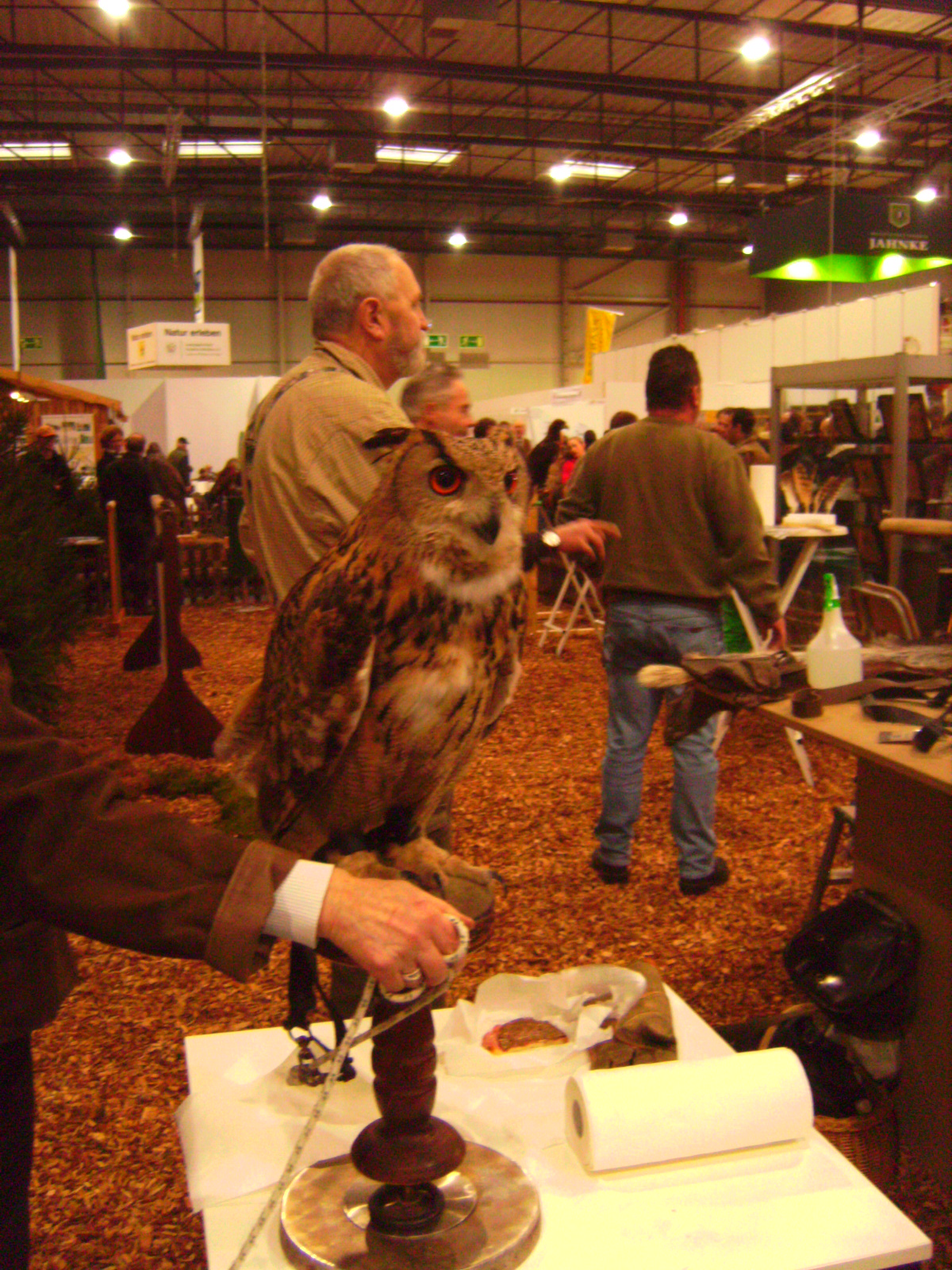
This is a case of YOLO...You Obviously Love Owls;-)...


This fellow actually did not like me much...;-)


 Falconer´s gear... lovely belt pouch, cloves, bells and cap.
 There also was a rather spectacular offroad parcours on site where you could actually test drive an offroad vehicle.
 This one would make for a great hunting vehicle...

The areas were well visited, but on Tuesday it was not that crammed full. Still, there were a lot of people around...

 Then I went to Gunnar´s booth. Gunnar works for www.siljan.se who make very practical Mora designs, including the famed Wasa knife. Now Gunnar´s a great guy. Once I worked for him, and I can really appreciate his being cool under pressure. He certainly knows how to work hard, but is also very laid-back and super-friendly at the same time. When we got there on Sunday, he gave us a huge load of weekend project Scandi blades out of three-layer-laminate steel, just to promote our beginners!
 The knives come in vivid colours and this may not be to anyone´s liking, but I guess I must not quite rave about Moras, do I? They are just THE one knife, period, when function is key, and they come at a bargain that often challenges me...
 Then I met with Rainer at the DMG booth. Rainer makes lovely custom gentleman´s folding knives, quite certainly not my personal style, if you so will, but still. Visit him at www.rg-knives.de. We had a chat, but then I cleared the space because he had a customer...
 And made my way to Attila Kertesz, who was displaying his art next to him. His website is www.afk-knives.com. Well worth a visit!
 Some of his works of art...
 Off to the booth of Nandger Franck (www.schmiedeglut.de). Nandger is a self-made man autodidactic knifesmith...
 ...and yap, he is not famous for nothing! Apart from that, it was a pleasure to meet and have a chat with him, him being a super - friendly guy.
 I loved this style of knife! He does a very clean Damascus, and the blades are certainly inspiring to boot!
 ...
 ...
 What was most intriguing was that he does a huge array of styles with his own spice in each. This is not easy to do, and it shows his pedigree as a craftsman. 
 Also on his booth were blades from monosteel and Damascus...
 Bushcraft knives and accessories.
 Then I went to Olaf´s and Heike´s booth. They are very great people and I am proud to call them friends. I helped them build their presentation again, and it was a joy to work with them - as always. They offer beautiful handmade custom leather clothing. This motorcycle jacket was made from 4 mm(!) bull leather. They do just about everything and are crazy enough to try things out.
 This is a jacket made from an old Swiss army blanket, custom - made to tailoring.
 Look at those buttons: They make each one of them by hand from old historical silver coins.
 I loved those vests from ostrich leather.
 ...
 ...
 Their prizes are very high, but given that buying one of those items is a more than lifetime affair and they stitch it all by hand to measure in Germany, often from local resources gives a new perspective on that. If I had the money, I would gladly spend it. Visit their website at www.wildfang-design.de

 They also had some smaller items on display, some Swiss army surplus, e.g. this tool roll...

 ...pouches, bags and paraphernalia...
 ...
 The booth was big fun, for there´s simply that much to see and all so lovingly arranged.
 Then suddenly it was Sunday, and Julia, Kathrin, Martin, Nick and myself went to see the expo. At first I was somewhat fuming, for the girls were constantly going their way without further notice, so it was a bit of a cat-herding going on, but we made appointments, and all went smoothly afterwards. We all were very fond of the booth of Juha and Jorma from Wood Oy, Finland. It was a bit like coming home, with the warm colour of birch burr greeting us and the guys being as they were. We had a great chat and I hope we can get together at the ironforge soon, folks, for it was a jolly meeting.
 I loved these clocks and wall boards.
 pendants, and we got a whole load of raw materials, too...
 ...ahem;-), yes, I must admit it, I do not react entirely rational to those wood jewel knives...;-) I got myself two of them.
 ...because it´s funny. I may be a knifemaker, but every time I try to get that special flair into one of my knives, I mess up one way or another, and it does look like a German knife, not a Scandinavian design. Yeah, true, I hear you say, you´re a German, so it´s no wonder you make German knives. But to truly understand how knives work, you have to make them "and fail properly";-).  
 But, no harm done, it did not feel that bad to have an excuse to buy some more blades...;-)
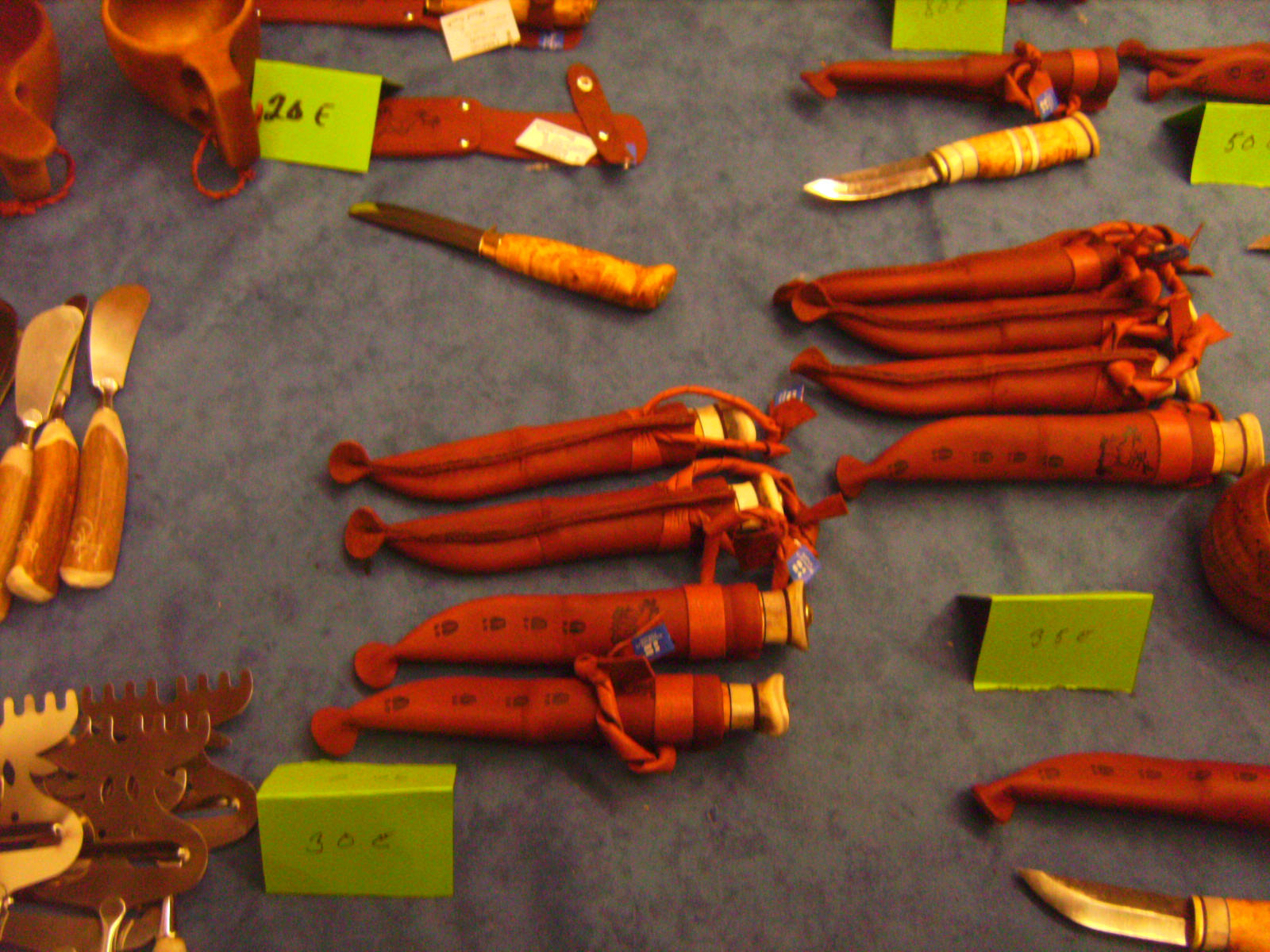
 I really love those Saami sheaths out of wood!

 Yeah, that´s 50€ for the knife in the picture...;-)

 I daresay it was a bit of an eye-opener to Martin, who is currently starting his own swordsmithing business to see the prizes (which were not THAT expensive given the quality!) at the DMG booth.

 ...in fact, for the quality, they were a bargain. This is one fine example by Mr. Fazekas.
 A real asset was that Mr. Fazekas  had his new book on display, and I guess I´ll get myself one in Solingen.
 Then we were off to the booth of Peter Huber (www.messerdesign-huber.de).
 To start with I must admit I did not think much of these knives. While they were excellently and meticulously made, they came in a powdermetallurgical steel hardened to 71HRC. Yeah, you read it right, that´s 71 HRC. Of course, as Peter said, these will most certainly be knives not exactly intended for bushcraft, but that´s not the culprit. It does not make sense to me, and I fear most buyers will put them in a showcase and leave them there.
 There will be a review of them in Messermagazin soon (www.messermagazin.de), and I daresay it will be a rave review...

 But other than that, all was grand in wonderland with all these really lovely German hunting knife designs around, which I found really inspiring.
 ...I simply love those elegant integral bolsters!
 Nicely made butt-caps with the tang peened over-perfect!
 Some sketches of Peter´s.
 Also he had this historical hunting sword from 1880.
 Round the bend there was this lady with a 100-yard-stare and constantly throwing sparks off a firesteel;-)... I was really enjoying meeting Gabriele from Karesuando, quite certainly one of the nicest persons around!
 Karesuando had a whole lot of new products on display. I hope to get some production proto photos soon, because my crappy camera just does them no justice.
 For now these sneak previews have to suffice: A lovely Saami knife design...
 And some really bling knife. The Ripan (willow grouse) exclusive edition comes with a damasteel blade and black diamond inlays... I hope to give you an article on the making of soon.
 But I must admit I loved this knife even more. It´s a knife that Gabriele made for herself. Just cool, if you ask me, in its worn appearance. A real knife that has seen real use (and a certain degree of abuse, too...;-)). Again, I was getting on the nerves of my friends by having another chat;-), but that´s how I am, am I?;-)
 YOLO....;-P
 ...and a lovely cupboard...
 Then off to the booth of Mr. Morsbach to get some Damascus for Martin. Now Mr. Morsbach always is good for something special. Here he shows his newest creation, a small folding knife from 1.4125 steel that will also be available in D2 soon.
The blade is ground to zero with a hollow grind. Mr. Morsbach (www.katzek55k.de) is one of the last qualified grinders in Solingen, and it shows. Apart from this, he also is a knife-nut always open for something new. I have a deep respect for him and the things he does, and have learned a lot from him.

Then all of a sudden all was over, and we were heading home with hearts full of pleasure and a truckload of goodies in our pack, and looking forward to 2017!

Freitag, 5. Februar 2016

Baltic / Slavic all-metal knife

This is a knife I recently forged that was a bit inspired by the Biskupin find from the 7th century. No file work yet, and it´s still waiting for a grind, and it is a bit longer than the original at some 100mm blade length, but I must admit I simply love those double scrolls. It is made from crucible steel I found in the woods and tempered selectively. Might be I will do it a bit less authentic and go for some scales, but we´ll see. As is, the all-metal design would make for a discreet carry. The balance is a bit awkward for me due to the weight distribution towards the rear, but we´ll see.

Some thoughts on the Sica

Now this is the blade I featured some time ago, a not-so-authentic version of the Daco-/Gallo-/ Roman sica knife. Arguably not so authentic is the semi-integral bolster, but I simply love it. But then there are sicae and other knife shapes found from the Roman empire or from Celtic and Iberian finds, e.g. a Sica from Botorrita, with a short socket where the handle was fitted into, just like with some modern-day gouges, so the look might be excuseable even for reenactors;-). The reason why there are no semi-integrals found (at least not with these relatively simple knives) and even full-tang knives are relatively scarce (abundant only in Roman and Celtic countries, with the exception of iron age seaxes in Germanic culture, that presumeably had an Eastern provenience, another interesting topic), is that iron, and even more so, steel, was costly and was obtained at great pains. It tells a big story that in ancient Rome full-tang knives were quite common.

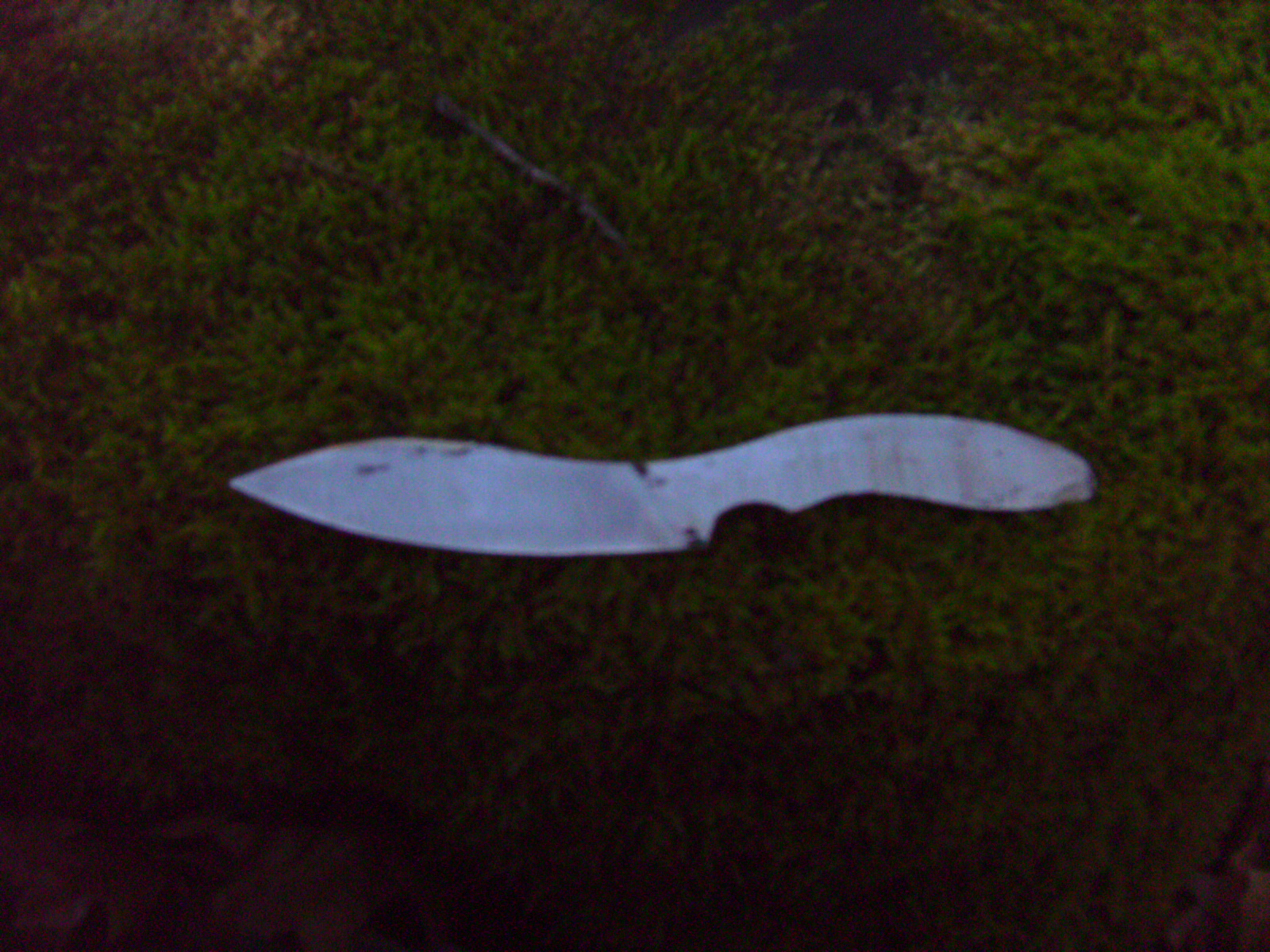
This one, however, does not at all claim to be a detailed reconstruction. It is made from an ancient chisel I found in the woods and shows a very weird spark analysis, might be Tungsten-alloyed steel such as HSS. The Sicae (or Kopis) knives I have made so far were not having that much an offset in the blade, and I thought to give it a try to test out the extreme. I have, for now, put a piece of antler on it to check out the balance while I contemplate what buttcap to fit. Balance point should be on the index finger.

Having played with it I must say that for everyday tasks such as cutting meat and slicing onions you have to think along a different train of thought. The blade gives you fierce cutting ability with a good purchase when you use it in a drawing motion, as you do with a sickle, so to say. The forward orientation of the tip gives you the possibility for a more pushing motion in a pressure cut. The shape of the blade really shines in two aspects: Woodcarving and slashing. The blade is ideal for delicate woodcarving in my book. I also tested the chopping prowess and again had to apply a different mindset. It will not work when you use the same motion as with a straight, say, drop-point knife. Is it less capable then? Not in the least, because when you use a straighter knife shape, you always have to adapt to the natural arcing motion of your wrist. With a Sica you have to keep in mind that this is not necessary. You can chop softer wood with a slashing motion by keeping your hand where it is and your wrist tight. Of course, it is no Khukhuri, but I was amazed.

The Sica in ancient Rome had a somewhat sinister reputation as the preferred weapon of back-alley cut-throats, and, having handled it, I can relate to that. It would also make a very effective fighting knife, if you knew how to handle it. The tip is always forward, and the sickle shape makes for amazing slashing capability. What fascinates me with this, is that the blade´s shape is most ancient and dates back to the earliest bronze age. And it actually follows a whiplash line, and I can´t tell it any other way, also feels "whippy". The "sweet spot" or "purchase spot" lies along the line of a Golden Ratio spiral, and, while there are always some liberties taken if you apply static geometry to a dynamic process, I strongly suspect that this has something to do with the "springy" feeling when  slashing. By the way, if you analyse the ideal curve of the application of force in some martial arts, you also get the impression of a similar dynamic (whiplash line e.g. in Qi-Gong). Of course, yeah, I admit it, I am a bit obsessed with that whiplash line thing, and might be I see spectres everywhere, but I can´t think of a better model for explaining it, and it works for me in martial arts and even mountainbiking, so, hey, I don´t get paid for this;-), so I can cook up any theory I´d like.

The culprit is, it was a great experience again to actually be able to do some work with a most ancient blade form. You can talk about endlessly about who has written what about it and when, but only if you rebuild it and use it will you be able to understand, and the enlightening effect feels that good I think I am getting addicted to it.;-)

When the knife is ready, I guess it deserves a "name" and a story, and I will see how it fares in the woods... watch this space!

On the bench-Nessmuk full tang

Currently on the bench and waiting for the finish is another Fimbulmuk design;-). I really love this style of knife. I have a great respect for George Washington Sears, not necessarily because I just think his more prosaic works are useful (they are, still, if you adapt them to modern times) or because he was a special man (he was) and a poet (he was) and an accomplished outdoorsman, but because he lived-in spite of all the adversities and difficulties he found a way to live his life. So a Nessmuk, while being a practical design, always is a kind of statement to me, a tribute to the ol´man.

This one is made from 19th century crucible steel and that steel might actually have some of the same properties the Nessmuk knife´s steel originally had. The tang has yet to be drilled out for balance, and there is still some flaw on one side that I have to get rid of, but then it will be good, I guess...look forward to it.

Oh the loot! ;-) Or: The adventure of steel processing

I went foraging for steel again in my local woods, and was stunned to find a treasure hoard again. As you say-one man´s trash is another one´s treasure. In this case it applies in the truest sense of the word. A lot of the steel I keep finding there is ancient crucible or extremely high carbon tool steel or saw steel. I found a chisel with a kind of octagonal shape, and having already processed one of those, I strongly suspect it is made of a very funny kind of steel. Spark analysis on the Sica blade showed dark-red, almost invisible sparks-but with bright-white sparks at the end, and, compared to file and spring steel, very funny shapes. Fact is, I can´t make heads nor tails out of it. Might be Tungsten in it or any such like, but what matters most to me is that the blade I forged from it keeps to a good temper with a very fine grain and a high amount of flexibility. So I look forward to the next.

Yeah, I know. I might not be that good with metallurgical theory. I make knives that have to work, and if I want to work with stainless or other stuff I should know my theory better. Yeah, I know, but DO I? Do I have to?

I have to admit that a lot of my tempering is done very intuitively. Of course, sometimes I get it wrong and have to do it all over again or worse yet, the knife breaks when testing. But, honestly, the last time I broke a knife is 3 years ago, and I have made a lot of them in the meantime, and the times when I get it wrong (with steel utterly unknown to me) I can count on three fingers.

I do not want to brag about my oh-so-extraterrestrial capabilities in bladesmithing, because I am not that good. What I want to say is, that it is possible. I forged a blade out of 440C intuitively and it stood up to some severe pounding while keeping an edge well. I daresay that´s what it´s all about. To be honest, I thrive on the adventure. There is something very archaic about bladesmithing and I find it more intelligible when you do it intuitively. It is like getting to know the NAME of iron. Not just the word, but what it really means, if that makes any sense. It is like I can tell you the word blue, but you have to feel it to know the blue sky on a warm summer´s day.

Patrick Rothfuss in his novel "The Wise Man´s Fear" (which I strongly recommend!) tells the story of a teacher of the arcane teaching "names". Not what we commonly think, but the actual names, not the sign, but the meaning, if you get my erm... meaning;-). He states that he will throw a stone at a given time with a given force and asks his pupils to calculate where the stone will fall down. Several well- educated people then start to make calculations, drawing diagrams and the like. When time is out, the teacher just opens the door and calls on a messenger boy, and without further notice, throws the stone. and the boy catches it on an instinct.

I know a lot of accomplished blade- and blacksmiths who make great knives, strictly according to the book of rules. Some make very durable knives, but some don´t.

And then I know several old Russian blacksmiths. One of them even could up until recently not read the newspaper or write his own name. He uses scrap steel, even rebar for his knives, and they are standing up to an abnormal degree of abuse with amazing edge-holding capacity. Viktor used rebar, too, and mild steel, and scrap and junk steel to amazing effect, too. They taught me one thing: That there IS the name of iron. You could put a piece of rust-pitted steel into their hands, and just by touching it they knew what to do. When asked, they failed to give a satisfying answer and just said that it had to be that way. Mielenko knew his numbers well, but was capable to tell the carbon content by the sound the steel made on the anvil, by weight and resistance alone. None of his knives, he told me, has ever failed.

I am a poet. A lunatic, if you so will, beloved of the moon. I tell a lot of crazy tales. Only on a secondary level am I a blacksmith, bladesmith or even bushcrafter. Might be it is like a kid once told me that in a different world or different time I´d be called a wizard. I like that, of course, but we live in 2016, and the world's not at all a place for wizards or warriors or even blacksmiths.

I have been on this path for a long, long time now. I know the wind and what lies therein. I know the sun and the moon and the stars and I love them. I love the earth and the trees. I listen to creeks and the murmur of the wind in the "soft, round tops of the pines and firs". They tell me of another world, a world of meaning, without signs, but names to be learned.

And with each piece of iron I find in the woods, I tell a new story, and learn the name of iron and fire. My knives are always more than just a blade and a "been there, done that", at least to me. It is not just a thing you covet and because you can´t afford it, you make it yourself. Their names are an armour I wear in the everyday mayhem of our world, even if their blades lie in my drawers. They are the gift of the woods, tormented by man and crooked and weird and powerful. Beyond the dream road through the wood of steel - lord of the forest makes love to his goddess; beautiful is the image of the moon in the water (to corrupt this famous Bujinkan meme;-)).

Every time when I go foraging for steel then, it is a kind of spiritual experience. It is an initiation as well as a lesson in humility. When you find, you find. If not, you find not. But if you do it according to the meaning of it all, chance is, you will find a treasure.

Donnerstag, 4. Februar 2016

Semiotics of Camouflage - An essay on Skóggángr philosophy

The term skóggángr refers to being in the forest for exile. It has an affinity to spirituality, survival and martial arts, and I have established it to sum up an activity that´s not new, but has never been combined that way in a consequent manner.

The primary idea is that while the term "skóggángr" in the times of early Scandinavian medieval age and the so - called "Viking age" referred to the process of being banned from the community of man (which often equalled a death sentence), its modern use is somewhat different. It has to do something with keeping one´s psychological, mental and physical health, if not with bugging out and surviving.

According to my observations, many people in modern society suffer from more or less grave psychological problems. Most people in leading positions are arguably in very poor psychological condition, if not mentally ill. A big part of the population is living a life depending on the authority of phone and internet providers, product identities and fashions and are very much ruled  by antidemocratic forces. In Germany, clinical studies some years ago have depicted that every third person in modern German society suffers from burn-out depression or a similar mental disease. Personally, I´d rather say that every person in Germany does at one point or the other.

Skóggángr is a term for my very own, personal escape. It does in no way claim to be "the next big thing", and I want to beg of my readers to take it all "cum grano salis". It´s just a way of living - and fighting, or better yet, avoiding a fight, if  you so will. To me, it offers a strategy to survive a life that is not exactly easy and have fun with it.

It might be escapism or an escape strategy, and the difference in terminology does not matter at all here. As a "martial art", if it can be called that way, it is aimed at being primarily defensive, and secondarily aggressive. This means that escape is the first priority, and attack is prioritized secondary. If an attack is necessary, it should be done with control and precision and utter commitment to make sure the aggressor will not come back again. To achieve that, any defensive movement has to be linked to an attack.

To achieve defensive and aggressive efficiency, camouflage techniques play an important role. I am no master in that, I am a student myself, but as a student I want to start by laying my foundation. To properly evade a sick world, you also need a spiritual camouflage, by the way.

The key to successful camouflage is crypsis. To define what is done in crypsis, we have to define first what the situation is.

Human beings can process roundabout:

visual 10.000.000 Bit
skin/haptic 1.000.000 Bit
acoustic 100.000 Bit
olfactory 10.000 Bit
taste 1.000 Bit

This might sound quite impressive, but these are theoretical numbers. It is relatively safe to say that only 10 % of this amount of information are actually consciously processed. According to Hogrebe (1995: Metaphysik und Mantik) the procession is established via a telic process and an act of semantics. Semantics in this case refers to the process of creating references between sign and meaning i.e. semantic interpretation (see also Ferdinand de Saussure and Charles Sanders Peirce) in a psychological and physiological coherence. The telic process in itself is not logical, but fractally organized. What we can relatively safely assume is that every object or subject emits a lot of information. Some of this information is not received by humans in the first place due to biological limitations, most of it is dismissed and cached as subsemantic, and 10 % of the signalled, perceived and processed information is subjects to the process of semantic interpretation.

As individual sneaking through the forest you emit a lot of signs, you cannot help it in any way. Crypsis now has several ways to obscure these signals.

1.visual (optical) and acoustic camouflage such as mimickry
2.nocturnality
3.semiotic camouflage

1 refers to the commonly used camouflage techniques known from the military forces, which are inspired by nature: https://en.wikipedia.org/wiki/List_of_camouflage_methods. Signals are obscured by obscuring outlines, countershading, blending into surface signals, and other means of overlapping and contradicting information (see 3). The "grey man concept" is a good example of blending into a crowd and serves a good job in illustrating the principle. What you want to do is avoid creating an optical or semantic stimulus. In order to do that you blend into the environment, obscure your outline, avoid contrasts and send contradictory signals. Movement is dynamic and creates contrasts and rhythms that are perceivable way better than a static perception, so the resulting contrast has to be minimized as much as possible by smooth and slow movements that mimick natural movements such as branches moved by the wind or an animal moving through the underbrush.

2 refers not necessarily to a nocturnal lifestyle, but to make use of naturally diffuse lighting situations to obscure position or movement, a challenge with camouflage in general. Low light situations easily coincide with other camouflage techniques.

3 semiotic camouflage refers to a technique of manipulating signs emitted from an object to give the impression / interpretation of
a) irrelevance, and thusly hypnagogic / subsemantic reference
b) being non - existent
c) being a different object

While b and c are obvious, a has some implications to the philosophy of skóggángr, for while camouflage in this context is aimed to be mainly defensive, hypnagogic reference has more implications than that.

If we assume a discrepancy between sign and meaning, and assume the setting of signs as a semantic, telic and psychocreative process, that leaves us with a whole world of subsemantic processes  happening all the while. The so called process of "hypnagogic vision" (Hogrebe, 1995) is a technique to gain access to the subsemantic aspects of perception and also offers access to subconscious processes. Subsemantic perception, however, is just a dynamic part of the subconscious, but not disconnected from the rest. In that manner, if we see something that "strikes a note" but "cannot put the finger on it", it is relatively safe to say that we are faced with a subsemantic, subconscious process that has a whole lot of implications. In Crypsis, we want to appear irrelevant, so, spoken in a defensive sense of the technique, we want to appear irrelevant. The "gray man concept" makes use of this, and in woodland camouflage we want to
-move stealthily
-avoid sound
-use woodland colours, i.e. "Ghillie suit"
-appear "sanitized" in a woodland sense of the word, meaning creating no stimulus for animals or human aggressors
-not "mimick a bush, be a bush"

In Skóggángr I want to turn defence into an attack. This can be done in this context by sending paradox stimuli to the aggressor. There are toads using bright, vivid colours to imply that they are poisonous. In a similar manner you can try to look unattractive or stick to an environment no one in their right mind would voluntarily walk into: Swamp, rockslide etc. Looking "poisonous" in this context has to be handled a bit careful, for human aggressors will not stay away from you if you wear neon ;-).

I am practicing for something different that at the first glance sounds a bit weird. There is a connection between the subconscious and the subsemantic, which is a psychological commonplace. There is also a connection between concept (idea) and reality, or better yet, idea and physis / phenomenon. The idea is linked to the subconscious, which makes techniques like hypnagogic vision and reference possible in the first place. The subconscious is partly universal, when human beings are concerned. It takes root in the body and can have an effect on the body. This means, there are psychological implications made by subsemantic processes not prone to semantic perception, and these implications can have an effect on the body. Vision is a physiological property. This means, if you send psychologically relevant signals in a subsemantic manner, you can have a direct effect not only on the psyche but also on the body. Hypnagogia commonly refers to the state of "drowsiness" before sleep, but is used also to describe the state of mind in meditation and hypnosis. The laid Dr. Karl Pribram (2007)( http://www.scholarpedia.org/article/Holonomic_brain_theory) with his holonomic brain (perception) theory not only showed some heavy evidence of the  nonexistence of time and space in neuronal networking and in my understanding, the universally connected linking of the network, but also (in: Brain and Perception, Addenda) experimental evidence of the possibility of creating alpha brainwaves voluntarily. This is not a one-way street in that this "drowsyness" can be used in camouflage and mental attack techniques on the opponents psyche by using subsemantic key signals. To put it simple, you emit key signals that dazzle the opponent. In its simplest form it means confusing the aggressor, in a more sophisticated form inducing hypnagogia by using key signals, and, possibly attacking his own subconscious psyche via hypnagogia. You move from reality to idea and from idea to different reality, to put it down in a bit of an abbreviated manner.

This does not necessarily mean some metaphysical concept of magic, but, as Sun Tsi put it "knowing your enemy". To achieve this you have to keep a psychological journal of his behaviour and identify key signals. Those have to be combined in the common techniques of (sensible) hypnotism. To be quite plaintive, digital camouflage works along the same lines, but with physical properties.

I will talk about the more aggressive aspects of this theory in a future post and also give you some examples and insight into my hypnagogic training.


Donnerstag, 28. Januar 2016

Ahlhauser ironforge website online!


Roland had a fit of creativity;-) and set up a new site for our founding club. Visit:

www.ahlhauser-hammer.de

to get the static data and informations on founding (if you can find it in you to make a donation, feel free to do so!;-), we have a roof to put on and are desperately in need of funds. Any amount, however little helps and is put 100% into restoring the buildings and the historical machinery. Use the contact form on the website if you need a receipt!

Choose this bank account:

Ahlhauser Hammer
"Donation"
Märkische Bank Hagen
IBAN: Nr. DE48450600090066445600
BIC Nr. GENODEM1HGN

And, of course, if you´re in the vicinity, drop me a line, and I´ll show you around.

Beliebte Posts