Those are the adventures of Mr. Fimbulmyrk, in bushcraft and blacksmithing, mountainbiking and hiking, reenactment, writing, singing, dancing, stargazing and having a piece of cake and a coffee. Pray have a seat and look around you, but be warned - the forest´s twilight is ferocious at times.
This is a fun little project I started in the magic troll 's living room. Actually there are few things that I love more-we were sitting there, after having some lovely, simple food, with our snacks and cozies and a hot beverage. I mounted a knife blade from Helle Knives, she made her beautiful Naalbindning needles, while there was some sort of documentary on the TV. To me, this is not only the perfect wintertime pastime, but it conveys a lot of meaning to me. I do think that this, or something very similar, was what our forebears did when the weather was grim, way back to the paleolithic. Well, without the telly, obviously. 😉 If you want to see her work, drop by Koboldkerker.blogspot.de, well worth the visit.
Anyway, I really do love Helle Knives. The blades always come in razor sharp, and most of them get the task done admireably. We had those Skóg/Fjellmann blades lying around for ages. It is made from H3LS, a three layer laminate steel with a carbon steel as a cutting layer and arming steel sides from 18/8 stainless steel, which offers rust resistance from hell, but cannot be hardened. It offers a bit of spring resistance, though, when forged. Blades like that are made by Helle since time immemorial and have been proven to be really resilient.
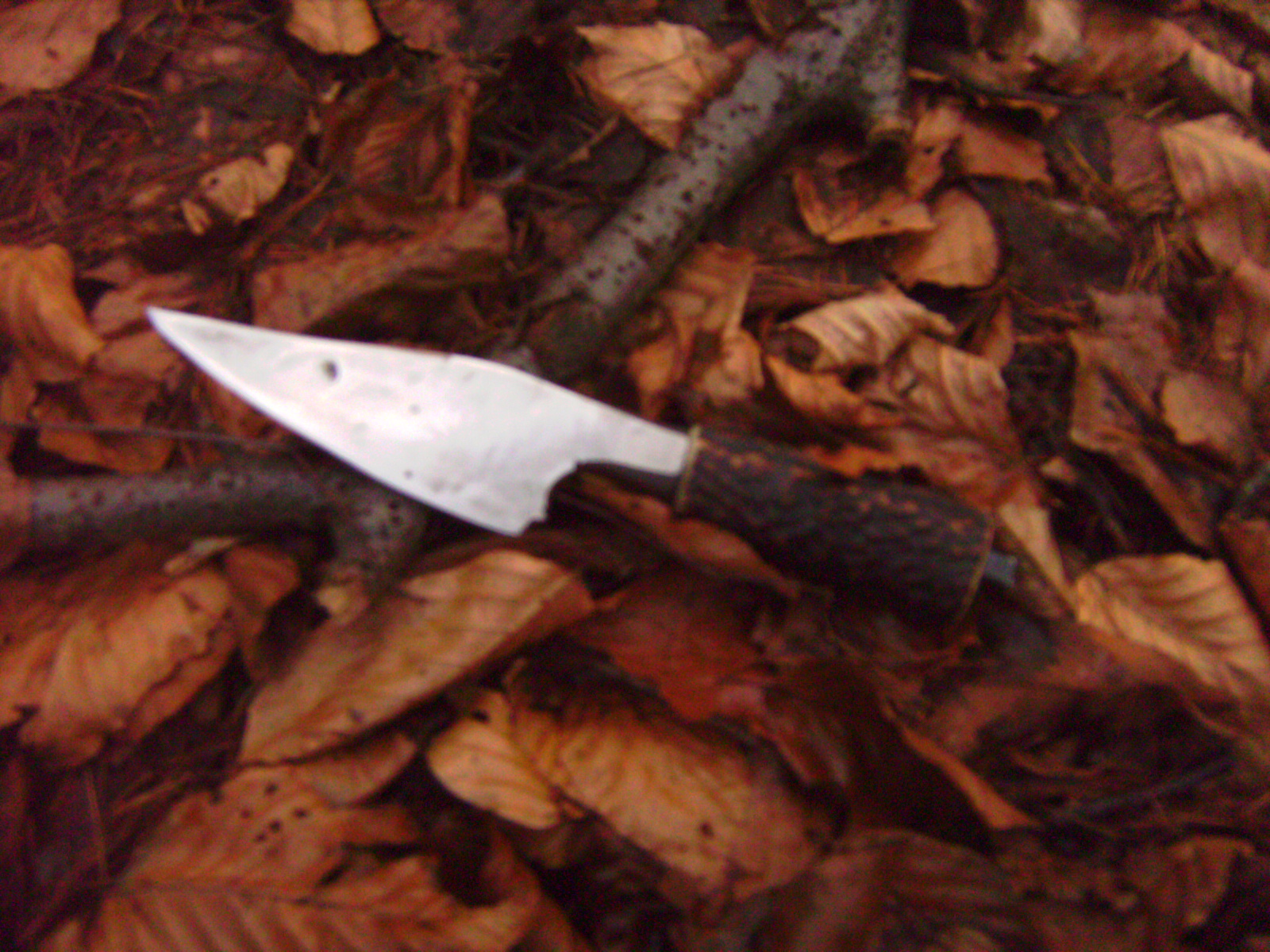
I mounted that little blade (80x2,7 mm) with a handle from reindeer antler and birchwood burl. At the first glance, it doesn't look any special, but it is
This is the original find. The pictures are copyright by @vegardvike and museum of culturalhistory, Norway. On the pictures you can see that the knife has a rather interesting handle shape, with sort of some diamond cross section and sort of a bevel towards the edge line of the handle. And testing my sample pieces, I found this to be a real game-changer for a lot of applications, from food prepping, to skinning, and it really excels at wood carving.
On the picture below, you can see what I mean.
I wanted to incorporate this idea in a more modern handle design. Because, while the handle on the Trollstein knife is actually really efficient, it also makes the sheath design a bstd to get right. Also, I do like a little more contour and purchase in the handle. So I put those facets on a more modern design. It is obviously not a replica, but really works awesome. It is about the principle of signalling your brain and body which way you hold the blade. And what I want to say is, that I would not have known had I not tried to make a replica of the find.
Archaeology gives us insight into the knowledge of the past. The principles that people applied historically still are relevant.
In Germany, there is something going on that can only be called a culture war against all things of cultural heritage, science and craft. I do know it is even worse in the US. At the Uni, there is currently a move of the administration, and behind that, possibly altright political forces, to close down entire ethically relevant faculties like Archaeology, literature and philosophy, but also actively defunding medicine, mathematics and physics.
Think about the relevance for your actual life situations. For Archaeology, it might not seem obvious, but the relevance actually is pretty commonplace. Call it "the knowledge of the ancestors" if you want.
I am not actually asking "cui bono" yet, because I do not need to. Suffice to say that this handle design is really a rather enlightening experience.
And it was first designed in the iron age.
If you possibly can, try it out to get my meaning.
I have been doing a lot of small bushcrafty projects lately. I find it is soothing to my mind to know how to create things out of nothing.
Do not get me wrong - I know perfectly well all of the stuff I know is not relevant. I am just biding my time. I am waiting for death, nothing less, nothing more. No so - called "Survival skills" will save us. There are a lot of people knowing a lot more than myself. But all of us are inevitably doomed. The lunatics ruling us will make sure of that. Nuff said.
But how I spend the time until they finally pull the trigger, is none of their business, not yet.
Making things in the woods makes me happy. Of course they do not want anyone to be happy, so I try to be as happy as possible. Maybe this is childish, but I do not care. I do not do this against anyone, but for my soul. Just because I have the custom not to soil it with their swamp, if not because I believe in something greater. Something good. Who knows? It is not fashionable to believe in anything anymore, but I am an old fart, so I am entitled not to be fashionable.
I made myself a spoon from elm wood. Actually I have fallen in love with this wood. I love the colours and the oxidation. I also tried my hand at some Kólrosing, which did not yet turn out too well, but could be much worse, so actually I really like the outcome.
The little pouch I just made to practice the technique. It is made from bramble splittings weaved together. After plaiting, I gave it a quick oiling to keep it flexible. I still have to learn a lot, and that is a very good thing, because it keeps my mind off things.
The "Nessmuk" I made some years ago. It is made from spring steel with a selective quench and temper. Scales are desert iron wood with mosaic pins. It is a bit of a controversial knife, having a spine thickness of almost 9mm at the handle (albeit with a distal taper towards the tip). For the length it is a very able chopper, but it is also a very heavy knife. Having fallen in love with Moras again I find it stays at home more often than not. Actually it also cuts quite nicely, but it needs to get some getting accustomed to it, mainly when carrying is concerned, but still. It is a monster, and actually overbuilt for what I do these days.
Anyway, it still is a very good feeling to make things out of nothing, to be even able to do so, in these times, and doing it with tools you yourself made from junk noone cares a runny shit about.
So, I had this blade lying around for ages. I have this from the last producing smithy in Solingen, and it was courtesy of Mr. Rudolph Broch, one of the best bladesmiths in Solingen city in his time. As is customary in Solingen, you get to know someone (and mean it) and he or she tells you to go to someone (who is informed) and then you get to know this person (and mean it) and so on, and this was the manner I was being introduced to Mr. Broch then. I would not have found the smithy in the first place, it is quite hidden, and Mr. Broch welcomed me when he learned that I was interested in learning some tricks of the trade and enthused when I said that I really loved those old styles of Solingen knives. So, some ten years ago, he not only welcomed me to his smithy and showed me some tricks, but also showed me around his garage, which was brim full of knife blades and blanks that either were discontinued in production since at least 50 years or were never produced at all. It was a knifemaker´s wet dream come true, and it was like wonderland. Amongst the blades I found there were trench knives from WW I and II, hunting knives that would have made Horace Kephart envious... and a whole dispatch of puukko blades. Mr. Broch did not quite know for which corporation they were made, for it was way back then, too, put assumed they were made either for Iisakki Järvenpaa or Puronvarsi. What I can safely say is that they are made from stainless steel, and they were all Rockwell-tested with nine cone imprints along the whole length of the blade, with groups of three. The imprints were marked with a pen. The hardness varies from 57-59 HRC according to the markings, and, from experience with testing blades I can say that this is most certainly true. The temper is even, and the tang was tempered through, so I gave the end of the tang a bit of an annealing. The blade has a characteristical diamond shape, which is common with the Finnish type of woodworking knife. I fitted a nickel silver bolster and a handle of reindeer antler and birchwood burr.
The tang was peened over a flower buttcap I filed from bronze (still has some engraving work to be done to;-)...
To make for a more durable edge, I gave it a tiny secondary bevel. The blade is now razor-sharp, and will be a personal item... I´ll give it a classic simple sheath or maybe even something more fancy, we´ll see...
The Puukko has fascinated me as an everyday tool, but also as a cultural aspect, and I hope to be doing more on the mythology and history of this great style of knife.
to get the static data and informations on founding (if you can find it in you to make a donation, feel free to do so!;-), we have a roof to put on and are desperately in need of funds. Any amount, however little helps and is put 100% into restoring the buildings and the historical machinery. Use the contact form on the website if you need a receipt!
Choose this bank account:
Ahlhauser Hammer
"Donation"
Märkische Bank Hagen
IBAN: Nr. DE48450600090066445600
BIC Nr. GENODEM1HGN
And, of course, if you´re in the vicinity, drop me a line, and I´ll show you around.
Hi there and a happy new year to y´all! I had a good time in my holidays, but with no smithing, and had no motivation to shoot any pictures for an article of riding or the hikes I did. What I did, however, is spending some time with the projects on my bench, and this is one I like a lot actually. What I tried to do is incorporate the Jagdnicker design into something more buscrafty and combine it with some thoughts I was inspired to by medieval knives and swords at the Solingen museum. The knife has a wider blade than most making for a high grind line and good slicing capabilities. For the traditional technique "ringeln" (German hunting colloquial for a special technique to remove the intestines via the anus of game, mostly roe deer, with the help of a kind of curling cut) it would be not so ideal, but few hunters do practice this nowadays in the first place, and I am no hunter in the second place. I mostly use knives for whittling, preparing food and harvesting, and for that a wide blade with a good balance does the job well enough.
Speaking of balance-the blade has a very distinct taper from a hefty 10 mm towards the bolster to just a mm at the tip. While it is no prybar, it is surprisingly well suited for prying. I have to add a buttcap (I plan to do it in brass, bronze or silver with some engraving), and hope to get the balance point on the index finger. This is a very delicate process few will appreciate, but in my book it´s well worth the effort. There are a lot of knives on the market with hefty looks and awkward balance, and I want to learn to do it right. Having had the opportunity to handle some good historical pieces it never ceases to amaze me how well-balanced even smaller knives were. I made this one for myself and I like to handle the knives I make while completing them. I have already doen some kitchen work with it. It is an able cutter and chopper at the same time as is and feels nimble and dexterous. The handle is relatively short. With just a tiny shift of grip the pommel will come to sit in the middle of my palm. Sometimes, when hunting (if I were so inclined, that is;-)) you need to apply force with a thrusting motion (Opening the pelvis, for instance), and this would be a good feature to have. But I am still figuring it all out. I write this because the nuances are fascinating me, not because I know it all;-).
The handle is stag antler and might see some carving, blade is 11,5cm x 10-1mm taper, spring steel, selective temper and forged at low temperature and then carburized, the grind is a very high convex bevel.
Now this is something of a challenge. Friends of ours had asked for some really thin blades for re-enactment camping, as thin and slicey as it would go and stronger than usual. Hm. Wait... I daresay there´s something.. can´t put my finger on it... erm... HOWDAF***???
I grumbled a bit, thought and mumbled, grumbled some more and set off to work. I figured spring steel would be best suited for the task, with a triple quench dynamic tempering, meaning slowly, deliberately sinking the blade into the quench (heated, boiling lard), and then taking it out to temper with the rest heat from the spine to a blueish hue, resulting in a blade that is not THAT hard (but at an estimated 56 HRC still hard enough). The blade is wider to make for a low profile and will get an even thinner high convex bevel than usual on water stones.
It was not easy to take a picture of the spine. It´s 0,2mm thick at its thinnest... I am not quite sure how long it will last, but still it´s a fascinating project to learn how to make real knives, not prybars. The question is, where the best compromise will be... projects like this help me to tune in the extremes.
And some knife out of the monster Damascus billet by Matthias Zwissler. It will be a light do-it-all knife with no great frills whatsoever, but I am experimenting with some heat treating techniques. For instance, it´s already normalized, so soft you can easily file it. Still have some work to do on it, but still, I just deep-froze it. It´s not fluid nitrogene, but we´ll see how it turns out;-). I´ll keep you posted!
It was that time of year again, and Unrest, Nick, Olaf and all the others kept calling what to do next;-). So we hitched car and train and whatnot to meet at the Klingenmuseum Solingen for the annual highlight of the year: The knifemaker´s exhibition.
Unrest fetched me with his ticket at Hagen railway station, and we took the train to Wuppertal Vohwinkel, where we had the privilege to see a lovely and well preserved art nouveau entrance and waiting hall at Vohwinkel railway station.
A bit off - topic, but maybe not, as we will see further down the post;-).
I loved those tiles, partly presumeably Venetian tileware. Beautiful!
Steampunk anyone?:-D
The station from outside. Why was this important? It was just a great start into a stress, but for the most part, very inspiring day.
We hitched the bus then to go over the hill and arrived just a short while later:
In the historic quarter of Gräfrath.
Up the hill, overlooking the beautiful village scenery, there is the old monastery of Gräfrath, which is now home to the world - famous Klingenmuseum (blade museum Solingen).
Now it´s a commonplace that the city of Solingen is home of some of the world´s finest cutlery since the medieval age, when "Cöllnische Schwerter" (Blades from Cologne) where a trading good dealt as far as Estnia and Russia by Hanse merchants.
The museum hosts exhibitions of blades and cutlery from the stone age to today, but again we were not coming for the exhibition.
At the first booth we had our first chat. Stefan of Steigerwald knives had a load of goodies on display:
Leatherworking tools and provisions...
as well as blade blanks, handle materials and blades, diamond hones and files, in short, everything one could wish for to get started in knifemaking.
Keeping our limited supply of time in the back of our heads, we went to the next booth...
...and completely messed up what time management we had mustered in meeting with Peter. Now what I can safely say is that I would not have been able to forge my first sword had it not been for my two favourite Peters, the Abel and the Johnsson one;-). This is the former, and we had a chat and a beer and many a discussion and some healthy laughs, too, for he is a nice guy to boot. He again gave valuable input, and I daresay he deserves another drink next time:-D.
Even if his works speak for themselves, I simply have to comment that I love his personal style that somehow bridges eloquence with character. He is someone I can learn a lot from by just talking to him, wait, was that an hour?
I certainly like the character pf the somewhat "tribal" look with those elegant handles and clean lines.
...
He is fond of the knife he points out here, somewhat of a modified Santoku design. Those are kitchen knives.
He had a lot of custom blades ranging from 39-open end €
...
He also does bargain: Those are knife project blades from Pakistan. I will discuss this topic further down, no worries...;-).
Nick bought some C105 steel from him and I daresay Peter shocked him when he bombarded him with words like cementitic grain conglomerate and bainite grain structure tempering;-), but as soon Peter realized this fact, he put it plain and simple. He is a most excellent teacher.
He gave him quite the insight into how to temper the steel in order to achieve a superior blade. I really look forward to the results!
Onwards with a bit of a frenzy, I met with Markus Schwiedergoll. Now Markus is an old acquaintance of mine. He runs "Die Klinge", a small, but excellent knife shop in Dortmund city. To say he is a nice guy does not exactly meet the point;-), for he has a kind of humour that can only be compared to the subtlety of a chainsaw massacre, but that´s alright with me :-D as you all know full well. If you come into a knife shop and are greeted by a action figure of Mama Bates and Chucky it must be a place worth visiting after all:-). Markus currently has a new project going on with staged seminars and asked me if I´d care to join in with a workshop or two. We´ll see what happens;-).
Off into the garden of the museum, we met with Olaf and Peter, and Olaf showed us his EDC. He had repaired the sheath for this seax and modified the grind. Of course I actually do like it a lot, but I also have somewhat of a controversial stand towards it, because he carried it openly on his belt, together with a "Gnadgott" dagger he recently made. While both are well made and certainly beautiful to boot and would never pose any problems on this expo, I suspect he carries them in public, too. We as knife users are faced with many problems, and the only chance we have is to illustrate that we are not maniacs, but sensible human beings. Now imagine Olaf would be caught in public with those two absolutely maniac knives. On a re-enactment fair or the expo, all would be fine. But we have but one option to retain the permission to actually be allowed to carry knives in general, and this is working with the legislative and not stupidly counteracting and provocating. I have had good success and even sold one or two legal bushcraft knives just by TALKING to policemen. If you do not have open access to a seax, it will be okay, provided you do not play the lunatic when the police asks you and politely answer questions. That way even a missing locking mechanism or other device to render it unaccessible will not be knife crime, but that depends strongly on whom you are confronted with. I do not know how often he carries that beast in public, but IF he does, I suspect he won´t be that diplomatic. Advice: Do not mess with the authorities. At least not that openly;-).
But of course we had a chat and a great time together as always.
Olaf also showed me his most recent creation, this beautiful bushcraft knife with a MOra blade and an oryx handle. I certainly love it!
The filework on the blade is most excellent and I am a bit envious!:-D
Off to the booth of Norbert. Achim and Matthias only were there on Saturday, but we had a chat with Norbert no less.
Now might be you know this kind of video, and you might even recognize the knives from last year. I find it most interesting that the Pakistani Damascus blade now has little in common in appearance with a knife while his kitchen knife is still like new. However, Norbert made a steel analysis, and found out it had 0,6% carbon content, which would not make for THAT bad a knife. Turns out, the Pakistani knife simply was not tempered. We then had a discussion why the heck this could be since in Pakistani culture there is a thousand-year old tradition of steel and most of the most eloquent metallurgical technologies we now have date back in one kind or the other to Oriental traditions. We discussed matters and came to the conclusion that it must have something to do with intercultural reception. I personally would suggest that those knives are made fast with next to no provisions, and while in a former Persian culture a blacksmith had a very high social status, even if he were not deemed a "free" man, nowadays it is a crappy job for the lowest of the low. Actually the craftsmen often take little to no pride in what they do, with a few exceptions, and that shows. I had the privilege to meet some Pakistani knifemakers who actually take pride into their products, and that shows in their products as well. I guess this is somewhat of a vicious circle: To gain higher social esteem, they need money, to get more money, they´d have to offer higher quality, even higher quality than a comparable European smith would have to offer in order to overcome the prejudice. It is good to have the opportunity to talk to actual people on the expo in order to actually gain insight in complex processes like these!
In fact, the expo was a hotspot of scientific research and learning. Herbert Schmidt was doing a very great lecture on Historical European Martial Arts (HEMA), while the students of his school did a great job demoing the cutting capabilities and principles of guard and attack in many demoes. Talking of which, often it was not the success, but also the failure that was very impressive, for it made well clear that the skills involved in European swordfighting were highly complex. I was listening intently, for it was not easy to understand all the aspects. It did not quite help that Olaf stood by my side the whole time ranting about how he would smash up the swordfighters with his billhook and that they were all sissies. I can tell you, I was a bit stressed out, for I tried to be respectful and polite, but at the same time simply wanted to get the meaning of the lecture given. I am normally not one for ranting about something like that on the web, too, and I do not mean any disrespect or offence to Olaf, but it makes something very clear: That there´s a difference between fantasy re-enactment and historical research. Not that I want to belittle fantasy re-enactment, everyone should do what he´d like as long as he does not voluntarily harm anyone. And wanting to learn is not for everyone, either. But when I look back along my life, the happiest and most rewarding moments I had, apart from the ones I spent on my mountainbike riding along impossible ridges at lake Garda or in the Alps or through silent and solitary woods, were those at the university, when after a long day in the library you finally came across that one word or sentence in a dusty book that simply fell into place. When you got a tiny glimpse of the truth.
The students involved had of course interest in the martial aspects of swordplay, but also did a very sound demo of the research involved. It´s not about smashing your opponent to pieces (even if I trust each and every one of them to be more than capable to do that), but a responsible line of learning with a most deadly offensive weapon that at the same time stands for a psychological archetype. A sword is a very essential piece not only of our culture, but also of our psychological landscape. In the same way that the use of axe and knife has shaped our very hands and motoric and sensoric interaction, the sword has shaped our archetypical psychological landscape. And, as I would like to put it, by studying it, you might get a tiny glimpse of that hidden truth. It is not an aspect of an academic guy being better than one who is not, but an aspect of self-respect and pride in the humility of being a student of life. For I find I deserve to know more than I know now, and deserve to be a better human being next year than I am now. Everyone deserves to. But since I cannot care for everyone, I simply decided it was about time I´d do what I want, and that is getting a glimpse of the truth. And the sword conveys that meaning.
Unrest and myself then made for the booths we had yet missed and came across the booth of Andreas Henrichs. He had a lot of goodies on display, including this Viking sword (Wheeler type III). I loved it!
It was also great to see the Damascus blades, which were absolutely bargain for that quality!
We had a great chat with Andreas. He is a very accomplished craftsman with a very laidback and down-to-earth attitude. It was a right pleasure to meet! We bought some scrap Damascus for next to nothing, and traded emails.
I daresay Unrest got the bug bad, and I guess there´d be one or the other forging session coming up soon...;-).
A detail of the lovely Viking sword hilt with gold and silver inlay.
Another detail...
Then it was a right-hand turn to face... one of my favourite human beings of the expo: JT Palikkö not only is an extremely accomplished master of swordsmithing and knifemaking, but also a great and funny chap to boot. In fact, it was mainly some weird jokes we traded:-D.
He got a visit by someone who might as well be the next shooting star of German swordsmithing. Lucas, a young gun, had brought this lovely late medieval long sword for evaluation by JT, and it turns out he was certainly quite impressed and seemed a bit reluctant to hand it back over;-). He gave valuable input as usual. I love that most when meeting with those swordsmiths: They are a great community with an abnormal degree of politeness and respect for each other. Those who really want to learn, can prosper in this community. I sincerely hope to make an article about Lucas soon, since we traded email addresses and will hopefully stay in contact! As for the swordsmithing scene I strongly suspect that most of them are very responsible characters well aware about the fact that what they create is a deadly weapon of assault and an artefact of grave importance. Of course, there´s also a lot of weird humour, but most of them are very unique and sympathetic characters. I daresay we will see further on why this might be;-).
And of course JT had more to offer than "just" some advice, for he had some of his lovely swords on display, too. This one is a Hungarian saber which he interpreted as closely as possible. While he extrapolated the hilt in his reconstruction, the whole concept of the saber is a s close to the real thing as possible, including the nodes of percussion and the distribution of the weight. I had the privilege to handle it (no swinging and flailing about wildly of course:-)), and it was that light and well-balanced you could handle it with three fingers. Nothing could be more wrong than thinking a medieval sword were a clumsy thing used like an oversized cold chisel to peel the opponent out of his plate armour! Fighting with such a weapon requires an abnormal amount of body control, precision and practice, and a swordfight certainly was nothing less than a romantic affair. It is unrealistic to think that a swordfight would last a day, as is often stated in romantic poems and stories. Closer to reality is the situation that lasts some mere seconds-then one would be dead. In Japanese philosophy there are the terms "one sword of Death, one sword of Life" referring to the fact that if a sword is kept in the sheath and used to develop one´s character, it can actually be life - giving. It is all about constantly keeping in mind the consequences of one´s behaviour and acting accordingly. I daresay this would be a great asset in today´s world if more people would relate to this line of thought.
On we went to the booth of Maihkel. Now Maihkel is another artist and great human being, always smiling and with a calm and steady air about him. He had many lovely art knives on display. Certainly not my piece of cake, for I tend to abuse my knives a lot, but that´s all my fault really:-).
I admired the craftsmanship on this axehead. Maihkel got the axehead, presumeably out of Wootz / Pulad steel on a flea market in France and did this lovely engraving on it.
More to my personal liking was this daneaxe, also an old one he engraved with a beautiful interpretation of an Urnes style Viking knotwork.
Maihkel seems to have an obsession to date with engraving;-). he transformed this roebuck skull into this work of art... almost makes you want to die so that he could engrave your bones...*ggg*.
Time was on short supply, so we just traded some friendly talk and one more smile, and off we were to my absolute highlight of the show. Having met Peter Johnsson, one of the premier scholars and craftsmen in swordsmithing, last year, and having written to and fro one or the other email, I can safely state that he has inspired my life. Unfortunately time´s ALWAYS on short supply when we meet, and a thorough discussion would take us way too far for the limited time. I have thoroughly studied his theories on sword physics, and to say I am inspired would not do it half justice.
Let´s put it that way: In a way we might as well be kindred spirits. I asked him if he´d call himself a warrior, and he said that he would say so, but not one of the sword, but one of the mind. It is quite obvious that he teaches with a fierce passion, and I got his meaning well.
But what is less than obvious maybe is that there´s a dimension of his theory that is a reproduceable metaphysical effect. In a post concerning last year´s expo, I had reported that there was this "little girl" who, when taking up the sword, was like a lamp unblended. Now look at the picture of this lady. She was a well-educated intellectual with presumeably an academical career, speaking English with an "Oxford" accent, and in her 70s.
When she took the late medieval sword to hand that Peter offered her, the same happened as it did last year with that "little girl". Suddenly she became far more present, radiant almost. She had a twinkle in her eye but you could also tell she became careful around the weapon.
We discussed this matter, and Peter again explained his theory that medieval sword physics, following the same principles as masonry and architecture, were designed to do exactly that. Following a kind of sacred and symbolic geometry, the sword was not only becoming a most deadly offensive weapon, but also a means of enlightenment, deeply embedded in a ritualistic canon.
What we talk about here is a philosophy dating back to philosophers like Thomas von Aquin, and, keeping in mind the other scriptures of that time, a philosophy that was called the "Solomonic master key" or "master´s sigil" in Christian natural philosophy. Musical harmony, astronomy, theology, art, medicine, law and alchemy as natural philosophy all followed these principles in order to gain "precision, subtlety, higher understanding and deeper reckoning" (Hanns Schmuttermayer, Fialenbuchlein, ca 1480, quoted after www.peterjohnsson.com).
It can be supposed that the theory is based on Pythagorean principles and philosophy, and at once something fell into place while we talked. Can it be that, just as well as the sword connects to the body when taken to hand, something happens on a deeper, more psychological level?
I have done a lot of research on the AZOTH, the Paracelsian principles of diagnostic and treatment in medicine and magic, and had tried to evaluate the facts and speculations concerning the obscure manuscript "The Cauldron of poesy", a manuscript by an anonymous scribe (featured in Eriu XXVI, in case you ask;-)) and embedded in "Imacallam in Dá Thúarad (colloquy of the two sages)" . When talking to Peter, something fell into place concerning these researchs and his theory. For just like the Vitruvian Man by Leonardo da Vinci not only symbolizes a proportion in arts, but a relation to the Cosmos, thus does this theory not only represent a proportional geometry, but a relation to the whole. And as I want to state that the psyche or soul, if you like that word better, has an effect on the body, it is quite obvious that the geometry and physics of the sword has an effect on its "metaphysis" (please take note that I mean this in the sense of the word, not the connotation, meaning "Above / behind the physical"), metaphysis in this case meaning the faculties of balance, handling, "feel" directly influenced by the layout. And as the soul or psyche reacts on the physics of a sword, it must be possible to draw a line of agnition between the way the psyche reacts to the layout of an "inspired" sword as I´d like to call it. For in my book there are well - made swords, badly made ones, and "inspired" ones. The latter give the owner or the person who handles them the impression of having a "spirit" or "soul". The observations I have made, while still lacking empiric relevance, hint that this effect is not only subjective, but objective and subject to geometrical layout of the sword. This would in turn indicate that the medieval theory- that geometry is more than just a method of construction -actually bears scientific relevance. In turn, this might imply that the metaphysical aspects of those theories deserve to be considered in a modern way. I have long since suspected that the observations I have made in meditation after a medieval diagram have more significance than being but a fancy of one half-mad outcast:-P. Suffice to say that a crucial ingredient of that diagram is the Vesica, which in turn is crucial to the construction of medieval swords also. And in a symbolic meaning as well in a biological, in a physical as well in a metaphysical way the Vesica has something to do with portraying a correlation between two node points or topological fields. I smell it here, and it has my mind racing in a most positive manner.
I have now neither room or space to spread this topic out, and it will have to wait for a different post. Suffice to say, as intellectual and prosaic one might be, the effect can even be witnessed by a sceptic like Unrest, who´s now moving to and fro the possibility of writing a mathematical program to analyse the theory, be it even to prove it´s wrong;-).
So what we have here is a massive amount of inspiration, and I daresay Peter would like that a lot.
I will go back to the drawing board, so to say. And I very much look forward to the exhibition "The sword - form and thought" , a most revolutionary approach to medieval and modern swordmaking which will take place in the Klingenmuseum Solingen from September 25th. I really, really look forward to meeting the likes of Petr,Peter,Jake,Owen,JT, and all the others in autumn on the selling exposition of swords and related deviant art.
I heard it told (by wanderers:-D) that the motto of the event which is more or less an Arctic Fire event gone "sober";-), will be the forging of Xiphos, "penetrating light", originally the name of an iron age type of sword, but now the concept of a combined effort of the best swordsmiths in the Western world.
So the event will offer enough interesting input for all aficionados, swordsmen and philosophers. In October, it will be followed up by a HEMA martial arts workshop and an exhibition.
After a good hour´s intense talk we went on our merry way. Please do not take me wrong: There was still a lot to see, and of very high quality, but there was little capacity left in my brain. But the other booths I just passed in a hurry and a frenzy.
What I did, however, is visit two booths that always stand out:
Gerhard Wieland had his really eloquent knives on display, meticulously handcrafted the "tribal" way.
This one I liked a lot!
And there was Andreas Schweikert, whom I owe a lot of valuable input and inspiration. He also forges with little machinery and also does Wootz and Damascus blades. He had these machetes, Kopis and Parang and En-Nep on display. They are made from C 60 steel and well documented:
What can I say?
Phew!
What an emotional rollercoaster ride. What a hotspot of extremely high quality craftsmanship and quality people. What a frenzy, but also how much inspiration.
Readers of my blog know how reluctant I was to forge my first sword. And even as I did it, I did not like the experience. But I realized one thing that I cannot deny. I am a swordsmith, and cannot help it. I did not call for it. But there are many things now pointing me into this direction. There are many, many thoughts racing through my mind now, and I can´t spill them right now.
But when visiting this expo, many things just fell into place. I cannot thank Peter enough. For offering the gear that clicked into my drivetrain of thought.


.jpeg)
.jpeg)