The birds were singing like mad, and the weather is becoming altogether warmer. The air has that smell and a touch to it that enbalms my whole being. Spring is here. So I went out for a stroll and thought I´d do some foraging. Above are beech sprouts (fagus, in German: Buche), and they make for a delicious salad. They have a very fine nutty flavour, and they are currently one of my favourites. Harvest them yound, and always leave at least half of the stem!
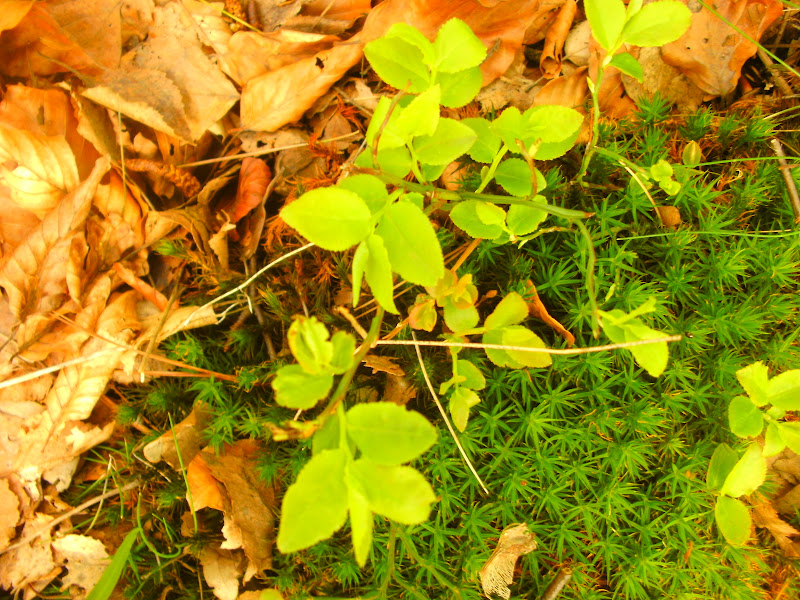
Blueberry leaves for tea and for a herbal syrup I am currently preparing.(vaccinium myrtillus, in German: Blaubeere). They are delicious!
Another, but controversially discussed wild food delicacy is bracken / fern (pteridium aquilinium, in German: Adlerfarn). mature, the plant is carcinogenic and even toxic. It is eaten throughout the USA, Europe and Japan and many other regions as sprouts. Wikipedia claims there is an increase in carcinome deseases (cancer) in these regions that is associated to the consumation of the plant. I personally do obstain from it for I am in doubt about it, but I feel obliged to give a choice. ALWAYS give the sprouts at least a few turns in boiling salt water. Another failsafe
might be, to dry them beforehand and
then giving them a good boiling. I Japan, it seems to be customary to put them into a hot Natron solution overnight, dry them AND then giving them a turn in boiling water. It´s yours to decide. And remember: If in doubt, rather obstain from the use of a plant. They taste great, though, but I AM in doubt and so do not use them any more.
The woods are vibrant with light these days. And those wonderful, marvellous green leaves have another advantage: Young birch and beech leaves make for a delicious salad, rich with vitamin C!
As is sorrel;-) which I collected for syrup. (oxalis, in German: Sauerklee).
The light healed all the darkness of winter, warm and radiant as it was.
Aegopodium, in German: Giersch, and blimey, I can´t figure out the English name;-). But delicious as a salad and good against arthtosis, blood circulation and a load of other implications.
Wild Strawberry leaves for tea (fragaria vesca, in German:Walderdbeere) and syrup.
Stinging nettle (urtica, in German: Brennnessel) for tea, spinache and nettle soup.
Garlic mustard "Jack-by-the hedge" (aliaria petiolata, in German: Lauchrauke) for schnapps, tea, as a spice and as salad. It has a garlic flavour before blossom, although not as rich as wild garlic, and tastes a bit like cresses after blossom. In any case, wild garlic tastes better by far, but it´s a good spice, albeit a bit bitter to my liking.
Ground ivy (glechoma hederacea, in German: Gundermann) as tea, for spice and for syrup.
Lungwort (pulmonaria officinalis, in German: Lungenkraut) as a medicinal, as a spice, as a tea and for syrup. As the name indicates, it´s good against pulmonary deseases, bronchitis and the like.
Sweet woodruff (galium odoratum, in German: Waldmeister) for tea, syrup and as a medicinal. Good for blood circulation. Please take note that sweet woodruff is mildly toxic (gives mild to strong headaches) and should be harvested before blossom. When using in tea, always use dried herbs. In syrup, only use one bundle for 1 l, and in schnapps the like. If you use blood clot prohibitor medicaments as Marcumar or other Cumarine preparations, consult your doctor before using woodruff, for it contains a high level of cumarine and works a cumulating effect with cumarine medicaments.
A licce liddybug*ggg* for tea... NOT.*ggg* I simply like these little fellows.
Lugra Moros did a great job that day... and I really love that knife.
I also collected lots of dandelion flower for syrup (taraxacum, in German: Löwenzahn) and tea.
On my path through the vibrant, living green of the woods I met this little fellow, too. A blindworm crossed my path, and I wished it a good journey. A young one, I assume, savouring the day and basking in the sunlight.
...

Since there were no good photos of it up to date, I thought I´d post you some, of my favourite Shilleleagh walking stick. Blackthorn, polished bark.
The rune is a bind rune I dreamt up, and it involves the runes "thurisaz", "thorn, giant", for the wood, and as a protective "wish";-), and "eihwaz", "yew, sorcery, death, magic, endurance".
My "trademark" rune disc, which shows the older Futhark, the runic alphabet in circular form. No end and no beginning here...;-)
It was getting dark, when I met this spirally little fellow... spring is here, definitely. I went home brimful with experiences and a deep satisfaction.
A happy Beltane to have had, everyone out there who celebrates it. To all the others: Enjoy spring, it´s great!



 Since there were no good photos of it up to date, I thought I´d post you some, of my favourite Shilleleagh walking stick. Blackthorn, polished bark.


