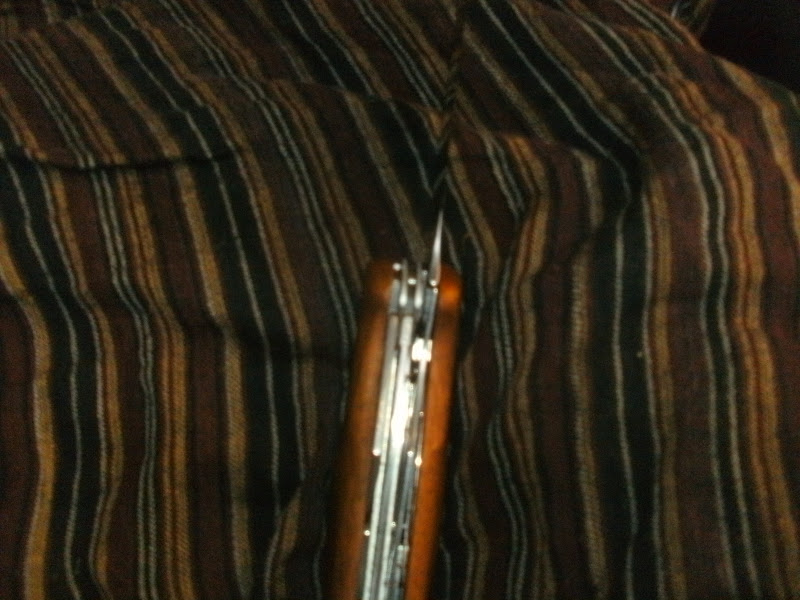
This is one of those knives I own and use for quite a long time now. It rides in my pocket every day, since 2013... for a reason. In the meantime, the corporation had shut down, but the good thing is, Wenger has been bought by Victorinox, and the management decided to keep up production on site in Délemont and keep up producing nearly all of the models, including the New Ranger Wood. Even better, while this one is from 1.4034 (similar to 420HC), which works well enough, to be true, newer models come in 1.4110 (440A), and since 2017, 1.4116 steel. The blade is nearly 100mm long and just 2,5 mm thick at the base with a high flat grind. 1 mm above the edge thickness is just 0,4mm, the grind angle is some 25°. The knife come with a saw from 1.4034, which works equally well in a pushing and pulling motion and which is 102 mm long, has a thin spine and thick albeit razor-sharp teeth, a caplifter, a tin can opener, a corkscrew and an awl. The saw is an absolute highlight and easily beats sawblades more than triple the size. It simply bites! The saw also holds an edge very well (I have never sharpened it since the knife came out of the box. The knife locks via an intersting system. It is more of a liner block. In this a strong back spring is complemented with a locking liner made from 1.4034 steel which is unlocked by pressing the marvellously fitted Swiss cross. After 4 years it still works like new!
The springs and liners are made from tempered 1.4034 steel that comes in a mirror polish even on the insides. They are riveted through under the scales with brass pins on massive washers. The washers ride in pockets of the scales, which are made from stunningly beautiful Swiss walnut scales. The wood comes from a certified forestry program and is chosen for its sustainability as well as its beauty. Over the years it has darkened considerably, and of course this is something you might or might not like.
The knife blade has some serrations on the spine making for quite a secure thumb rest. The blade is razor sharp, which I experienced personally when I was off my attention and quartered an apple freehand and cut off the top of my left index finger with a smooth cut... I had put it back in place, and it even stuck back on ;-) with just some tape and stitching (I was a bit clumsy, so I still have some sensitivity issues, but no harm done, if you think you get through life unscarred, you did not get the gist ;-)). It is of a respectable size for snacking and stuff. Due to a somewhat chunky handle there are better knives for whittling delicate tasks, but there are worse knives, too, and most of them labelled as explicitly bushcraft knives.
The handle, however chunky, feels great in your hand, due to an ergonomic design and offers a very secure grip. The caplifter works a cinch. The tin can opener works well enough, but with a reverse motion that needs some adapting to, but it keeps an edge very well and it so sharp out of the box that you could actually whittle with it (I tried ;-)). The corkscrew is excellent and does its job flawlessly. the awl, however, is a tool I seldom use, because the spring is so stiff it is a pain in the arse to open it. It has no edge to it and cannot be used to drill holes as with the Vic pocket knives, but only for poking... maybe they have changed that in the meantime... ?
Overall, this is a knife that is very underestimated by many. Of course, the blade does not offer the nimbus of a heebie-jeebie-goobalahbah fancy unobtanium steel. But I cut a lot with it, from cardboard boxes to snacks, from hard, seasoned sausage and bacon to paper and wood, leather and persenning and Paracord, and it holds an edge well. All I had to do was strop it frequently on a common steel strop and I once put a very fine stone to it to bring it back to hair-popping sharpness. The saw is simply lovely and offers a good length, the tools (except for the awl) work perfectly or well enough, and it comes in at a bargain prize. Of course, batoning is not quite an option, but I daresay, thsi knife would live up to that task, too, if you do it sensibly. For a bimble through the woods with a picknick with your friends and even overnighters it´s a very valuable tool.
Those are the adventures of Mr. Fimbulmyrk, in bushcraft and blacksmithing, mountainbiking and hiking, reenactment, writing, singing, dancing, stargazing and having a piece of cake and a coffee. Pray have a seat and look around you, but be warned - the forest´s twilight is ferocious at times.
Posts mit dem Label Wenger New Ranger Evo Wood werden angezeigt. Alle Posts anzeigen
Mittwoch, 2. August 2017
Mittwoch, 24. Oktober 2012
Short Review of a Wenger New Ranger Evo Wood
Okay, so I had one of those opportunities again. I got myself a Wenger New Ranger Evo Wood CHEAP, so I did buy it. I am a bit off my rocker when knives are concerned, and I am the first to admit that;-). But, as is, my first impression was "gotta have it!". Here are my second thoughts.
The main blade has an overall length of roundabout 100 mm. Due to the beautiful round ricasso, roundabout 93 mm of it are useable. I much prefer an edge all the way to the handle, for there you can work with the most force. But then, the design contributes much to the beauty of the knife, and it´s not much of a tribute;-) to pay to aesthetics. It´s made from a quality variety of 1.4034 (420HC). This steel, that can vary from 0,45-0,55% carbon content, certainly is not the latest magic powder D2 steel, but it gets the job done well enough for generations of Swiss army knife users and lovers. Plus, if the manufacturer gets the tempering right, it will get as hard as 56 - 59 HRC(selective temper). If you temper it any harder, you risk fractures of the blade. As a rule of thumb, the hardness potential of any steel should not be scooped out more than 75 % to get the best compromise between edge-holding capability and elasticity. The steel is easy to sharpen. Out of the box, the blade came wickedly sharp. Hair just popped away. The blade locks via an interesting mechanism. It is held in place by a slipjoint mechanism and locked by a locking liner. The liner locks all the way towards the inner part of the blade´s root and is unlockes by pressing the Swiss cross. Radially, there was a minimal play of about 0,05 mm, coaxially there was no play whatsoever, and the liner simply springs into its position with an audible and very reassuring sound. The saw, made from the same material, is razor sharp also and works pulling and pushing with a tendency towards a pulling motion, as with a Japanese saw.
The teeth of the saw are slightly set, and the saw has an enormous length when compared with the in-house competitor brand, Victorinox, and nearly all of it can be used. The caplifter also works as a screwdriver. When loaded, the tool is locked and will not fold in accidentally, which is very good. The tin can opener works in a reverse motion. It is nice and sharp, and I daresay it depends on your own taste if you prefer the direction of the motion. It does not lock, but, to be true, this isn´t needed any. The corkscrew is straight and fine and has a useable tip, and also included is an awl. This one will work in an emergency, but the T-handle position to me makes for some awkward work.
The blade has serrations on the spine which make for a better grip.
How the locking liner works. The highlight of this knife are the beautiful scales out of domestic Swiss walnut wood, harvested from woods with a FSC certificate.
First and foremostly, it is a very beautiful knife. The natural scales make for a different feeling, the dynamic lines just make you want to look at it for hours on end. But this knife, the evolution of a proven design, also feels rock - solid. It offers all a bushcrafter might want to have on even an overnighter. Its blade is elastic, serviceable, yet holds an edge well enough, the saw is the greatest I have seen so far in a folding pocket knife, and the other goodies don´t hinder the function a bit. There are minor flaws or compromises to design. Do I recommend it?
In the short time I own it it has already become my favourite EDC.
The main blade has an overall length of roundabout 100 mm. Due to the beautiful round ricasso, roundabout 93 mm of it are useable. I much prefer an edge all the way to the handle, for there you can work with the most force. But then, the design contributes much to the beauty of the knife, and it´s not much of a tribute;-) to pay to aesthetics. It´s made from a quality variety of 1.4034 (420HC). This steel, that can vary from 0,45-0,55% carbon content, certainly is not the latest magic powder D2 steel, but it gets the job done well enough for generations of Swiss army knife users and lovers. Plus, if the manufacturer gets the tempering right, it will get as hard as 56 - 59 HRC(selective temper). If you temper it any harder, you risk fractures of the blade. As a rule of thumb, the hardness potential of any steel should not be scooped out more than 75 % to get the best compromise between edge-holding capability and elasticity. The steel is easy to sharpen. Out of the box, the blade came wickedly sharp. Hair just popped away. The blade locks via an interesting mechanism. It is held in place by a slipjoint mechanism and locked by a locking liner. The liner locks all the way towards the inner part of the blade´s root and is unlockes by pressing the Swiss cross. Radially, there was a minimal play of about 0,05 mm, coaxially there was no play whatsoever, and the liner simply springs into its position with an audible and very reassuring sound. The saw, made from the same material, is razor sharp also and works pulling and pushing with a tendency towards a pulling motion, as with a Japanese saw.
The teeth of the saw are slightly set, and the saw has an enormous length when compared with the in-house competitor brand, Victorinox, and nearly all of it can be used. The caplifter also works as a screwdriver. When loaded, the tool is locked and will not fold in accidentally, which is very good. The tin can opener works in a reverse motion. It is nice and sharp, and I daresay it depends on your own taste if you prefer the direction of the motion. It does not lock, but, to be true, this isn´t needed any. The corkscrew is straight and fine and has a useable tip, and also included is an awl. This one will work in an emergency, but the T-handle position to me makes for some awkward work.
The blade has serrations on the spine which make for a better grip.
How the locking liner works. The highlight of this knife are the beautiful scales out of domestic Swiss walnut wood, harvested from woods with a FSC certificate.
First and foremostly, it is a very beautiful knife. The natural scales make for a different feeling, the dynamic lines just make you want to look at it for hours on end. But this knife, the evolution of a proven design, also feels rock - solid. It offers all a bushcrafter might want to have on even an overnighter. Its blade is elastic, serviceable, yet holds an edge well enough, the saw is the greatest I have seen so far in a folding pocket knife, and the other goodies don´t hinder the function a bit. There are minor flaws or compromises to design. Do I recommend it?
In the short time I own it it has already become my favourite EDC.
Abonnieren
Posts (Atom)
Beliebte Posts
-
I have come to like that steel. Made a blade from an old machining hacksaw from HSS. The steel might not be a great choice for longer blad...
-
At my recent visit to Solingen I also dropped by the Otter knives booth. Now they were very persuasive;-) and I got this beautiful tradit...
-
In winter I got myself two blackthorn shanks for a quarterstaff and a shillelagh. I really like the symbolism of the wood, and of the Shill...
-
The other day I came across some Gunnera and was pretty amazed about the pliability and durability of the fibres. Since there have been som...
-
This is somewhat of an edit of an ancient post from way back then. But as is, the times have changed a lot, and so has my persp...
-
Yesterday, on a ride from a really shitty appointment, I came across some linden trees full of seeds. Took them to the kitchen, cleaned,...
-
The other day I came across some beautiful rosebay Willowherb/fireweed , Chamaenerion Angustifolium, in German: Weidenröschen, and decided t...
-
This is a part of my collection of pocket knives. (Top to bottom: Otter "Notschlachter", 1.4110 100 mm blade, á virole lockback...
-
On Sunday it was spring fair in the Muttental, near Witten, and I worked for Volker. I forged with children, and they came at me like mad;-...
-
I had decided to make a neck pouch from the Amadou I recently harvested, and I thought, well, why not make it a challenge and make it with...