Posts mit dem Label Dwarves werden angezeigt. Alle Posts anzeigen

Donnerstag, 13. Juli 2017

Those stone doors -the legend of the dwarven kindom of the ennepe valley

 Sometimes, when i am at the ironforge, the door is open, and while I always hear that eerie cry of the woods in my heart and in my soul, it is different there.
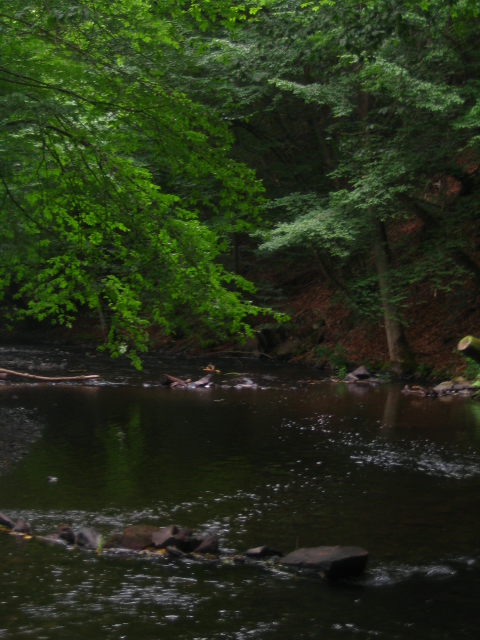
 The light shines ever so brightly, and the woods are beautiful - and they are woods that bear the mark of man- but they remember.
 They remember a time when man did not yet reign supreme. They remember while they feel into the earth with gnarléd roots, with tendrils gentle and serene. They remember the stories of old, and stories untold, unheard of at the hearth fire of man. Oh, there are the remnants of an industry, but if you listen, listen, listen intently, intensively, there is a whisper in the wind and in the last breaths of a youngling bird, the last breeze of life from lungs that are no more. Words are spoken, have been spoken, had been spoken, oaths were spoken and broken, and war was fought and wrought and won...
 The old manor still lies there, but ancient as it might be, it is but a fading spectre compared to what lies beyond.
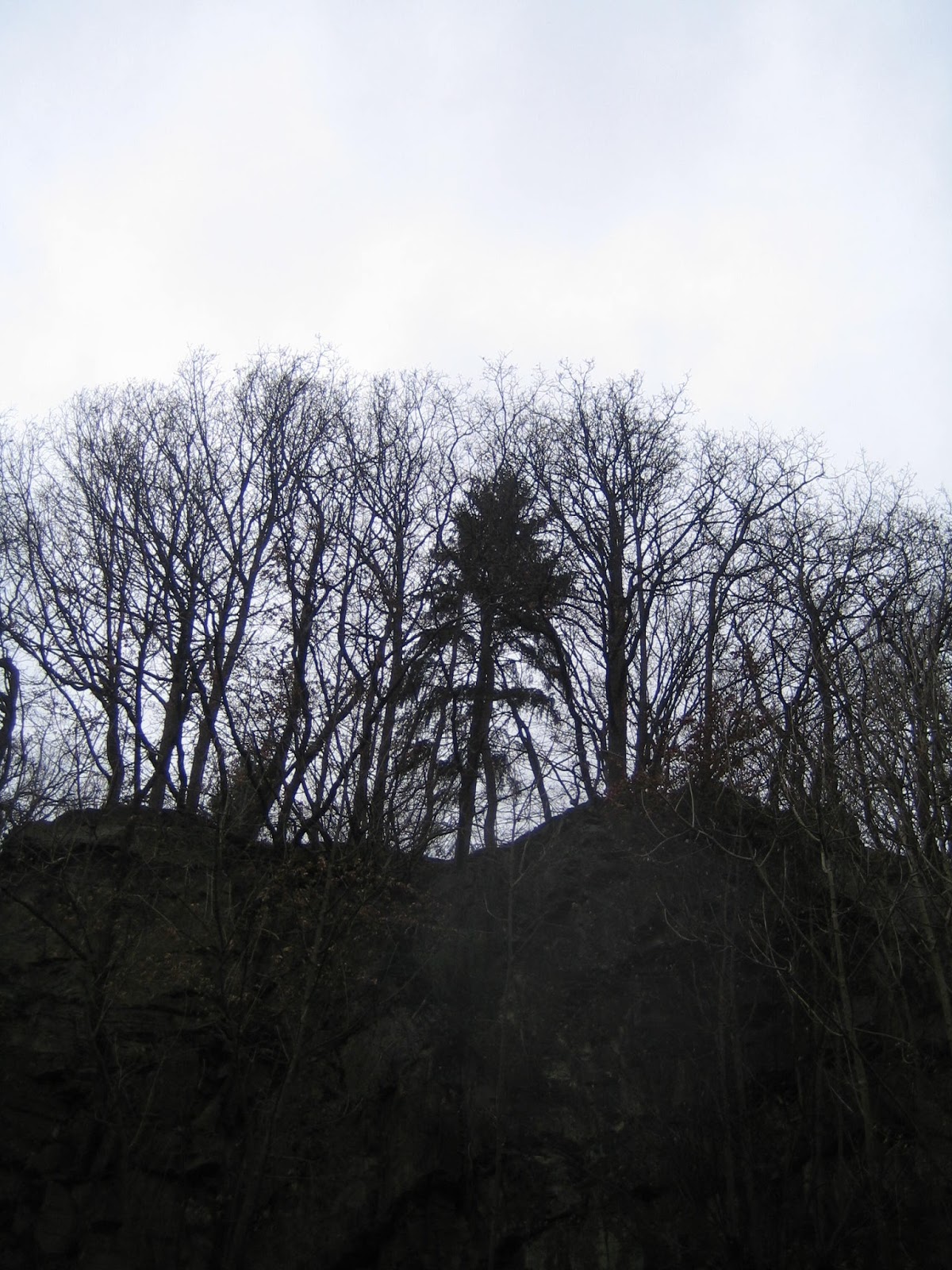
 The rock, it remembers what still lies there, beyond the stone doors that were sealed with cunning and magic. It does not speak with ravaged, creaking voice; the picture is sneaking, creeping into the poet´s mind from crag and crevice, silence.
 And the river runs swiftly, the creek it murmurs in the dale and obscures what lies...
 ...beyond and yonder dale and glen..
 Beyond the rock, beyond the roots..
 beyond the flowering, towering, ancient trees.
 For it was once upon a time, in a time when time was but a word, in aplace that might or might not have been, that the dale of the Ennepe was ruled by other masters. Oh, young was mankind, and foolish and blind even then, but then still they could see beyond the veil-some of them.
 You have heard the tales, and sat by the fire they were well enough, and you were frightened and maybe awed. But the truth is grave and deep as the famed archway of Dúrathrondr within the ancient halls. But the words have been forgotten, as the ancient language of man is even now doomed to oblivion by slavers and clerks, and the ability to see is subject to ostracity... But it was not always that way.


Was it or was it not that only recently an elderly person in the small town of Breckerfeld had died or do I confuse fact and fiction? Has all this really happened or is this but a dream? Dreams come and they wither, fade and go... and some are truth made lie and some are dream and some are true and some are lies... they fade like the seasons, fade and blend into each other even now... This elderly man had been a blacksmith, that much is known. His wife had died long before, and he lived a life in grief and sorrow and inhabited a small flat with two rooms. He was beaten and broken from a hard life, but still he got along and was too proud to ask for help; and as mankind often does, his fellow citizens sneered at him, for he was poor and took no longer much care of himself. 

One day he was found dead by his caretaker, a nurse who came to look after him once a day and to change the compresses on his necrotic leg. He had no family, and so his posessions were disposed of. One of the workers clearing the household yet beheld an old book of strange countenance, and within the book, which was written in strange lettering and, apparently, in the ancient language of the region, he found two pages with the design of a knife on it, which bears close resemblance to depictions and originals of the "Brekkersfelders dehhen". 


From what seems to be legible on the handwritten pages, a story is told in a very archaic Nether German that incorporates some alien idioms, that relates to the local legend as well of the Volme valley as the Ennepe dale. Having tried to translate the lettering and the words, I can say that while appearing strange and outlandish at first, the "runes" bear a striking resemblance to hieratic writings as well as the archaic "Sytterlin" lettering system which was once common in Germany. It also seems that in the manuscript a local legend is represented, which is centered around a mythical figure of the Volme valley, the "Smith Of The Lei", and the associated kingdom of the dwarves of Finking. Now the Volme valley is in close vicinity of the community of Breckerfeld, and it is plausible that the legend somehow transpired into local folklore. In the manuscript, however, a direct connection is suggested, as a prophecy is uttered by this aforementioned "Smith Of the Lei", and directed to a swordsmith and bladesmith in Breckerfeld, who was depicted as an ally and friend of the "dwarves" that if his offspring ever needed a refuge, they should make a rondel knife close to the design depicted and the crags should open to them - should they utter the "words", I might add.

Had I just envisioned what journey lies ahead! 

Oh, yes, always had I been different... all of the women in my family had been spookseers (spökenkiekers) and soothsayers apart from living a simple and strenuous peasant´s or blacksmith´s or locksmith´s life. I had not envisioned what lay ahead no less. 


For beneath the darken crags of Hohenstein, there still they lie: The most ancient halls of Haukrinnar Stainns, the "Rock Of The Hawks", most ancient domain of Dúrathrond, king of Janpárardal, as the dwarves called it (the dale of  making), deeply shrouded by the forest´s twilight, by twilight spell and magic of the mind, by trick of vision and curse of sight, by cunning and veil and magic work, by a cloak woven from moonlight and starlight and shadow and cobwebs... by song and chant and spell and curse, by iron, by steel and slag and fire, by tree and root and rock. There it is that truth fades into dream and dream withers and prospers and therefore it is that truth is born from lie. This magic cannot be circumpassed and not transgressed: Too strong are the spells that are sung into this fabric, the cloak of hiding, woven into the forest´s twilight and made thereof. It is hard to describe and harder to find; this finely woven silver thread.
 This silver path, tiny in the twilight, tinier even in the sun... that leads to the threshold of the hidden door. Ask me not the ways in the darkness of a nocturnal wood! Ask not of me translation of the song of owls and howls of foxes! Ask not of me the secrets of the Sindhurismaolur who gave me insight and training and the knowledge to work weapons from the dwarven ore! Free me of the claim of mastery in both speech and work! For my true kin is jealous and quick in anger, if loyal to their own, and their fury is kindled quick and fierce... but let me now tell the tale that lies beneath. Let me sing the songs of the Grímsearkir, those who walk the mist like spectres.
 Come now with me along this path...
 And unbecome human.


Once upon a time, in a time, when time was but a mere word, there lived a folk in the crags of Haukrinnar Stainns. We humans like to call them "dwarves", and think of tiny-minded creatures of small stature, and we are quick to laugh and think of garden gnomes.

Let me give you a sincere warning: Nothing can be farther from the truth. And beware: They are often friendly and generous in giving, but their anger is kindled as quick and as fiery as their mirth and joy. Man has belittled them in order to feed his own arrogance and soothe his fear and awe in the face of the true rulers of woodland and mountainside. We tell tales of little beings labouring for man´s industry, but do not understand their gifts. Rarely has ever one man seen a blade made by the folk of the mist, as they prefer to call themselves. Ulfperchto was but apprentice to their mastersmiths, and yet it needs the skills of a master to even recreate his apprentice pieces. He has not given any of his works to humans for a long time and has long refrained from the beliefs of  man. Man he once was, but no more... he has lived long now, but still his works improve. I have not met the Smith Of The Lei in person, but have been shown his works. The Niflungar they call themselves, those of the mist, and of the mist they are. They kill stealthily, and stealthily they tread: So alwas keep in mind the warning. Man and these beings are like spirit and water. Spirits burn, water does not. We forget this at our own risk.

Anyway, it was long, long ago, when first the folk of the mist came to the Ennepe valley, which then was not called by any name that is still known to man. They were the exiled survivors of an ancient race fleeing a war that had devastated their land, which some say was found in the "high places" in the South-East of the world. They came to the lands of the far North, and for a long time, settled there in  a land of volcanic fire and mountains of glass. Had they been a people that lived in the woods and mountains in domed houses and huts before, they now settled in mountains, where they built workshops, forges and temples in the dark heart of the mountain and ramparts of green glass. There they went into hiding, for they feared a terror that had been wrought by their own people, the "Stone of the Dhuodhai", which some say was an all-powerful weapon, but a weapon it was not, but a sort of artificial focus. One part of their people had worked up a magic that is now all but extinct, for the powers they evocated could never be called upon afterwards; it was a spell that erased their individual reality while enabling them to become virtual. One of their master craftsmen explained it to me that way:

Assume you want to forge a knife. There is a picture in your mind beforehand, an idea, and then you go ahead and make a drawing of this idea, enabling it to become paper. Then you have an image of your idea. It does not incorporate everything the idea had, but still shows close resemblance to it. You draw other pictures, in order to catch the idea, which becomes actual, when you go to the smithy and forge that knife in actual. With creatures theybelieve in a similar process. There are infinite ideas, and, upon being born, from these ideas it is that the being springs to life, and it is rare and seldom that this being remembers what its idea was in the first, and even more rarely it remembers the multitude of ideas. Upon being born, and upon dying, beings lose consciousness. The living normally cannot remember the multitude, the all and the void, and the dead in a similar manner cannot remember life in one shape, for they see all of it and more. What part of the folk of the Dhuodhai now worked into this spell is that they sacrificed their actual bodies in favor of the ability to transgress void and life. Had they been masters of the "dance in the iron wood", their martial arts, before, many say that they became invincible by this act of magic. They did this  to protect their loved ones from a threat that brought man to this world as well as endangering the whole of the planes of existence. It was not Evil, as many say, but just a race that was part of the universal multitude as well as their own, but this they only understood after becoming the folk of war. They rampaged among their enemies as a wolf amongst sheep afterwards, for they were not existent and could not be fought, and the primitive people they fought against, the Oreamm, the folk of fury, could not fathom their presence, for present they were no longer, but fictional. In fact, they were their own personification, and the spell was actually and originally a curse they had willfully inflicted upon themselves and altered and cunningly reforged like to the proces of refining a blade. In fact, they transformed into something that became synonymous with Death, and one of their favourite weapons became an attribute of the reaper, the "sickle of blood" became the scythe of Death. But all the killing and the terrors of war and the curse they had inflicted upon themselves had changed them, so that their own kin shunned them, and again those who remained unchanged fled. The stone they feared, the essence and magnifying focus of the bodies of the Dhuodhai na nCaláidhÍrenn, remained a terror that haunted their dreams at night, and who can say if it were not their actual kin? There are rumours that this terror was soothed when they found the heart of darkness, the light of silence, which plays an important role in their rites and culture.

Into hiding they went, and grew ever more subtle of stature, and over the times and eons that passed became a different race, although some say it be in the halls of Wórahhall, the red hill in the vicinity of Haukrinnarshall (which sometimes, by the way is also called "Janpararshall", but do not mention this when talking to one of the Wórahhall, for the meaning of Wórahhall is similar to Janpararshall, but Janpara is a word in the elder language of the "dwarves", and therefore a word of higher status, while the Haukrinnarshall-kin are less powerful in the eyes of the Wórahhall-kin, for they trace their ancestry back to Dúrinn Dúrinnssonar Dúrinnssonur Dúrinnsson, who is said by some to be the "father of stone" of their race and therefore holds a higher status amongst the folk of the mist) that scrolls are kept that state the race of dwarves was born from stone. The folk of Haukrinnarshall is different still; they are more swift and slender and less educated, but wilder than their more civilized kin from Finking or Wórahhall and are more akin to elves than "dwarves", and some of their men even clip their beards or even shave them off. Often, they get taller than their kin, and less muscular, and some are of a stunning, albeit disturbing beauty and irritating grace. One of the first and most disturbing erotic experiences I ever had was when I met a woman of the Janpara kin (which is, in fact, one of their oldest kins) in the woods during my adolescence, collecting herbs nearby an old iron mine ignorantly dug by humans near one of their entrances to an enclave of their kin, I never got over it, and I must admit my taste for female countenance amongst humanity has been changed forever by this encounter. Typically they have a high brow with high cheekbones and almond-shaped eyes, sometimes slanted like a cat´s. Their ears, by the way, are NOT pointed, and they are well aware of the bullshit humans talk about their race. They have a little less curved arc on top of their ears, but the disturbing feature of their countenance is not that they look so different from us. They are typically very small in stature, but not in a way you would notice, say, in a railway station´s hall, and in fact, some of them amuse themselves by walking amongst us unseen and unnotices, making fun of our blindness. Their humour is typically very broad and swiftly kindled, as well as their anger, which is terrible even for the toughest human. But they like to laugh and sometimes their jokes are very gnarled, so to say, and sometimes very strange and deep. They are said to be immortal, but they can be wounded and they most certainly also die a natural death, like ourselves, but they are extremely long-lived, and due to a lot of exercise and certain foods not commonly available amongst men, they keep their health up into very high ages. Some of their folk are most certainly over 9000 years old, but since those are mostly not skilled in speaking a modern human language, and I am not good at speaking the elder tongue, this might be a misunderstanding, for they also believe in the concept of reincarnation, and I can only warn you to go boasting with this assumed knowledge. I have been given free permission to spread the little knowledge I have in order to maybe further understanding between our races-you have not. The Janpara-kin, as I like to call them, for the difference is very stark to the folk of Wórahhall, as I cannot cease to emphasize (and it annoys Grábak who is just now throwing his pint at me;-). But then Grábak is from Wórahhall, and dresses up funny with that camouflage pants and chainmail shirt he so much likes... ouch... :-D), anyway, the Janpara-kin is, as I said, one of the oldest clans in Haukrinnars-Stainns Hall, and they reign supreme over the other clans of the Haukrinnarshall kindom. I take their word in that they claim they first settled in the valley and lived by the creek until the first humans pressed in. At first they helped them a lot, and the first human settlers, who really toiled to make a living, profited from their help and prospered. Those first settlers never forgot to put bread and milk into the stable or on a window sill for the "elves", and both races lived in relative peace. It was with the advent of the new belief that the good relationship was deteriorating and the peasants and local smiths tried to exorcise them, which made them a laughing stock amongst the folk. Still, they retreated into the rampart within the crags and started expeditions in order to play cruel jokes like upturning the milk and disease and storm and havoc. When humans started burning their own, mostly those who had stayed friendly to the folk, they shook with disbelief. Still, they did not want to harm those who had been kind to them, for they did not understand that they were so short-lived that those who wanted to harm their kind were not the ones who had been friendly to them. And they recognized the frenzy of the self-pronounced priests and judges as madness and pitied them for it, but then humans have ravaged the nearby Kindom of Klauti-Radshall by their presence and driven the folk away with ruckus and litter. They have now fortified their remaining ramparts with even more spells of deception and a veil of mist and obscurity and withdrawn even farther into the twilight.

But still, they stick to their friends...

And sometimes, in the twilight, in the mist under the moon, when it rises from the dale, you might hear an eerie pipe or a low tune sung in the woods. Stay respectful, and do not insult them!

But you might obstain from sleeping under the hawthorn tree-you might become like me. ;-)

Donnerstag, 23. Februar 2017

The legend of the dwarves of Finking

Besides the grey and steady waves of the Volme river, in the vicinity of the village of Dahl, there rise the crags of Finking, the Finkinger Lei.


Legend has it that once upon a time there was a shepherd, young in years, herding his sheep on a meadow above the crags, when he all of a sudden saw a dwarven child playing with a crown adorned with gold and set with gems, and sparkling in a sudden twilight, for mist arose. When the dwarven child in its robes of exquisite fabric, hemmed with silver and stitched with gold, caught sight of him, it shied in terror and fled, and left the crown tumbling to the floor.

Now always the wise were set sparsely amongst the human race, and thusly the shepherd took the crown and rejoiced in its value of gold and silver and sparkling jewels and all the things he could buy from all the money he could make with it, and he stood there in amazement, his herd and duty  forgotten in the rising mist.

And higher rose the mist... and thicker grew the clouds, and like a breath of stone and dewy twilight it rose, rose like a being from the crags of Finking. Rose up, obscuring the rocks and the meadow. ever thicker the mist became, his tendrils rising like feelers, like fingers creeping, seeking for a soul.

And amidst the mists he suddenly saw a rising aureole of light, dimly lit at first, but it was as if a gate had opened in the ever-thickening mist, and on a trail of twilight there strode an astounding figure. A dwarf he was, but warlike; upon his brow there rested a helm of wrought steel and artful gems, of knotworked silver and a filigree of gold. Thick his beard fell down upon his gleaming breastplate, braided and well-groomed... his chainmail was a flicker and tinkle of silvery stars, and he was armed with sword and axe, with seax and dagger of exquisite manner, but strange to look at with the eyes of humans.

And nearer he strode from amidst the mist, on a path of twilight, and terror filled the shepherd´s heart, as the kinglike dwarf said with a booming growl:

"Give back what you found or death will be upon you!"

In terror, the shepherd handed over the crown, and the dwarf took it and vanished as if into thin air.

And as all of a sudden the mists cleared, the shepherd realized that he stood at the edge of the crags and had been walking as if in a dream when the dwarf addressed him and that the dwarf´s voice had saved him from a long and shattering fall down the crags.
This was one of the few times the dwarves interfered with humans. But there is another legend, told in hushed voices amongst the elders of Dahl, and it is as if they were afraid of something or someone, and they do not like to talk about it openly, and this is the legend of the Blacksmith of The Lei.
For it was long, long time ago, in the earliest of the days of man´s memories, when there was a blacksmith working in the village of Dahl. He was a blacksmith as blacksmiths generally are, not a good man and none too bad, either. He went about his work, and was no excellent master, but not too bad, either.

This master had an apprentice, and this apprentice was something special. He always stocked up the charcoal before his master could even tell him to do so, minced to exactly the same grain. He also fetched the water without the need to tell him. As a boy, he was the best helper with the bellows, and when he first was allowed to use the sledge, he also excelled at that. His master never needed to tell him twice, and often he even bested his master, so it was him who was doing most of the work soon, and better than his master could even dream of. But his master was content to receive his apprentice money and hesitated to pronounce him journeyman. But alas, the parents of this apprentice were very poor and often went hungry to pay for his apprenticeship, and there came a day when the young smith talked to his master and begged him to pronounce him free so he could make a living from his work.
But the master, thinking of all the money he had earned from this apprentice, still did not pronounce him free. The apprentice begged, he pleaded, and after he had had no success he demanded to be pronounced journeyman, and their voices grew loud, and the knuckles were white on their fists, and they yelled at each other, and the master threw his apprentice out of the smithy in shame.

And he went to the Hogreve, the head of citizens, to achieve a pronounciation as journeyman smith as to earn money for his starving parents, with no effect. Thus his mother died from hunger, and his father was taken by the plague, and the poor and tiny house the family had inhabited was given to others.

And it was when his little property was all taken away, and he just had one copper coin, one iron and one silver coin left, barely enough for a sip of wine and a piece of bread, when he stepped out on the loamy street, that a very strange figure stepped towards him from the shadows of the dusk; a woman she was of strange countenance and unusual bearing, leaning on a knotted staff, and she was carrying a basket. Upon brushing him with the hem of her shoulder scarf, she murmured as if to herself:

"When thou hast but a sip of wine and one comb of honey, go to the crags in the darkest of nights, and the crags shall open for thee upon the words that are written on the river´s waves".

Of course, he did not heed these words much attention. Like all the other villagers, he had heard the legends of the dwarven kingdom, but like all the other villagers he thought it best to be inside come dusk. He had heard the tales of blacksmiths along the river talking in hushed voices of the mannekens grísebaorts coming in the darkness of the night, when the sickle moon was shining, to grind and hone the scythes and knives and the swords and daggers for the few noblemen and rich merchants, and doing a work far excelling the capabilities of mortal smiths, but never paid those tales much attention. For to his master´s place they had never come. Those stories were good to hear in the inn, with a mug of beer and the hearth fire blazing, while the autumn wind shook at the shutters, but there was work to be done and sorrows to be had.
But the warm room of the tiny house was gone, and a violent snow had fallen, and the longest night came with bitter frost. And thus he stood near the river´s waves, with a small sickle of the moon shining above and mist was rising from the meadows, and the stars were sparklingly, piercingly bright in the dark and frostbitten sky. He thought of Chrismas, and that it would be his last, and that he was faced with certain death, when he looked at the trail that the moon´s light had laid upon the river´s waves. And there he saw what he thought to be a strange scripture written on the waves´flow, ever changing, ever dancing.
Now he was not adept at reading, but he was quick of mind, and he had copied many sketches from the merchant´s sketchbook that he kept with him to show how things had to be made, and so he copied the writings as fast as he could with his pen knife into his hand. Still it was not fast enough to behold the changing scroll of water, but he had a feeling that he was right, and this feeling was strong enough.

And, concealing the blood on his hand, from the nearby inn with his last copper, iron and silver coin he bought a small flask of wine and one honeycomb and a piece of stale bread. The bread he ate, for he was starving. And wine and honey he took with him, and planned to celebrate his last Chrismas night before the crags of Finking.  And to the foot of the crags he came, and up he climbed, for all of a sudden he felt a great urge to climb, as if a voice was calling him, boomingly and growlingly deep, as if the rock itself had found a voice.

And there, he opened the flask of wine and put the honeycomb on a shale of rock, and, following the sudden need, he pressed his bleeding hand with the runes of the flowing water carved into it, against the blood-red face of the rock.

Ever deeper the mists rose from the meadows, from the face of rock, creeping from the crevices, covering the ivy-clad walls. Ever deeper the silence grew, and it was the silence of a darkness beneath the mountainside. It spilled from the foot of the towering crags, spilled into his bones and being, into his heart and soul. How long he rested with his hand pressed against the face of rock, he could not tell me afterwards, and he had the impression that he was there, crouching before the crags, in a void of space and time, waiting, waiting, waiting-for what?


And was it a second, or an hour, a century, or an aeon?

There, on the side of the crags of Finking, the smith´s apprentice crouched, and it seemed to him that season after season was just a short breath under the stars.
Then there was a screeching voice and a sharp crack and a sound as if a key was turned in a lock, an iron key in a copper lock, a copper key in a silver lock, a silver key in a golden lock, a lock of rock unfastened, and deeper the mists became.

And the light shone bright like the light at the root of the mountain.

Thus cracked open the gates of Finking, and the crags opened wide to perceive him in.

Little is known about what he saw and felt and learned, and thirteen moons danced a circle ere he returned. He told me of his adventures, but he let me swear secrecy upon the exact things he learned, and not permitted am I to tell you; but there came a day when the sickle moon was high upon the crags of Finking, when he returned all of a sudden, taller than he was, and with a mighty beard and clad in black clothes of stern fabric. He carried a knife of strange manufacture that glistened like steel does not. Straight to the smithy he strode, and to the Hogreven he went. And from him he bought the smithy, and paid in specie all of the costs. The master of old had run down the workshop and had been driven from the property, but with the work of his own hands he made the smithy prosper again. And there was a time of good look and fortune, when the farmers and peasants, the merchants and noblemen bought his tools, for his scythes and knives cut steel like straw.

But greed prospers well amongst humans, and there often was a woman of strange and unwomanly bearing coming to visit, and people saw them  sitting alongside on the bench come dusk and holding their strange council, and this woman was said to be a witch.

Came the time when the old dean retired after a long period of care for his fold, and a new dean was proclaimed and invested. And he ruled with terror where the old dean had ruled by kindness and mercy and a gentle hand. So he sent out his servants to pursue witches, and women were burned and buried alive, and men burned and broken on wheels of iron for being werewolves... and they also set out to capture that strange woman, but to no effect, for no one seemed to know where she was living nor when she would be there. Midwife had she been for a lot of children, but she came and went as like to a mist.

It was about that time when the new dean ordered a knife from the blacksmith, and he made it well and after a strange pattern, and he made it from a steel no one had ever seen made in Dahl. And it had a sleek and slender blade that was glistening in a dull grey. So sharp was it, that it could split a woman´s hair, and yet so hard that one could cleave iron with it; and yet it would not break, how much one would abuse it. And the dean was amazed but did not want to pay the prize, but made a ridiculous offer. And the smith demanded the dean to give the knife back to him.

But the dean ordered his servants to bind him, and arrested him for witchcraft, stating that no natural means could make a knife like this, and he was to be broken on a wheel of iron and thrown into the dungeon.

Thus came the evening of his emprisonment, and a small and piercingly bright sickle moon was shining... and through the grates he could see a faint glimmer of silver and hear a faint song like silver and a growling groan from the bosom of the bare earth he was lying on.

Come the morn. Opened the door.

And empty lay the dungeon, with not a trace left of the blacksmith of the Lei.

But sometimes, if you read carefully the scripture written upon the moon´s trail on the water, you might be able to see them dancing. Are they the dwarves of the Kingdom? And can you see the witch and the smith amongst them?

So many tales, tales in tales spiralling to a weave, a fabric of spirals, tales to be heard and tales to be told in the golden halls...

...beneath the Finking´s root. 

And I fear this is the reason the people of Dahl do not like to tell.

(to be continued)

Beliebte Posts